

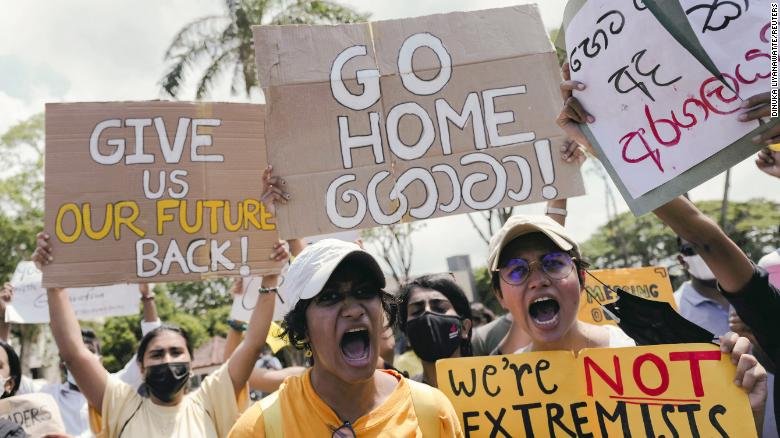

Seven people were murdered and more than 200 were injured in Sri Lanka’s capital city of Colombo on Tuesday in confrontations that forced Prime Minister Mahinda Rajapaksa to step down.
Thousands of demonstrators disobeyed curfews to assault government officials, setting fire to the residences, stores, and enterprises of governing party parliamentarians and provincial leaders as the Indian Ocean nation battled its worst economic crisis ever.
According to Police spokesperson Nihal Thalduwa, the situation had calmed down by Tuesday, despite indications of a disturbance. He said that over 200 people had been hurt by violence that led to an island-wide curfew until 7:00 am (0130 GMT) the following day.
Government officials in Sri Lanka indicated sweeping powers for the military and police to hold and question people without warrants of arrest under President Gotabhaya Rajapaksa.
As of Tuesday, the government has issued a gazette notification stating that the military can hold anyone for up to 24 hours before handing them over to the police and force can inspect that private property, including automobiles.
Armed forces were given 24 hours to follow suit after the law mandated that anybody apprehended by a police officer be brought to the nearest police station.
Analysts were concerned about the possibility of emergency measures being abused.
A state of emergency was already in effect as protests continued to rise on Friday when the president made the announcement.
A day of rage
After an event occurred just hours before Rajapaksa resigned, a number of attacks were made on government officials.
Following speculations he was considering resigning, Rajapaksa talked to hundreds of supporters at his official house on Monday.
In response to his words, many of them rushed to a camp of protesters armed with iron bars, assaulting and torching their tents.
When the skirmishers refused to withdraw, police used water cannons and tear gas to disperse them, according to Reuters eyewitnesses.
Tension rapidly erupted in Sri Lanka as Rajapaksa stepped down as president, and thousands of people took to the streets to celebrate.
After some of the night’s bloodiest skirmishes, protesters tried to break down the gates of Temple Trees, his mansion in central Colombo. Broken glass and abandoned footwear littered the streets.
Troops scoured the scene, where eight partially submerged vehicles had been set alight. The trashed offices of government officials were cluttered with discarded documents and shattered equipment.
Following a pandemic that decimated the country’s tourism industry, the administration was forced to deal with rising oil costs and the repercussions of populist tax cuts.
The World Bank and the International Monetary Fund, as well as Asian powers India and China, have all offered support.
Foreign reserves of as little as $50 million are estimated by Rajapaksa’s former finance minister Ali Sabry, who resigned on Monday along with the rest of his government.
More than a month of rallies, most of them nonviolent, have attracted thousands to the streets about shortages of fuel, food, and medication.
