



ISLAMABAD: The International Consortium of Investigative Journalists (ICIJ) has issued “Pandora’s Paper” tonight which show some sitting ministers, advisors, and ex-senior military officials of Pakistan own offshore companies.
Now leaked documents reveal that key members of Khan’s inner circle, including cabinet ministers, their families and major financial backers have secretly owned an array of companies and trusts holding millions of dollars of hidden wealth. Military leaders have been implicated as well. The documents contain no suggestion that Khan himself owns offshore companies.

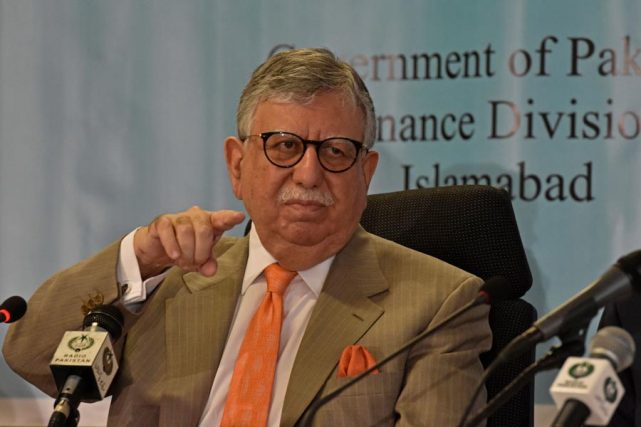
Among those whose holdings have been exposed are Khan’s finance minister, Shaukat Fayaz Ahmed Tarin, and his family, and the son of Khan’s former adviser for finance and revenue, Waqar Masood Khan. The records also reveal the offshore dealings of a top PTI donor, Arif Naqvi, who is facing fraud charges in the United States.
The files show how Chaudhry Moonis Elahi, a key political ally of Imran Khan’s, planned to put the proceeds from an allegedly corrupt business deal into a secret trust, concealing them from Pakistan’s tax authorities. Elahi did not respond to ICIJ’s repeated requests for comment. Today, a family spokesman told ICIJ’s media partners that, “due to political victimisation misleading interpretations and data have been circulated in files for nefarious reasons.” He added that the family’s assets “are declared as per applicable law”.
In one of several offshore holdings involving military leaders and their families, a luxury London apartment was transferred from the son of a famous Indian movie director to the wife of a three-star general. The general told ICIJ the property purchase was disclosed and proper; his wife didn’t reply.
The revelations are part of the Pandora Papers, a new global investigation into the shadowy offshore financial system that allows multinational corporations, the rich, famous and powerful to avoid taxes and otherwise shield their wealth. The probe is based on more than 11.9 million confidential files from 14 offshore services firms leaked to the International Consortium of Investigative Journalists and shared with 150 news organizations around the world.
The window into the personal finances of individual Pakistani generals is especially rare and provides a glimpse at how top military officers – known in Pakistan as “The Establishment” – use offshore to quietly enrich themselves while maintaining, until now, the military’s image as a bulwark against civilian corruption.

In the 48 hours leading up to the publication of the Pandora Papers, a Pakistani television station, ARY-News, reported that, “the owner of two offshore companies registered at a similar address as of Prime Minister Imran Khan has revealed that they were registered by him on a different address and denied any role of the premier in this regard.” The story also attributed the information to “a database of the offshore companies.”
ARY-News is not an ICIJ partner and doesn’t have access to ICIJ data.
In its reporting prior to publication, ICIJ had asked Khan about the same companies. A Khan spokesman told ICIJ that the prime minister had no link to either, adding that two houses in the same neighborhood share an address, providing a map as evidence.
The spokesman also told ARY-News that Khan denied any connection to the companies, adding that their owner “never met Imran Khan face to face and it may however be possible that they had attended an extended family function.”
The Pandora Papers investigation exposes civilian government and military leaders who have been hiding vast amounts of wealth in a country plagued by widespread poverty and tax avoidance.
The newly leaked records reveal the use of offshore services by Pakistan’s elites that rivals the findings of the Panama Papers, which led to Sharif’s downfall and helped propel Imran Khan to power three years ago.
Today, a few hours before the Pandora Papers’ publication, Khan’s spokesperson told a press conference that the prime minister, “has no offshore company but if any of his ministers [or] advisers have it will be their individual acts and they will have to be held accountable.”
An unaccountable military elite
Khan’s anti-corruption rhetoric resonated in Pakistan, where the military has pointed to what it calls the corruption and ineptitude of civilian politicians to justify overthrowing democratically elected governments three times since the country’s founding in 1947.
Military autocracies have ruled Pakistan for almost half the country’s history. They have been bolstered by support from the U.S and NATO countries, which have relied on Pakistan’s support as a bulwark against the Soviet invasion of Afghanistan and, later, the Taliban.
The military also claims legitimacy as the nation’s protector against longtime adversary and nuclear rival India.
Over the decades, the military and its secretive spy agency, Inter-Services Intelligence, have repeatedly stoked anti-India animus, even at the cost of angering Pakistan’s Western allies.
Support independent journalism
Do you believe journalism can make a difference? For just $15/month you can help expose the truth and hold the powerful to account.Donate
Foreign policy analysts have accused the military of playing a double game, receiving billions of dollars in U.S military support while continuing to work with members of the Afghan Taliban.
One legacy of colonial rule is the military’s wealth. The military’s combined business holdings amount to Pakistan’s largest conglomerate, and it controls 12% of the country’s land. Many of the landholdings are owned by current or former senior leaders.
The Pandora Papers reveal that in 2007, the wife of Gen. Shafaat Ullah Shah, then one of Pakistan’s leading generals and a former aide to President Pervez Musharraf, acquired a $1.2 million apartment in London through a discreet offshore transaction.
The property was transferred to Gen. Shah’s wife by an offshore company owned by Akbar Asif, a wealthy businessman who has opened restaurants in London and Dubai. Asif is the son of the Indian film director K Asif. The younger Asif once met with Musharraf at London’s Dorchester Hotel to ask for an exception to Pakistan’s 40-year ban on Indian films to allow the release there of one of his father’s most acclaimed movies. Musharraf granted the exception and later lifted the ban.
The leaked documents show that Asif has owned a multimillion-dollar property portfolio through a web of offshore companies.
One of those companies, called Talah Ltd. and registered in the British Virgin Islands (BVI), was used to transfer the London apartment to Shafaat Shah’s wife. Talah bought an apartment near the Canary Wharf financial district in 2006. The next year, Asif transferred ownership of the company to Fariha Shah.
Asif’s sister, Heena Kausar, is the widow of Iqbal Mirchi, a senior figure in a leading organised crime group, D-company. Mirchi was at the time under sanction as a drug trafficker by the U.S. Before his death in 2013, Mirchi was one of India’s most wanted men.
Gen. Shah told ICIJ that the purchase of the London apartment had been made through a former army colleague then acting as a consultant to London real estate firms, not through any personal connection to Asif. Gen. Shah said the flat “was named” to his wife because “I already had properties in my name while she did not have any and to balance tax deductions.”
Shah said that his wife has never met Asif and that he met him just once, while an aide to Musharaff, when Asif briefly lobbied the president for his father’s film “in the corridors of Dorchester Hotel when he had accompanied the hairstylist, who had come to cut Mrs Musharraf’s hair.”
Insights into the private wealth of top military officers and their families are exceedingly rare; journalists who have written about the military within Pakistan have been jailed, tortured and killed.
The Pandora Papers also reveal that Raja Nadir Pervez, a retired army lieutenant colonel and former government minister, owned International Finance & Equipment Ltd, a BVI-registered company. In the leaked files, the firm is involved in machinery and related businesses in India, Thailand, Russia and China. Records show that in 2003, Pervez transferred his shares in the company to a trust that controls several offshore companies.
One of the trust’s beneficiaries is a British arms dealer. According to U.K. court documents, one of the trust’s other companies has helped broker arms sales from Belgian manufacturer FN Herstal SA to Hindustan Aeronautics Ltd., a state-owned Indian defense company.
While he owned International Finance & Equipment, Pervez also held several high-level positions in Pakistan’s government. He was elected to the National Assembly in 1985 and later joined Khan’s party. Pervez did not respond to reporters’ questions.
Another influential former military leader who shows up in the leaked documents is Maj. Gen. Nusrat Naeem, the ISI’s onetime director general of counterintelligence. He owned a BVI company, Afghan Oil & Gas Ltd, that was registered in 2009, shortly after his retirement. He said that the company had been set up by a friend and that he didn’t use it for any financial transactions.
Islamabad police later charged Naeem with fraud related to the attempted purchase of a steel mill for $1.7 million. The case was dropped.
The Pandora Papers also bring to light the notable offshore holdings of close relatives of three senior military figures.
Umar and Ahad Khattak, sons of the former head of Pakistan’s air force, Abbas Khattak, in 2010 registered a BVI company to invest what documents call “family business earnings” in stocks, bonds, mutual funds and real estate.
The Khattaks did not respond to reporters’ questions.
In an example involving intergenerational wealth transfer, Shahnaz Sajjad Ahmad inherited a fortune from her father, a retired lieutenant general, through an offshore trust that owns two London apartments, purchased in 1997 and 2011 in Knightsbridge, a short walk from Harrods. She, in turn, set up a trust for her daughters in 2003 in Guernsey, a tax haven in the English Channel. Her father was a favorite of Field Marshal Mohammad Ayub Khan, the country’s first military dictator (1958-1969). After her father retired from the army, he founded one of Pakistan’s biggest business conglomerates. Ayub Khan’s son later married into the family and sits on the boards of several of the group’s businesses.
Shahnaz did not respond to ICIJ’s requests for comment.
Taken together, the findings offer a portrait of an unaccountable military elite with extensive personal and family offshore holdings.
‘A defining moment’
As Pakistan’s ultimate political arbiter, the military would eventually test Imran Khan’s reformist ideals.
Born in 1952, Khan was the son of a Lahore civil engineer, and he enjoyed the privileges of Pakistan’s insular, and insulated, upper class. When the electricity failed, elites could turn on generators. If hospitals were substandard, they flew abroad for care.
“I was from that privileged class that was not affected by the general deterioration in the country,” Khan wrote in his 2011 autobiography, “Pakistan: A Personal History”.
Khan’s elite boarding school, Aitchison College, was named for the colonial administrator who founded it. Lessons were in English; boys caught speaking Urdu during school hours were fined.
The education system replicated colonial values, Khan wrote, teaching elites that they should “look upon the masses with contempt” and that “the natives were not to be trusted.”
As a young man, he befriended future leaders of Pakistan, meeting Nawaz Sharif at a cricket club, stopping by for Sunday cheese and canape parties at the Oxford University lodgings of another future Pakistani prime minister, Benazir Bhutto. He also developed a reputation as a playboy and a denizen of London’s nightclubs.
Khan played his first cricket match for Pakistan’s national team in 1971, when he was just 18, became captain at the age of 29 and, 10 years later, led the team to victory in the 1992 World Cup.
In a country passionate about cricket, Khan’s athletic feats made him a national hero – and drew the attention of politicians hoping to capitalize on his popularity. Two of the Pakistan’s military leaders – Generals Musharraf and Muhammad Zia-ul-Haq – and Sharif, the three-time civilian prime minister, invited him to join their governments. He refused them all, later declaring in his autobiography that each administration was either incompetent or corrupt.
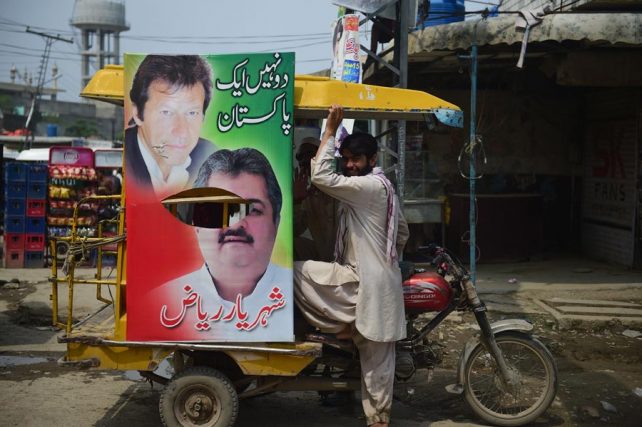
He wrote that he entered politics after the experience of building a cancer hospital in his mother’s memory in 1994 left him stunned both by the generosity of ordinary Pakistanis and the failings of their government: “I discovered how hard it was to achieve anything in Pakistan while also battling bureaucracy and corruption.”
In 1996, Khan founded the PTI party, vowing to root out corruption, address wealth inequality and break the hold of the country’s two political dynasties – those of the Bhutto and Sharif families – which he claimed ruled Pakistan like a “fiefdom.”
Among the early targets of Khan’s anti-corruption campaign was another powerful family, the Elahis, known in Pakistan as the Chaudhrys of Gujrat.
After Musharraf forcibly ousted Prime Minister Sharif in 1999, during his second term, Chaudhry Pervaiz Elahi, a prominent political figure, organized the Pakistan Muslim League-Q to support the coup. The PML-Q, known for backing Pakistan’s military governments, remains closely aligned with the military.
Over the years Pakistan’s anti-corruption agencies have launched and dropped several investigations into his business dealings. Around 2002, Khan petitioned the national bank to investigate loans to Elahi’s company which had allegedly been written off. At one point he called him “the biggest dacoit in Punjab,” using an Urdu word for “bandit.”
Despite being a national hero and benefiting from well-funded campaigns powered by the enthusiastic support of Pakistanis abroad, Khan remained a political outsider, in part because he refused to make alliances with forces he called corrupt.
Middle-class and other reform-minded voters flocked to his 2013 campaign, waving cricket bats. And Khan gained a powerful ally: the military, then in a power struggle with both mainstream civilian factions. But the PTI gained just 35 of the 342 seats in the National Assembly that year.
Then came the Panama Papers.
The revelations about then-Prime Minister Sharif and his family’s London real estate holdings, followed by the discovery that his oldest daughter forged documents in an attempt to cover up her ownership, played perfectly to Khan’s anti-corruption message and turbocharged his political fortunes.
“’The leaks are God-sent,” Khan said at the time. Taking stock of the impact on the country’s ruling elite a year later, he declared, “This is a defining moment in the history of Pakistan.”
Pakistan’s Supreme Court soon disqualified Sharif from office for falling short of constitutional requirements to be “truthful and trustworthy.” The ISI was involved in the investigation of Sharif. He was later sentenced to 10 years in prison on related corruption charges.
In the 2018 elections, Khan’s PTI secured a fourfold increase in National Assembly seats, bringing the party to the brink of power. Throngs of his supporters danced outside the party’s headquarters in Islamabad.
But Khan hadn’t won the outright majority and needed to form a government. Sharif and Bhutto’s parties, the target of years of his attacks, were not an option.
That left a coalition of smaller parties, led by the Pakistan Muslim League-Q, the Elahis’ party. Khan made the deal.
A fateful political alliance
Since taking office, Khan has continued to deploy anti-corruption rhetoric and rail against elites who, he has said on Twitter, “come to power and plunder the country.”
But analysts say Khan has disappointed his reform-minded supporters and has become widely viewed as a figurehead. “He doesn’t have a problem with the military ruling the country while they pretend that he’s in charge,” Aqil Shah, a visiting academic at the Carnegie Endowment for International Peace,told ICIJ.
The Pandora Papers reveal that Khan has surrounded himself with people – cabinet ministers and their families, donors and other political allies – who have holdings hidden offshore.
Shaukat Tarin, Khan’s finance minister, and members of Tarin’s family, own four offshore companies. According to Tariq Fawad Malik, a financial consultant who handled the paperwork on the companies, they were set up as part of the Tarin family’s intended investment in a bank with a Saudi business. He said that, “as a mandatory prerequisite by [the] regulator, we engaged with the Central Bank of Pakistan to obtain their ’in-principle’ approval for the said strategic investment.” The deal didn’t proceed.
Tarin didn’t respond to ICIJ’s questions. In a statement issued the day of the Pandora Papers’ publication, Tarin said: “The off-shore companies mentioned were incorporated as part of the fund raising process for my Bank.”
Omer Bakhtyar, the brother of Khan’s minister for industries, Makhdum Khusro Bakhtyar, transferred a $1 million apartment in the Chelsea area of London to his elderly mother through an offshore company in 2018. The state anti-corruption agency has been investigating allegations that his family’s wealth inexplicably “ballooned” since Bhaktyar first became a minister in Pervez Musharaff’s government in 2004.
In a written statement to ICIJ, Makhdum Bakhtyar said that the anti-corruption agency’s investigation was founded on baseless allegations which had underestimated his family’s past wealth, and that it has so far not resulted in a formal complaint.
The son of Waqar Masood Khan, Khan’s chief adviser for finance and revenue between 2019 and 2020, co-owned a company based in the British Virgin Islands. Masood resigned in August amid a policy dispute. Khan told ICIJ that he did not know what his son’s company did. He said his son lived a modest life, and was not his financial dependent.
And Khan’s former minister for water resources, Faisal Vawda, set up an offshore company in 2012 to invest in U.K. properties, the Pandora Papers show. He resigned in March amid a controversy over his status as a dual U.S.-Pakistan national. Vawda told ICIJ that he has declared all worldwide assets held in his name to Pakistani tax authorities.
