

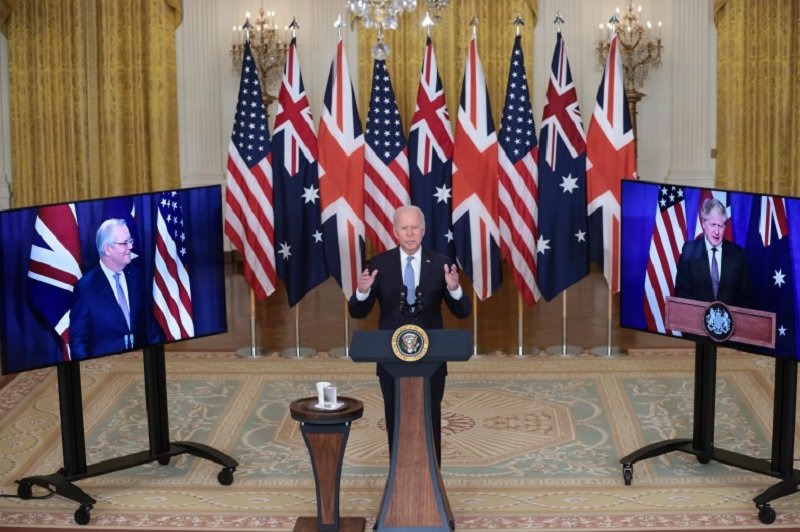

France has accused US President Joe Biden of acting like his predecessor Donald Trump after Paris was pushed aside from a lucrative defence deal that it had signed with Australia.
Foreign minister Jean-Yves Le Drian’s comments today came a day after the United States, United Kingdom and Australia announced they would establish a security partnership for the Indo-Pacific that will help Australia acquire US nuclear-powered submarines.
The pact, dubbed Aukus, is understood to be an attempt to counter China, though the three leaders did not mention Beijing explicitly in their remarks on Wednesday as they revealed the move.
Aukus means a multibillion-dollar contract Australia had signed in 2016 to buy French diesel-powered submarines will now be scrapped.
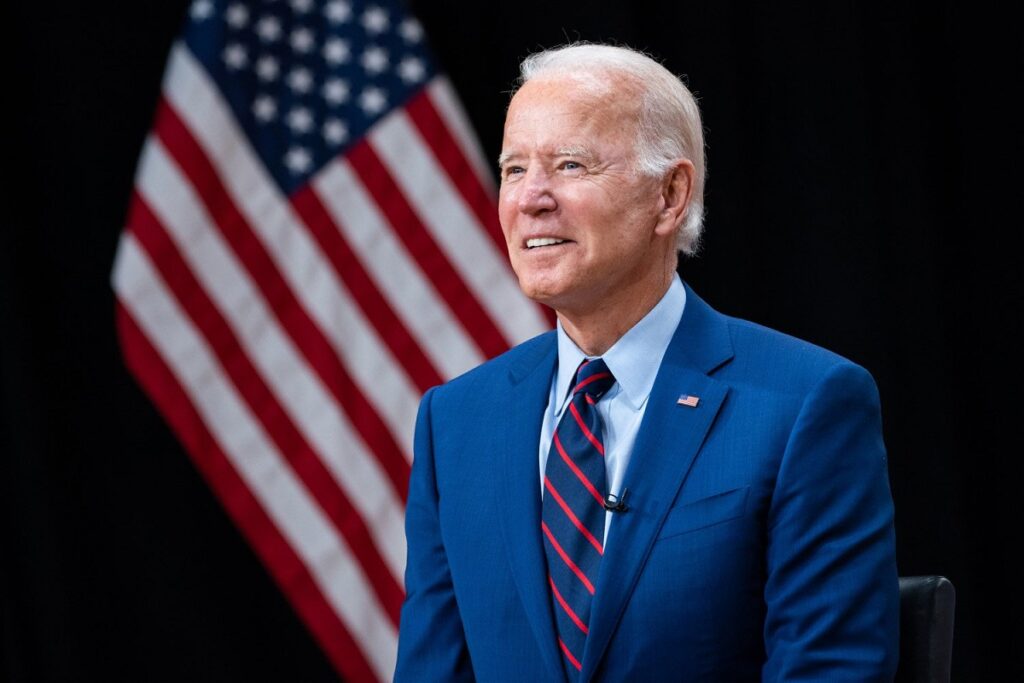
Le Drian said he was “angry and bitter” over the move, slamming it as a breach of trust.
“This brutal, unilateral and unpredictable decision reminds me a lot of what Mr Trump used to do,” he told Franceinfo radio. “This isn’t done between allies.”
‘Stab in the back’
Two weeks ago, the Australian defence and foreign ministers had reconfirmed to Paris the 2016 deal with French shipbuilder Naval Group to replace France’s more than two-decades-old Collins submarines.
French President Emmanuel Macron also lauded decades of future cooperation when hosting Australian Prime Minister Scott Morrison in June.
“It’s a stab in the back. We created a relationship of trust with Australia and that trust has been broken,” Le Drian said.
Asked if Paris had been “duped” by Washington over what Le Drian once called a “contract of the century” for France’s naval yards, the minister replied: “Your analysis of the situation is more or less correct.
London defends pact
But UK Defence Secretary Ben Wallace stood by the new submarine pact, saying it did not represent a strategic difference between London and Paris.
“The Australians have taken this decision that they want to make a change,” he told the BBC on Thursday.
“We didn’t go fishing for that but as a close ally, when the Australians approached us, of course, we would consider it. I understand France’s frustration about it.”
