

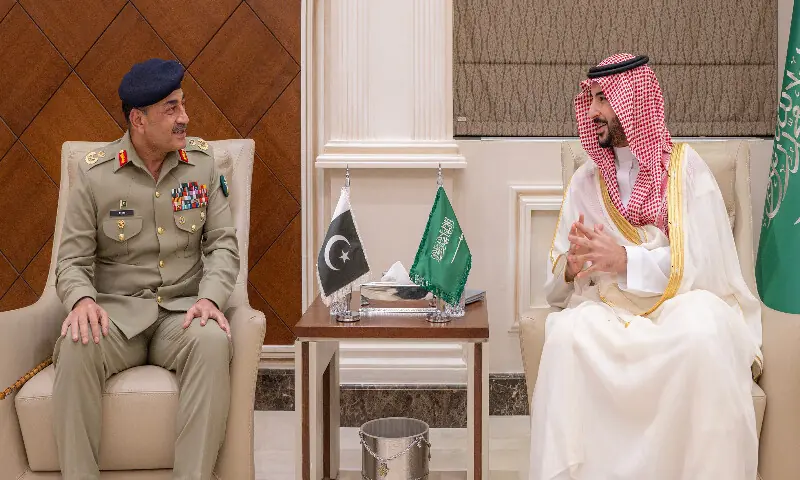

Senior defence officials from Pakistan and Saudi Arabia held important talks in Riyadh to review military cooperation and regional security challenges. The discussions took place as tensions in the Middle East continue to rise following recent strikes involving Iran.
The meeting was attended by Asim Munir, Pakistan’s Chief of Defence Forces and Chief of Army Staff, and Prince Khalid bin Sultan, Saudi Arabia’s Defence Minister. Both sides reviewed bilateral defence ties and exchanged views on the evolving regional security situation.
According to a statement released by the Saudi Ministry of Defence, the two leaders discussed ways to strengthen military cooperation and enhance coordination between their armed forces.
Pakistan and Saudi Arabia Review Strategic Defence Partnership
During the meeting, both delegations emphasised the strong strategic relationship between their countries. Pakistan and Saudi Arabia have maintained close defence ties for decades. Military cooperation, training, and security coordination remain key parts of this partnership.
Officials also reviewed progress under the Strategic Mutual Defence Agreement signed by both countries in September. The agreement states that aggression against one nation will be considered an attack on both.
The defence ministers discussed how the agreement could be implemented to strengthen regional security. They also explored ways to improve intelligence sharing and defence collaboration.
In a statement shared on social media, Prince Khalid said the meeting included discussions about attacks targeting Saudi Arabia. He stressed the need for coordinated measures to stop such threats under the framework of the joint defence agreement.
The Saudi minister added that such actions threaten stability across the region. He expressed hope that Iranian leaders would show restraint and avoid further escalation.
Concern Over Regional Security and Iranian Actions
Officials from both countries expressed concern over recent developments in the region. According to the Saudi statement, the discussions included what it described as aggressive actions by Iran.
The leaders highlighted the importance of maintaining peace and security in the Middle East. They agreed that dialogue and responsible decision-making are necessary to avoid further instability.
Prince Khalid said the attacks targeting the Kingdom undermine regional peace. He added that both countries remain committed to working together to protect stability.
The meeting also highlighted the shared interest of Pakistan and Saudi Arabia in ensuring the safety of critical infrastructure, energy routes, and regional trade.
Analysts say the growing security cooperation reflects the strong political and military ties between the two nations. Pakistan has historically played a supportive role in regional security initiatives involving Saudi Arabia.
Senior Officials Attend High-Level Defence Talks
Several senior officials attended the meeting alongside the defence chiefs. The Saudi delegation included Fayyadh bin Hamed Al Ruwaili, Chief of General Staff of the Saudi Armed Forces.
Another key participant was Hisham bin Abdulaziz bin Saif, adviser to the Saudi defence minister on intelligence affairs.
The Pakistani delegation included senior military officer Muhammad Javed Tariq.
In a separate development, Saudi Interior Minister Prince Abdulaziz bin Saud bin Naif held a phone conversation with Pakistan’s Interior Minister Mohsin Naqvi.
According to the Saudi Press Agency, Naqvi strongly condemned attacks targeting Saudi Arabia. He also reaffirmed Pakistan’s solidarity with the Kingdom.
The Pakistani minister emphasised that Islamabad supports Saudi Arabia in confronting any threats to its security and stability. The conversation highlighted the close diplomatic coordination between the two countries.
Security experts believe the recent discussions demonstrate the importance of the Pakistan–Saudi partnership during times of regional tension. Both nations continue to emphasise cooperation, dialogue, and strategic coordination to maintain stability in the Middle East.
