

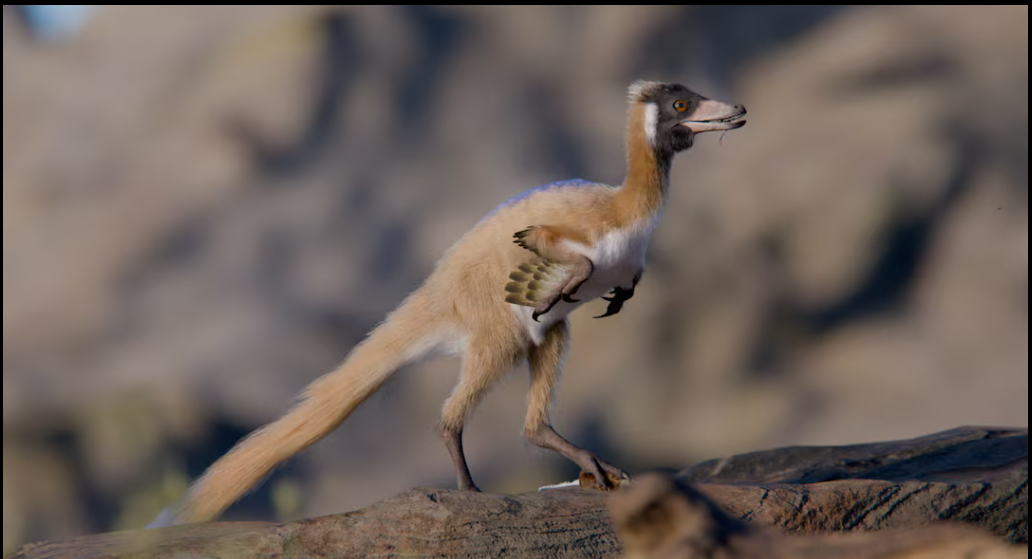

A remarkable discovery in Argentina’s Patagonia reveals one of the world’s smallest-known dinosaurs, shedding new light on prehistoric biodiversity. Researchers unearthed a nearly complete and exceptionally well-preserved skeleton of Alnashetri cerropoliciensis, nicknamed “Alna.” This crow-sized dinosaur likely hunted small animals, including lizards, snakes, mammals, and invertebrates.
Tiny Predator Thrived Among Giants
Around 95 million years ago, Patagonia was home to enormous dinosaurs such as Giganotosaurus and Argentinosaurus. However, Alnashetri shows that small theropods also played a crucial role in this ecosystem. Its delicate skeleton, preserved in life-like positioning, allows scientists to study alvarezsaurs—an unusual family within theropods.
Alna was a small female, living in a desert environment known as Kokorkom, or “desert of the bones.” She died at about four years old, nearly full-grown. Rapid burial by a sand dune contributed to the fossil’s exceptional preservation.
Anatomy and Lifestyle
Weighing approximately 0.7 kg (1.5 pounds), Alnashetri was smaller than a chicken and stood below the knee of an average adult. The dinosaur had slender legs for agile movement across dunes, a long tail for balance, and forelimbs that were powerful yet not suited for flight.
Researchers suspect Alna was feathered, similar to other alvarezsaurs. Its numerous, pointed teeth resemble those of a small Velociraptor, indicating a carnivorous diet. Later alvarezsaurs evolved reduced teeth and arms specialized for digging termites, but Alnashetri lacked such adaptations, showing diversity in feeding strategies.
Fossil Significance
The fossil was discovered in 2014 at La Buitrera, a site rich in small vertebrate fossils, including early snakes, mammals, and small dinosaurs. Histological analysis of Alna’s bones revealed microscopic details of growth and skeletal structure. Scientists estimate the dinosaur reached about 70 cm (28 inches) in length, most of it tail.
Co-author Sebastián Apesteguía emphasized that Alnashetri highlights the presence of small, nimble predators in an era dominated by gigantic dinosaurs. Its lightweight body, agility, and small size demonstrate the immense biodiversity of Patagonia during the Cretaceous.
Patagonia’s Fossil Wealth
La Buitrera has yielded multiple small vertebrates, making it a hotspot for understanding the full spectrum of prehistoric life. Alongside Alnashetri, fossils of Jakapil, Buitreraptor, and other small animals provide insight into complex ecosystems.
Apesteguía noted that landscapes dominated by giant dinosaurs were not devoid of smaller creatures. “Alnashetri shows us that the age of southern giants was also a time of immense biodiversity,” he said. This discovery emphasizes the importance of small animals in prehistoric ecosystems and offers valuable context for the evolution of theropods and birds.
