

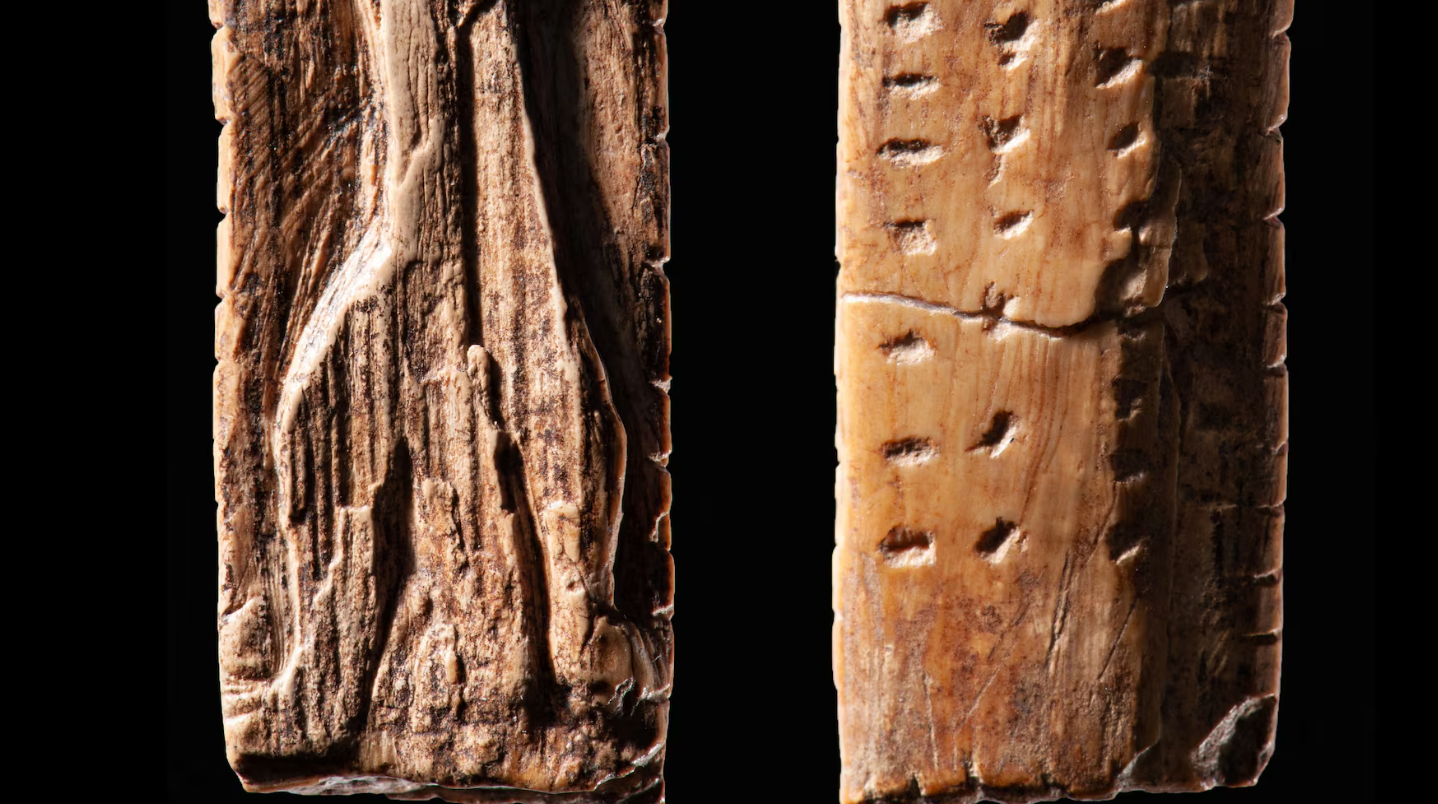

A small ivory object known as the Adorant figurine has drawn fresh scientific attention. Researchers discovered it in a German cave in 1979. The figurine dates back roughly 40,000 years.
Crafted from mammoth ivory, it depicts a hybrid lion-human figure. Moreover, it bears carefully carved notches and dots. Similar marks appear on numerous artefacts from the same period.
New research suggests these markings do not form a true written language. However, their structured sequences show intriguing similarities to early script systems.
Sequential Signs Show Structured Patterns
Scholars examined more than 200 Stone Age artefacts. These objects date from about 43,000 to 34,000 years ago. They originate from four cave sites in southwestern Germany.
These sites connect to the Aurignacian culture. This culture represents some of the earliest modern human communities in Europe.
Researchers described the markings as “sign types.” These include notches, dots, lines, crosses, and star shapes. Furthermore, the team applied computational analysis to study their arrangement.
They focused on a concept known as information density. This measures how much information a symbol sequence conveys. In spoken language, a syllable carries information. Similarly, each carved sign may represent meaningful content.
The findings suggest that these signs were not random decorations. Instead, patterns indicate selective and conventional use. For example, crosses appeared only on tools and animal figurines. They did not appear on human figurines.
Such consistency implies cultural transmission across generations. Therefore, these sign systems likely followed shared rules.
Comparison With Early Mesopotamian Script
Although the Aurignacian signs differ from modern writing systems, researchers noted key similarities. Their information density resembles that of proto-cuneiform.
Proto-cuneiform emerged around 3300 BC in ancient Mesopotamia. It later evolved into cuneiform, one of the earliest known writing systems.
However, the Aurignacian signs lack several essential writing features. Most importantly, they do not connect clearly to spoken language structures. Consequently, they cannot be classified as a full writing system.
Nevertheless, their structured nature suggests advanced cognitive abilities. These early humans demonstrated symbolic thinking far earlier than previously assumed.
Cultural Context of the Aurignacian People
The artefacts belong to a period when Homo sapiens expanded across Europe. These hunter-gatherers migrated from Africa. Along the way, they encountered Neanderthals.
The Aurignacian culture produced some of the earliest figurative art. Many artefacts were carved from mammoth ivory. Others were shaped from bones and antlers.
Objects included animal figurines of mammoths, cave lions, and horses. Some figures blended human and animal traits. Additionally, archaeologists found tools, ornaments, and musical flutes.
The Adorant figurine itself measures about 38 millimetres long. Despite its small size, it carries significant historical importance.
What These Signs Reveal About Early Human Minds
Researchers did not attempt to decode the signs’ meanings. Instead, they examined structural properties. The results indicate organized and repeated patterns.
Such patterns likely passed down through generations. Therefore, they reflect shared symbolic conventions.
Scholars believe modern humans 40,000 years ago probably spoke complex languages. However, the carved signs appear independent of speech structures.
Even so, the artefacts demonstrate remarkable symbolic capacity. They reveal that early Europeans engaged in sophisticated abstract thinking.
In conclusion, these 40,000-year-old German artefacts may not represent written language. Yet, they display cognitive features resembling early script systems. Consequently, they offer valuable insight into the origins of symbolic communication.
