

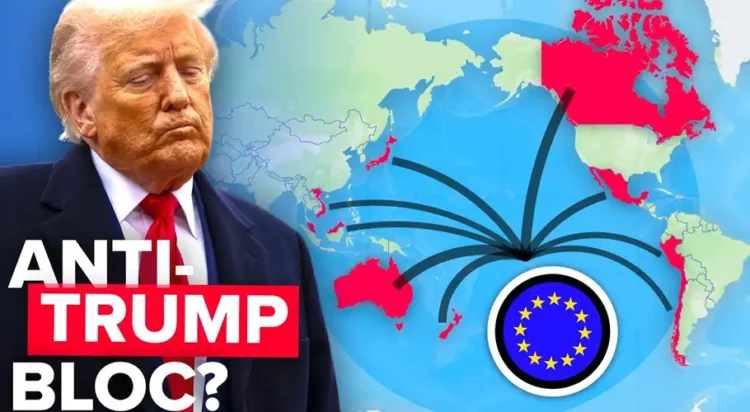

A major global trade shift is underway. The European Union and the Comprehensive and Progressive Agreement for Trans-Pacific Partnership have entered formal negotiations. Their goal is clear. They want to create a powerful 40-nation mega trade bloc.
The move is widely seen as a response to former US President Donald Trump and his aggressive protectionist tariff policies. Trump’s “America First” strategy disrupted global supply chains. It also raised tariffs on key trading partners.
Now, two of the world’s largest economic groupings are moving closer together. If successful, this alliance would unite Europe and the Asia-Pacific under one broad economic framework. The proposed bloc would represent nearly 1.5 billion people. It would become one of the largest trade groupings in modern history.
Middle Powers Push for Trade Stability and Low Tariffs
According to reports, the talks aim to shield member countries from rising trade uncertainty. Many nations want protection from sudden tariff hikes and shifting US policies.
Middle-power economies are leading the push. Countries like Canada are playing a key role in shaping discussions. The strategy focuses on strengthening supply chains across continents. Leaders want goods and industrial components to move freely. Low-tariff policies are central to the plan.
The EU has expressed strong support for synchronizing regulatory standards with CPTPP members. This includes aligning trade rules, customs procedures, and industrial benchmarks. Such coordination would reduce barriers and increase trade efficiency.
The CPTPP currently includes 12 member nations from the Asia-Pacific region. A merger with the EU would dramatically expand its reach. Together, the bloc would connect 40 countries into one structured economic system.
The proposed alliance would also create independent trade routes. These routes would reduce reliance on the US consumer market. That independence is seen as critical in today’s volatile trade environment.
Strategic Impact on Global Trade and Geopolitics
This potential mega-bloc signals a historic shift in global geopolitics. For decades, the United States dominated international trade systems. However, tariff wars and protectionist policies created uncertainty. Many nations now seek greater stability through diversified partnerships.
If finalized, the EU-CPTPP partnership would represent a massive share of global GDP. It would reshape international commerce for the 21st century. The bloc would promote predictable trade flows. It would also encourage investment security and supply chain resilience.
Experts believe the agreement could rewrite global trade rules. It could strengthen multilateral cooperation at a time when unilateral trade actions are increasing. Businesses across Europe and Asia-Pacific would benefit from improved market access.
The negotiations are still at an early stage. However, the political message is strong. Major economies are willing to unite to counter tariff-driven disruptions.
This emerging 40-nation alliance could become a defining feature of modern global trade. It reflects a world adjusting to shifting power dynamics and evolving economic priorities.
