

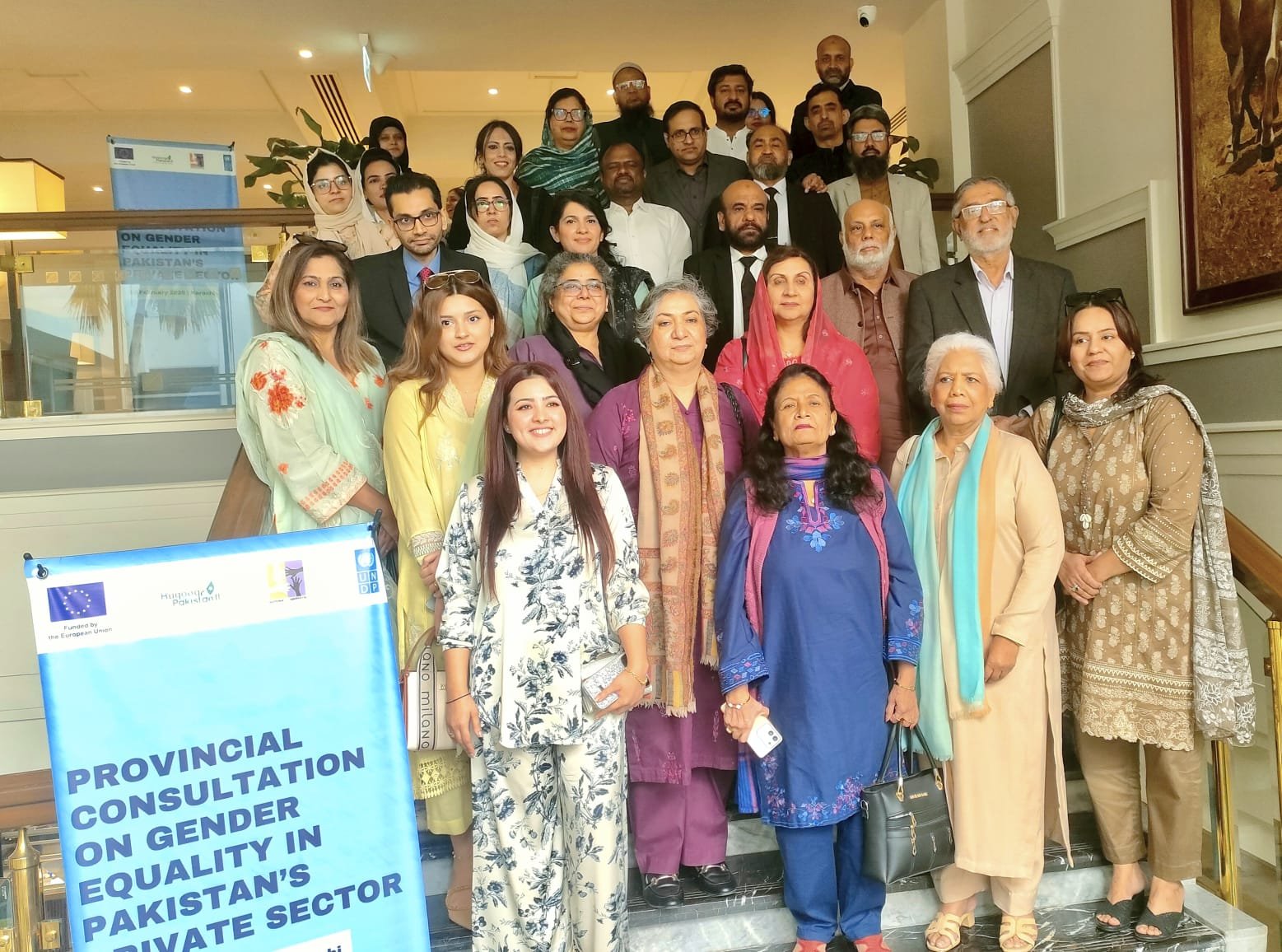

KARACHI: The National Commission on the Status of Women (NCSW), in partnership with UNDP Pakistan under the European Union–funded Huqooq-e-Pakistan II Project, convened its first provincial consultation on Gender Equality in the Private Sector in Karachi.
The consultation was headed and addressed by Chairperson NCSW, Ms. Ume Laila Azhar, who underscored the urgent need to move beyond symbolic commitments and ensure substantive gender equality, dignity at work, and access to remedy for women across Pakistan’s private sector.
Speaking at the consultation, the Chairperson highlighted that Karachi—Pakistan’s economic hub and a major centre of private employment was a strategic starting point for a dialogue that seeks to bridge the gap between existing legal frameworks and lived workplace realities faced by women in both formal and informal sectors.
The consultation was grounded in a gender-responsive and gender-transformative approach, aligned with the UN Guiding Principles on Business and Human Rights (UNGPs) and Pakistan’s National Action Plan on Business and Human Rights (NAP-BHR), with particular emphasis on access to remedy, accountability, and justice.
Chairperson Ume Laila Azhar emphasized that while laws and policies addressing workplace discrimination, harassment, and labour rights exist, women continue to face systemic barriers in recruitment, equal pay, job security, workplace safety, career progression, and effective grievance redress mechanisms. She stressed that weak implementation, lack of institutional coordination, and power imbalances remain key challenges that must be addressed through collective action.
The multi-stakeholder consultation brought together representatives from the private sector, banking and financial institutions, textiles and garments industry, manufacturing, beauty salons and service industries, home-based workers, government departments, civil society organisations, women’s rights groups, researchers, and development partners.
Through sector-specific group discussions, participants shared practical, experience-based insights on gender inequality within workplaces and institutions. The dialogue generated concrete and actionable recommendations focusing on:
Strengthening workplace policies and organisational culture;
Ensuring pay equity and non-discriminatory recruitment;
Improving workplace safety and protection from harassment;
Establishing effective grievance mechanisms and access to remedy;
Addressing vulnerabilities of women in informal, outsourced, and home-based work.
Chairperson NCSW reaffirmed the Commission’s statutory mandate to monitor gender equality, advocate for policy reform, and strengthen accountability mechanisms, noting that gender equality is not merely a social obligation but a prerequisite for sustainable economic growth and social justice.
The findings and recommendations from the Karachi consultation will directly feed into NCSW’s Annual Gender Equality in the Private Sector Report, aimed at informing evidence-based policymaking and promoting gender-responsive business practices nationwide.
NCSW announced that this consultation is part of a broader provincial consultation process, which will continue with: Peshawar, Lahore and Quetta. These consultations will collectively inform national-level policy advocacy and strengthen Pakistan’s commitments under international human rights and business standards.
