

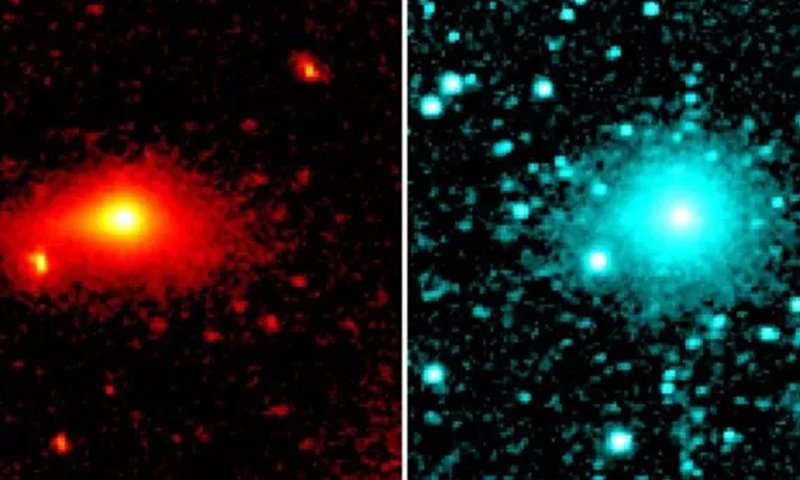

In a stunning farewell performance, the rare interstellar comet 3I/ATLAS has erupted with unexpected activity long after its closest approach to the Sun, giving astronomers an unprecedented look at the chemistry of a visitor from another star system. NASA’s SPHEREx space telescope captured the dramatic brightening in infrared light in December 2025, revealing a surge of gas, dust, and complex organic molecules streaming from the comet.
Discovered in July 2025, 3I/ATLAS is only the third confirmed interstellar object to pass through our solar system, following the enigmatic ‘Oumuamua and comet 2I/Borisov. Unlike its predecessors, however, this comet put on an extended chemical show. SPHEREx observations show it developed a bright, glowing coma rich in water vapor, carbon dioxide, methane, methanol, and cyanide—key building blocks for planets—as well a distinctive pear-shaped dust tail.
“Comet 3I/ATLAS was full-on erupting into space in December 2025, after its close flyby of the sun, causing it to significantly brighten,” said study lead author Carey Lisse. “Even water ice was quickly sublimating into gas in interplanetary space.”
What makes this outburst particularly surprising is its timing. Comets typically peak in activity at perihelion—their closest point to the Sun—when solar heat vaporizes surface ices. SPHEREx data suggests that sunlight slowly penetrated beneath 3I/ATLAS’s surface after its solar flyby, triggering a delayed release of ancient, buried volatiles from its interior.
The SPHEREx telescope, designed to study the history of the universe and ices across cosmic epochs, was uniquely equipped to conduct this chemical forensics. Its infrared capabilities allowed scientists to identify specific molecules in the comet’s coma, offering the clearest snapshot yet of the raw materials that form around other stars.
This late-stage outburst has provided a rare opportunity: a detailed inventory of interstellar chemistry, captured as the comet arcs back into the darkness of interstellar space. The data will help scientists understand how planetary ingredients differ—or align—from one star system to another, deepening our knowledge of how worlds form both here and light-years away.
