

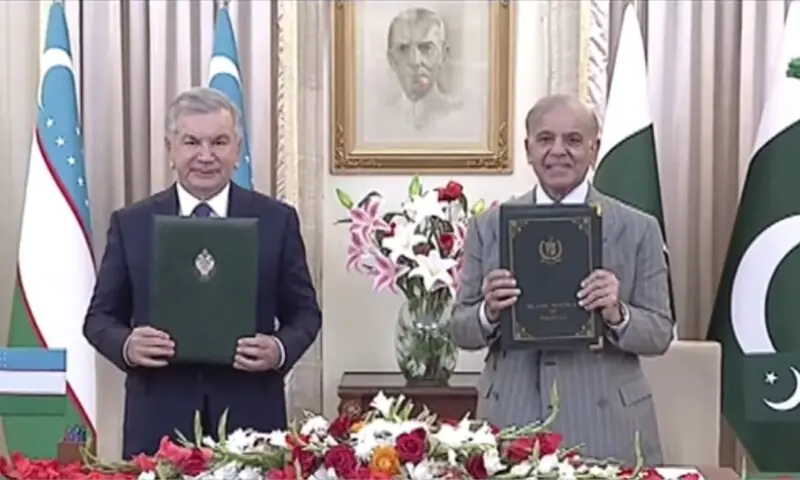

Pakistan and Uzbekistan on Thursday signed 28 agreements and memoranda of understanding following the arrival of President Shavkat Mirziyoyev in Islamabad for a two-day official visit, marking a major step forward in bilateral cooperation.
A document exchange ceremony, broadcast live on television, confirmed that 20 agreements were signed in the presence of Prime Minister Shehbaz Sharif and President Mirziyoyev. The accords aim to deepen collaboration across multiple sectors and strengthen regional connectivity.
Wide-ranging agreements across key sectors
The signed documents covered diverse areas, including an action plan for defence cooperation, climate change and disaster risk reduction, disaster management, agriculture, mining and geosciences. Both sides also agreed on sanitary protocols for fruit exports, cooperation to combat drug trafficking, and arrangements for the transfer of sentenced persons.
Officials said the agreements reflect a shared commitment to expanding practical cooperation and institutional links. Moreover, they are expected to support trade growth and investment while enhancing people-to-people ties.
Warm reception and high-level engagement
Upon arrival at Nur Khan Airbase, President Mirziyoyev received a warm welcome from Prime Minister Shehbaz Sharif and President Asif Ali Zardari. A 21-gun salute was presented, while a contingent of the Pakistan armed forces offered a static salute and the tri-services band performed.
According to the Foreign Office, President Mirziyoyev is visiting Pakistan at the invitation of Prime Minister Shehbaz and is leading a high-level delegation comprising cabinet members and business leaders. During the visit, he will meet President Zardari, hold delegation-level talks with the prime minister, and address the Pakistan-Uzbekistan Business Forum.
Officials noted that this is Mirziyoyev’s second visit to Pakistan, following his 2022 trip. The visit comes amid expanding economic ties, including a $1 billion trade agreement signed in 2023 and a recent commitment to raise bilateral trade to $2 billion.
