

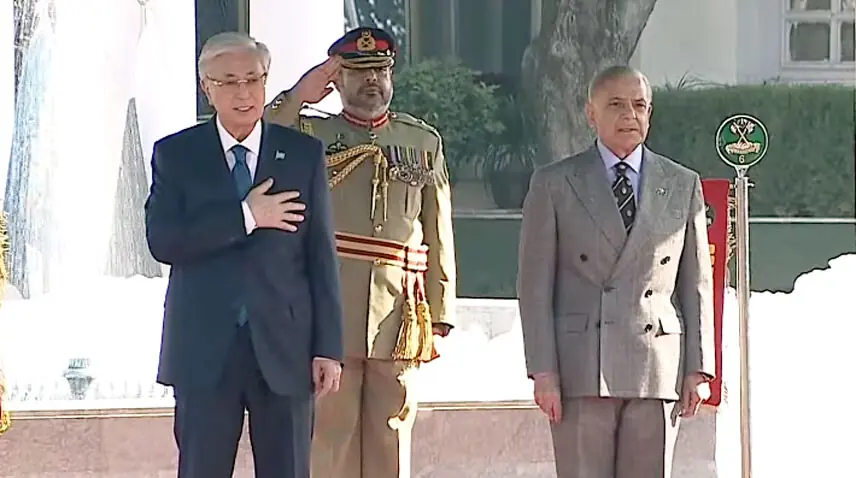

Pakistan and Kazakhstan on Wednesday agreed to scale up their bilateral trade to $1 billion within a year, following high-level talks in Islamabad. The move signals deepening economic and strategic ties, with leaders from both countries expressing confidence that the goal can be met by tapping unexplored business opportunities.
Prime Minister Shehbaz Sharif announced the goal at a joint press conference with Kazakhstan President Kassym-Jomart Tokayev. At the same time, Tokayev began a two-day visit to Pakistan. Notably, no Kazakh president has visited Pakistan in more than 20 years. The trip aims to deepen trade, energy links, and transport connectivity.
Trade agreements signal fresh economic momentum
During the joint press conference, Pakistan and Kazakhstan signed dozens of agreements and memorandums of understanding. The deals cover petroleum, mining, maritime affairs, transport, agriculture, and investment cooperation. Leaders from both sides stressed the need to move quickly from paperwork to implementation.
Prime Minister Shehbaz highlighted that last year’s bilateral trade stood at only $250 million. He called the figure modest and unrepresentative of the strong political relationship. Therefore, he urged business communities to invest in joint ventures and explore new markets. He also promised fast implementation of signed agreements to ensure visible economic progress.
Meanwhile, President Tokayev welcomed Pakistan’s offer to provide full access to its transit infrastructure and seaports. He noted that ports like Karachi and Gwadar could offer Kazakhstan alternative routes to global markets. As a result, both sides agreed to prioritize transport and logistics projects that enhance regional connectivity.
Strategic partnership and regional connectivity plans
Both leaders signed a joint declaration establishing a strategic partnership. President Tokayev described Pakistan as a reliable and important partner in South Asia and beyond. He emphasized shared history, cultural ties, and common aspirations rooted in the legacy of the Silk Road.
In addition, the two sides discussed a multi-country transport corridor linking Central Asia with South Asia. The proposed route includes Belarus, Russia, Kazakhstan, Uzbekistan, Afghanistan, and Pakistan. Leaders believe the corridor can boost trade flows and reduce transportation costs across the region.
Energy cooperation also featured prominently in the talks. Both sides exchanged views on oil, gas, and mining collaboration. President Tokayev called energy cooperation a win-win opportunity, while Prime Minister Shehbaz highlighted Pakistan’s human capital and natural resources as key strengths.
Business, defence, and people-to-people ties expand
Alongside trade and energy, leaders discussed defence cooperation, technology, and digital development. They also agreed to explore the resumption of direct flights between the two countries to promote tourism and business travel.
President Tokayev invited Pakistani companies to set up production units in Kazakhstan. At the same time, he promised favorable conditions for Pakistani investors. As regional dynamics continue to shift, Islamabad and Astana view closer cooperation as both strategic and mutually beneficial.
Meanwhile, education and cultural cooperation also drew attention. Currently, over 1,000 Pakistani students study in Kazakhstan. Both leaders therefore agreed to expand collaboration in science, education, and research.
Overall, officials from both sides believe President Tokayev’s visit offers a timely opportunity to turn relations from potential into performance. As a result, both leaders agreed to deepen cooperation in science, education, and research.
