

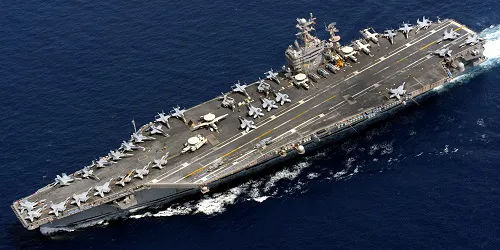

A US stealth fighter jet destroyed an Iranian drone after it moved aggressively toward an American aircraft carrier in the Arabian Sea, escalating tensions in the region, a US military official confirmed. As a result, US forces emphasized that the action was defensive, aimed at protecting personnel and military assets from any immediate threat.
F-35C intercepts drone to protect USS Abraham Lincoln
According to the US Central Command, an F-35C fighter jet from the USS Abraham Lincoln intercepted the Iranian drone in the Arabian Sea. The pilot acted in self-defense, destroying the drone before it could pose a danger. Furthermore, Centcom spokesperson Captain Tim Hawkins confirmed the drone’s hostile intent and stated that US personnel and assets remained unharmed.
Meanwhile, the USS Abraham Lincoln continues to lead a US naval strike group deployed in the region. Washington sent the group amid rising regional instability. This deployment followed weeks of unrest inside Iran and strong warnings from President Donald Trump. Moreover, only days earlier, Centcom had warned Iran’s Islamic Revolutionary Guard Corps to avoid unsafe and unprofessional behavior near US forces. Consequently, Tuesday’s shootdown has increased pressure on already strained relations.
Iranian gunboats approach US-flagged tanker
At the same time, a separate incident heightened tensions in the Strait of Hormuz. Specifically, maritime sources and a security consultancy reported that Iranian gunboats approached a US-flagged oil tanker near northern Oman. The tanker, identified as the Stena Imperative, received orders to stop. Iranian boats instructed the crew to shut down engines and prepare for boarding. However, the tanker accelerated and continued its voyage.
Vanguard, a maritime risk management firm, said the vessel stayed outside Iranian territorial waters. Additionally, a US warship escorted the tanker during the encounter. A US official later confirmed the ship’s American registration. Earlier, the United Kingdom Maritime Trade Operations issued a warning that armed boats attempted to intercept a vessel about 16 nautical miles north of Oman. Authorities are still investigating the incident.
Iran denies escalation, cites territorial violation
Meanwhile, Iran disputed Western accounts of the encounter. According to the semi-official Fars news agency, unnamed Iranian officials claimed a foreign vessel entered Iranian waters without legal permission. In response, Iranian forces issued warnings, after which the vessel exited the area. Officials said no special security incident occurred.
The Strait of Hormuz links the Persian Gulf to the Arabian Sea through the Gulf of Oman. It also remains one of the world’s most vital shipping lanes, as major oil producers rely heavily on it to export crude, especially to Asian markets. Specifically, the strait carries oil for Saudi Arabia, Iran, the UAE, Kuwait, and Iraq, making it a critical artery for global energy. Therefore, any disruption can trigger immediate spikes in oil prices worldwide.
In recent years, Iran has seized vessels near or within the strait, including two incidents in 2023 and another in 2024, some following US seizures of Iran-linked tankers. Combined with the recent drone shootdown, these events highlight the increasing danger in the region. As a result, the risk of mistakes or confrontations at sea and in the air remains alarmingly high.
