

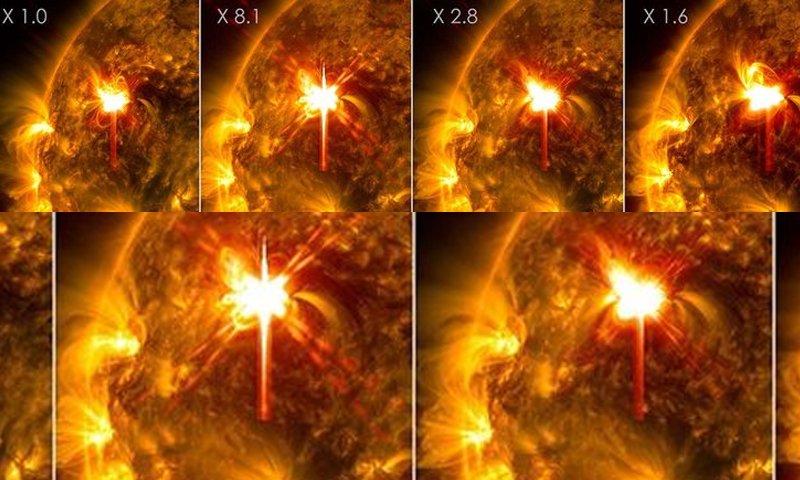

The Sun has unleashed a series of significant solar flares, highlighting a period of intense activity with potential impacts for Earth. NASA has reported four notable eruptions, including one of the most powerful flares observed in recent years.
The flares, detected by NASA’s Solar Dynamics Observatory and other spacecraft, occurred in quick succession. They have been classified on the logarithmic scale used for such events:
An X1.0-class flare
A powerful X8.1-class flare—one of the strongest of the current solar cycle
An X2.8-class flare
An X4.6-class flare
X-class flares denote the most intense category of solar eruptions. The number provides further information on its strength; an X2 is twice as intense as an X1, an X4 is four times as intense, and so on.
Potential Impacts on Earth
These powerful bursts of electromagnetic radiation travel at the speed of light, causing immediate effects upon reaching Earth. The primary concerns are:
Radio Communications: High-frequency (HF) radio signals can be degraded or blacked out on the sunlit side of Earth.
Navigation Signals: GPS and other satellite-based navigation systems can experience interference and reduced accuracy.
Power Grids: While the radiation itself does not affect the ground, the associated coronal mass ejections (CMEs)—clouds of solar plasma often released alongside flares—can trigger geomagnetic storms. These storms can induce currents in long power lines, potentially overloading transformers and causing voltage control problems.
Spacecraft & Astronauts: Increased radiation levels pose a risk to satellites and astronauts in space, potentially causing instrument malfunctions and raising radiation exposure concerns.
Monitoring and Preparedness
NASA acts as the research arm of the nation’s space weather effort, constantly observing the Sun with a fleet of spacecraft. For operational forecasts and alerts regarding impacts on Earth, the official source is the NOAA Space Weather Prediction Center (SWPC).
The SWPC provides watches, warnings, and alerts for power grid operators, airline pilots, satellite controllers, and other industries vulnerable to space weather. The recent flare activity may lead to enhanced auroral displays (Northern and Southern Lights) at lower latitudes than usual in the coming days, depending on the direction of any associated CMEs.
As the Sun approaches the peak of its 11-year activity cycle, expected in 2025, such powerful flares are likely to become more frequent. Continuous monitoring by agencies like NASA and NOAA is crucial for predicting and mitigating their effects on our technology-dependent society.
