

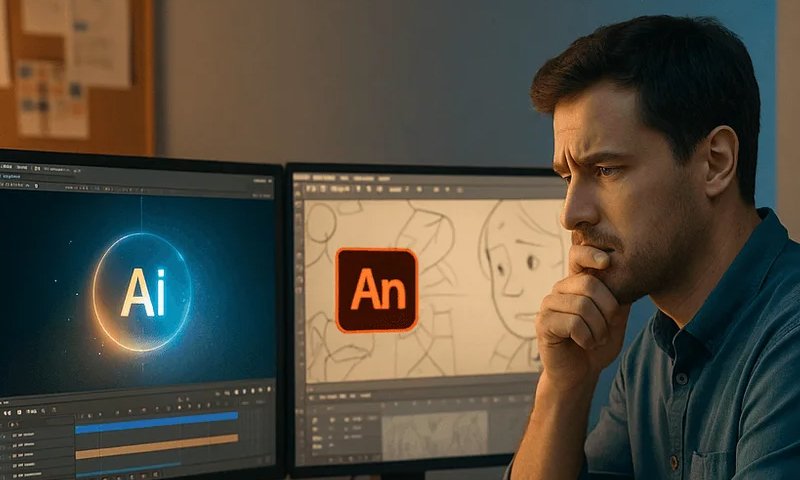

Adobe has delivered a seismic shock to the creative world by announcing the end of Adobe Animate, its flagship 2D animation software with roots stretching back over 25 years to the era of Flash. The program will officially shut down on March 1, 2026, marking a decisive—and controversial—strategic pivot as the company doubles down on investments in generative artificial intelligence across its product portfolio.
The announcement, made via customer emails and support site updates on Monday, leaves thousands of professional animators, game developers, and web content creators scrambling. Individual users will lose access to updates and technical support in March 2025, while enterprise clients will receive extended support through March 2029. The move signifies not just the sunsetting of a tool, but the potential abandonment of an entire workflow integral to the animation ecosystem.
Community reaction has been one of visceral anger and disbelief. Social media platforms erupted with outcries from professionals who relied on Animate as their primary creative engine. “This is legit gonna ruin my life,” wrote one user on X, while another stated, “Animate is the reason a good chunk of Adobe users even subscribe in the first place.” Many have pleaded with Adobe to open-source the software rather than consign it to oblivion.
Perhaps the most telling aspect of the announcement is Adobe’s inability to recommend a true successor from within its own suite. In an FAQ, the company vaguely suggested that “portions of Animate functionality” could be replicated using a patchwork of other apps: complex keyframing might be attempted in After Effects, while basic animation effects could be applied in Adobe Express. For professionals, this is akin to replacing a specialized surgical tool with a box of band-aids.
The discontinuation did not come without warning for observant users. Animate was conspicuously absent from Adobe’s 2025 Max conference, and no 2025 version of the software was ever released. These were clear signals of deprioritization, aligning with the company’s all-in bet on AI-driven tools like Firefly, and the integration of generative features across Photoshop, Illustrator, and Express.
Financially, the move severs a subscription line that cost users $34.49 monthly, or $263.88 annually. While installed software will remain functional, it will become a vulnerable, unsupported relic in a rapidly evolving digital landscape.
This decision underscores a harsh new reality in the creative software industry: legacy tools that don’t fit the AI-centric growth narrative are becoming expendable, regardless of their loyal user base or historical importance. For Adobe, resources dedicated to maintaining a 25-year-old animation platform are apparently better spent developing AI capabilities that drive stock price enthusiasm and new subscription models.
The creative community is now actively migrating. Alternatives like Toon Boom Harmony and Moho Animation are gaining traction in forum discussions, but the transition promises to be painful, involving steep learning curves and the potential loss of nuanced, frame-by-frame control that Animate provided.
Adobe’s termination of Animate is a watershed moment. It vividly illustrates the velocity at which established digital landscapes are being reshaped by the AI gold rush. For the company, it’s a strategic recalibration. For the animators who built careers with it, it’s a profound disruption. The ultimate question remains: Will the value of Adobe’s AI future justify the cost of alienating the creators who helped build its past?
