

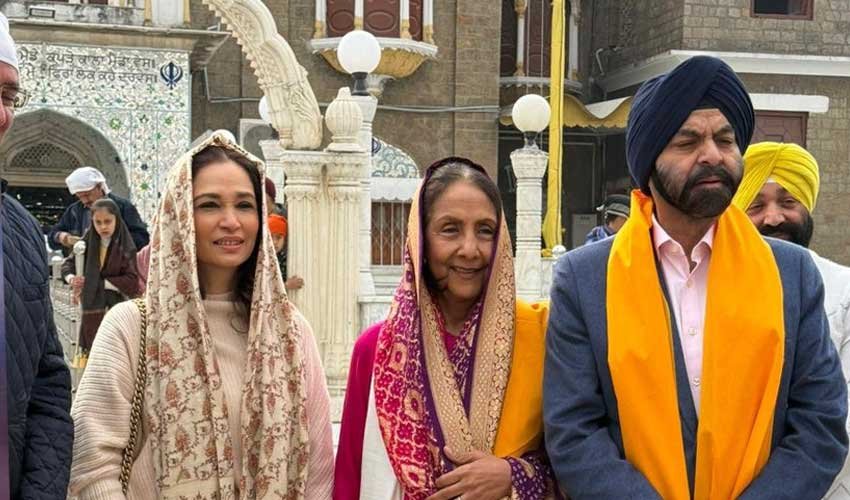

ISLAMABAD: World Bank Group President Ajay Banga visited the historic Sikh shrine Gurdwara Panja Sahib in Hasan Abdal on Sunday, marking a high-profile engagement highlighting Pakistan’s religious heritage and interfaith outreach. Local civil and police authorities received Banga and his delegation on arrival, ensuring smooth administrative and security arrangements throughout the visit.
Respect paid at revered Sikh site
Attock’s deputy commissioner and district police officer formally welcomed the World Bank chief before he proceeded to the gurdwara. There, Banga paid his respects and took part in religious rites, acknowledging the site’s deep spiritual importance for the Sikh community. He later joined worshippers in the langar hall, where he shared the traditional communal meal.
Moreover, Banga praised the management and volunteers for their hospitality and organisation. In recognition of the visit, representatives of the Sikh community presented him with a traditional siropa, a robe of honour customarily offered to distinguished guests at Sikh religious sites.
Officials highlight harmony and heritage
Federal Minister for Finance Muhammad Aurangzeb and Punjab Minister for Minority Affairs Ramesh Singh Arora accompanied Banga during the visit. Officials said their presence reflected the government’s commitment to religious harmony and respect for minority communities across the country.
Gurdwara Panja Sahib ranks among the most sacred Sikh sites in Pakistan and regularly welcomes pilgrims and international visitors. Accordingly, authorities implemented special security and facilitation measures to ensure orderly proceedings and uninterrupted religious activities.
Officials added that the visit underscored Pakistan’s resolve to protect religious heritage sites while promoting interfaith understanding. They noted that such engagements also project the country’s cultural diversity and traditions internationally, and reinforce messages of coexistence and tolerance.
Religious Importance of Gurdwara Panjab Sahib
Gurdwara Panja Sahib in Hasan Abdal, Pakistan, stands as one of the most important pilgrimage sites in Sikhism, commemorating Guru Nanak Dev Ji’s visit in 1521. The shrine is revered for a sacred rock bearing a handprint, or panja, believed to have been left by Guru Nanak when he miraculously stopped a massive boulder hurled at him.
According to Sikh tradition, Guru Nanak and his companion Bhai Mardana arrived in Hasan Abdal during their travels. When the local saint, Wali Qandhari, refused to share water with the Guru’s thirsty followers, Guru Nanak caused a spring to emerge from the ground. Enraged by this act, Wali Qandhari allegedly pushed a huge rock down from a nearby hill. The rock is said to have come to a halt when Guru Nanak placed his hand on it, leaving behind the visible imprint that remains the focal point of the shrine.
Located about 48 kilometres from Rawalpindi, Gurdwara Panja Sahib is regarded as among the holiest Sikh religious sites. While an early shrine existed at the location, the complex was significantly expanded during the Sikh Empire under Maharaja Ranjit Singh and later by Hari Singh Nalwa. The present three-storey white marble structure was completed in 1925 with major funding from Maharaja Bhupindar Singh of Patiala.
The gurdwara also holds a natural spring believed to be more than 500 years old and serves as a central gathering place during major Sikh festivals, particularly Vaisakhi. The site is also historically significant due to the 1922 Saka Panja Sahib incident, when Sikhs protesting colonial repression were killed or injured while attempting to provide food to detained reformers.
Today, the complex includes a large pool, a library, and modern lodging facilities that host thousands of international pilgrims each year.
