

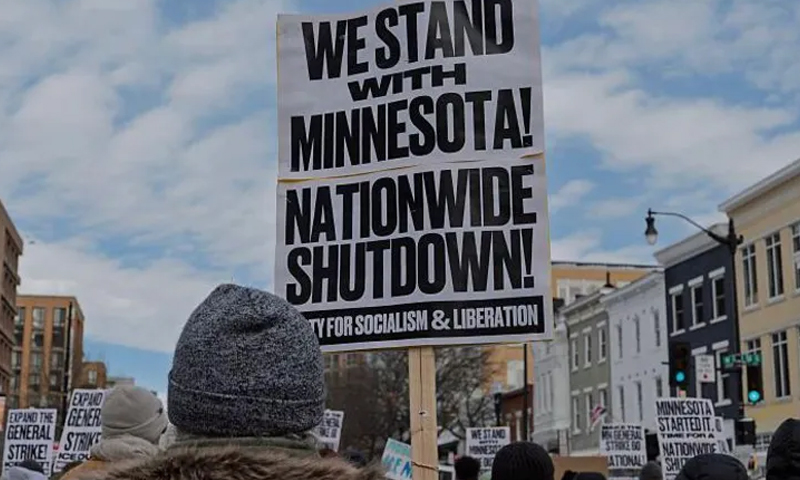

Negotiations to prevent a US government shutdown have intensified in Washington, D.C., with lawmakers reportedly edging closer to a deal over the Trump administration’s immigration enforcement operations. The discussions follow national outrage over the fatal shooting of 37-year-old Alex Pretti in Minneapolis by federal agents, an event that has sparked renewed scrutiny of U.S. Immigration and Customs Enforcement (ICE) and Customs and Border Patrol (CBP) practices.
Democrats have been pressing to remove funding for the Department of Homeland Security (DHS) from the $1.2 trillion (£870 billion) government spending package. Their goal is to introduce strict new restrictions on federal immigration agents, including requirements for warrants before making arrests and clearer rules for identifying themselves while on duty. According to U.S. media reports, the White House and Senate Democratic leadership are nearing an agreement that could meet these demands.
If successful, five of the six spending bills could pass before the Friday deadline, while the DHS bill would receive a short-term extension to allow further debate over the proposed reforms. Failure to reach an agreement would trigger the second government shutdown in months, starting at one minute past midnight on Friday, January 30.
Currently, the House of Representatives has passed the spending bill, but it still requires 60 votes in the Senate to advance. With only 53 Republican senators in the 100-member chamber, some Democratic support will be necessary to pass the legislation. Senate Minority Leader Chuck Schumer emphasized this week, “I will vote no on any legislation that funds ICE until it is reined in and overhauled, and Senate Democrats are overwhelmingly united on this issue.” Republican Senate Majority Leader John Thune described the negotiations as “productive,” but the final outcome remains uncertain.
Some Senate Democrats have escalated their demands, explicitly calling for DHS Secretary Kristi Noem’s removal and structural changes to both ICE and the U.S. Border Patrol. “This madness,” Schumer said, “this terror must stop.” Meanwhile, Republicans such as Texas Senator John Cornyn have urged that any modifications must not come at the expense of shutting down the government.
A partial government shutdown would not affect all federal agencies. Legislation has already been passed to fund dozens of departments through the end of the 2026 fiscal year, including the Department of Justice, the FBI, and the Department of Veterans Affairs. These agencies would continue operations normally.
However, other branches that fall under the same spending bill as DHS—including the Department of Defense, Health and Human Services, the Treasury, and the federal court system—could be impacted. In practical terms, a shutdown could disrupt court operations, medical research, and the release of key labor and economic statistics. The Internal Revenue Service would also be affected, potentially delaying tax processing and refunds.
DHS itself is a sprawling department, encompassing ICE, the Coast Guard, Secret Service, and Customs and Border Protection. Employees deemed “essential” would continue working during a shutdown, but without pay until funding is restored unless alternative funding measures are enacted—as happened with military personnel during last year’s shutdown under the Trump administration.
The last government shutdown, which occurred in late 2025, lasted 43 days from October 1 to November 12, making it the longest in U.S. history. That standoff began over Democrats’ refusal to support a funding bill unless Republicans agreed to extend health insurance subsidies for low-income Americans. Eventually, eight Democrats broke with their party to help pass the bill. The shutdown affected roughly 1.4 million federal employees, who were left on unpaid leave or required to work without pay. Federal food aid was delayed, and air travel across the country was severely disrupted.
Since 1981, the United States has experienced 16 government shutdowns, though some lasted only a few days. As negotiations continue this week, lawmakers face significant pressure to find a compromise that both funds the government and addresses Democratic concerns about ICE and DHS operations, particularly in the wake of Pretti’s killing.
With the Friday deadline looming, a resolution may yet be reached to avert another disruptive shutdown, though both sides remain firm on key aspects of the negotiations. The outcome will determine whether parts of the federal government experience operational interruptions, and whether proposed reforms to federal immigration enforcement become a reality.
