


China Pushes AI Beyond Earth’s Atmosphere
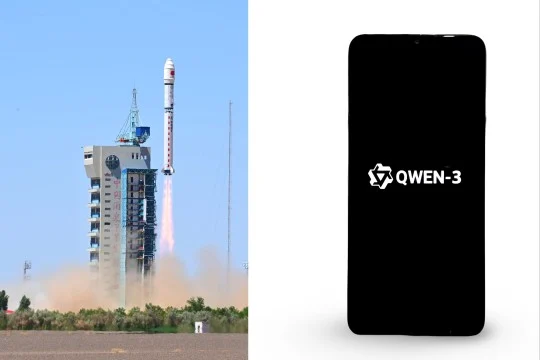
Alibaba Cloud has propelled artificial intelligence into an entirely new era , reshaping the limits of innovation and technological possibility. Its advanced language model, Qwen-3 has crossed Earth’s boundaries, becoming the first general-purpose AI to operate in outer space. The historic milestone highlights a defining moment in China’s growing ambitions in space-based computing, marking a new era of AI seamlessly integrated with orbital technology.
Wang Yabo, executive vice president of aerospace start-up Ada space Technology, confirmed the milestone on Monday. He called the deployment a “crucial breakthrough” in building large-scale computing capabilities beyond Earth. Star Market Daily first reported the announcement.
Adaspace successfully installed Qwen-3 at its initial space computing center. The facility forms a key component of the company’s long-term Star-Compute Project, which aims to reshape how data is processed outside Earth’s atmosphere.
Inside the Star-Compute Project
Through the Star-Compute Project, Adaspace plans to deploy a constellation of approximately 2,800 satellites. The network will support physical AI systems and allow artificial intelligence models to train and operate directly in orbit. By doing so, the project reduces dependence on terrestrial data centers.
Engineers conducted the first operational test in November. During the trial, Qwen-3 performed multiple AI inference tasks while orbiting Earth. The successful test proved that advanced AI systems can function reliably despite the extreme conditions of space.
The system also delivered impressive performance. From sending queries from Earth to receiving processed results, the entire operation took less than two minutes. This speed highlights the growing efficiency and viability of orbital computing platforms.
Adaspace deployed Qwen-3 aboard its initial constellation of 12 satellites. The company launched these satellites in May 2025. Alibaba Cloud had released the Qwen-3 model a month earlier, in April 2025, as part of its expanding open-source AI portfolio.
Why Orbital AI Changes the Game
Operating AI models in space offers clear strategic advantages. Satellites draw on constant solar energy and benefit from the natural cold of space, which helps reduce cooling costs. These conditions make orbital computing more energy-efficient than many Earth-based data centers.
Processing data in orbit also cuts down on the need to transmit large volumes of information back to the ground. This approach lowers communication costs and reduces delays. As a result, AI systems can deliver faster insights and scale more effectively.
Industry experts expect several sectors to gain from this technology. Defense, telecommunications, Earth observation, and disaster response stand to benefit from real-time data processing in space. Faster analysis from orbit could significantly improve decision-making during critical situations.
By activating Qwen-3 beyond Earth’s atmosphere, China has strengthened its standing in the global competition for AI and space dominance. The achievement underscores the accelerating convergence of artificial intelligence and satellite infrastructure.
With advances in orbital computing technology , Alibaba Cloud and Ada space Technology are spearheading advancements in this rapidly developing sector. Their achievement with Qwen-3 may inspire comparable initiatives, turning the page to a new era of AI-powered space innovation.
