

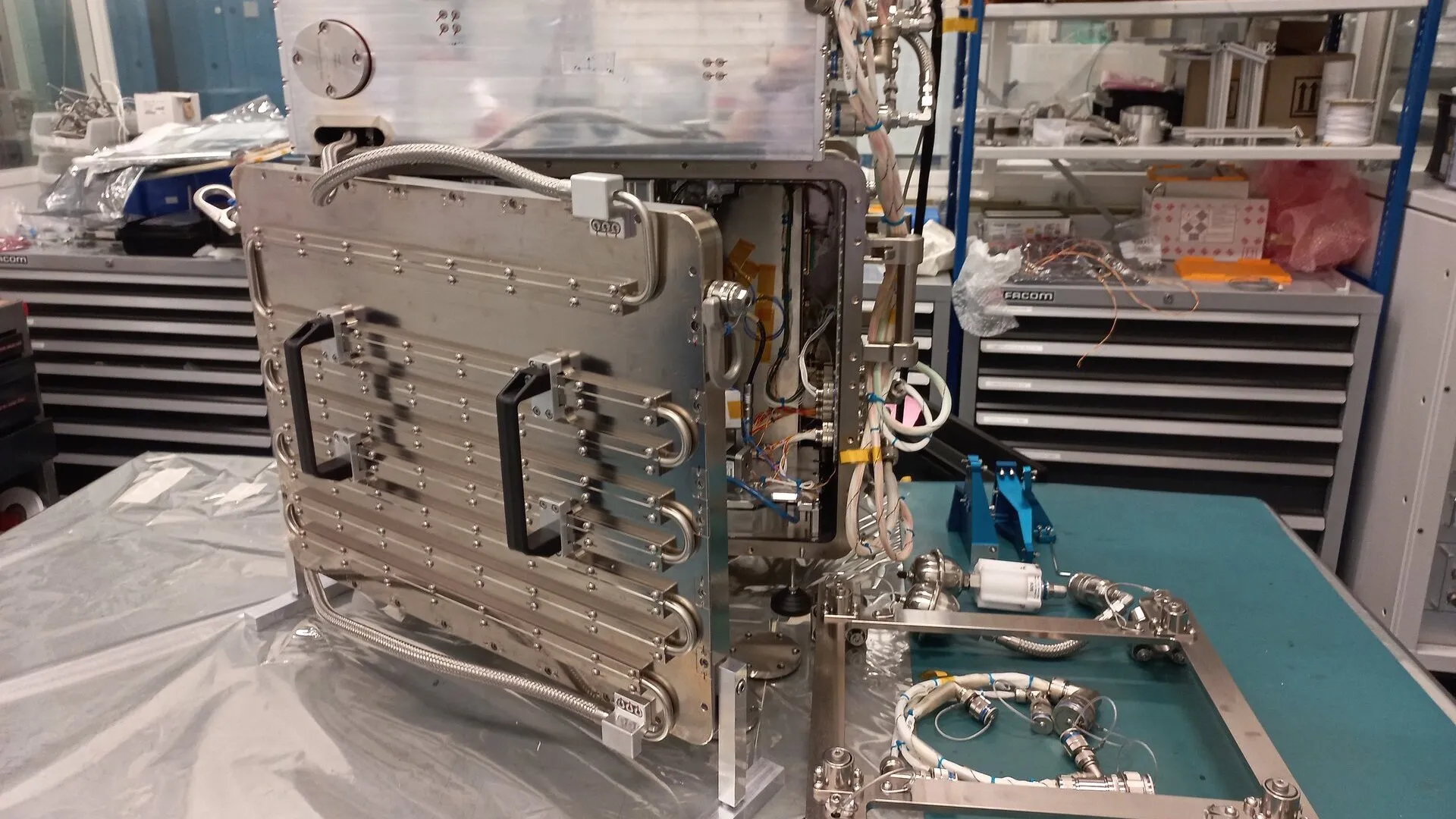

BEIJING: China has successfully completed its first in-space metal 3D printing experiment, marking a significant milestone in space-based manufacturing. The experiment was conducted using a retrievable scientific payload developed by the Institute of Mechanics under the Chinese Academy of Sciences (CAS).
The payload flew aboard the Lihong-1 Y1 suborbital vehicle, a commercial recoverable spacecraft built by CAS Space, which completed its inaugural test flight from the Jiuquan Satellite Launch Center on January 12. After crossing the Kármán line and reaching an altitude of approximately 120 kilometers, the experiment autonomously produced metal parts in the microgravity environment.
CAS highlighted that this achievement transitions China’s metal additive manufacturing technology from ground-based research to “in-space engineering verification,” positioning the country at the global forefront of space manufacturing. The experiment also provides a foundation for future space infrastructure projects.
Researchers successfully addressed numerous technical challenges, including stable material transport and forming under microgravity, full-process closed-loop control, and high-reliability coordination between the payload and the launch vehicle.
The mission concluded with a safe, parachute-assisted landing of the payload capsule, enabling scientists to acquire critical first-hand data on melt pool dynamics, material transport, solidification behavior, and the mechanical and geometric properties of the parts printed in space.
The Lihong-1 Y1 spacecraft, which carried metal 3D printing facilities and rose seeds for an agricultural experiment, has proven to be a versatile and cost-effective platform for suborbital scientific research.
Deputy Chief Designer Wang Yingcheng noted that the spacecraft is being developed for extensive reuse, with ongoing work to incorporate crew life-support systems and highly reliable escape technologies.
This breakthrough not only strengthens China’s capabilities in space manufacturing but also opens new opportunities for commercial space tourism and low-cost scientific experimentation in microgravity environments, establishing a foundation for future technological advancements in orbit.
