

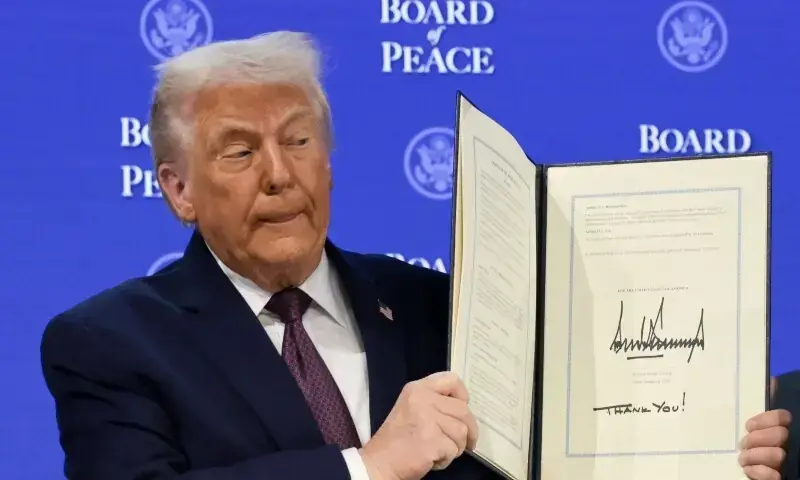

India has so far stayed away from US President Donald Trump’s proposed “Board of Peace”, despite receiving an invitation to join the initiative. New Delhi’s absence from the recent Davos ceremony, where 20 world leaders, including Trump and Pakistan’s Prime Minister Shehbaz Sharif, signed the board’s charter, has sparked debate within India’s diplomatic and media circles.
At the heart of the hesitation lies concern over Kashmir. Trump has repeatedly offered to mediate the long-standing dispute between India and Pakistan, particularly after their military flare-up in May 2025.
India has consistently rejected third-party involvement, maintaining that Kashmir is a bilateral issue. Critics fear that joining the Board of Peace could expose the region to international scrutiny or even US-led mediation.
Trump has described the board as a mechanism not only to make the Gaza ceasefire permanent and oversee an interim Palestinian government, but also as a model that could be extended to other conflicts. He has even suggested it could one day replace the United Nations. This has added to unease in New Delhi, especially as Washington withdraws from several UN bodies.
An editorial in The Hindu called Pakistan’s participation a “warning signal” for India, arguing that Trump’s self-styled role as a global peacemaker could lead him to include Kashmir in the board’s agenda. The paper warned that Indian membership might make it harder to oppose the deployment of international peacekeeping forces in the region.
Former Indian ambassador to the UN Syed Akbaruddin has pointed out that, unlike a UN Security Council-mandated arrangement with a fixed end date, Trump’s board has no clear time limit and could be applied beyond Gaza. Other diplomats, such as Ranjit Roy, argue that India faces a dilemma: rejecting the board could anger Washington, while joining it carries high political and strategic risks.
For now, India appears to be weighing its options carefully, balancing ties with the US against its long-standing red lines on sovereignty and Kashmir.
