


The first lesson Zara Dunne offers her new junior colleague Myrtle, as she gives her a tour of the trades processing floor at their pension management firm, is deceptively simple: don’t think too hard about how every day at work is one more day wasted. Also, learn where the good biscuits are kept.
It’s advice most twenty-somethings could use on their first job, though it lands especially hard for Myrtle — saddled with a name that likely hasn’t earned her much mercy from her peers. Comfort, however, quickly becomes irrelevant. Because within minutes, armed criminals storm the building, and Steal explodes into life.
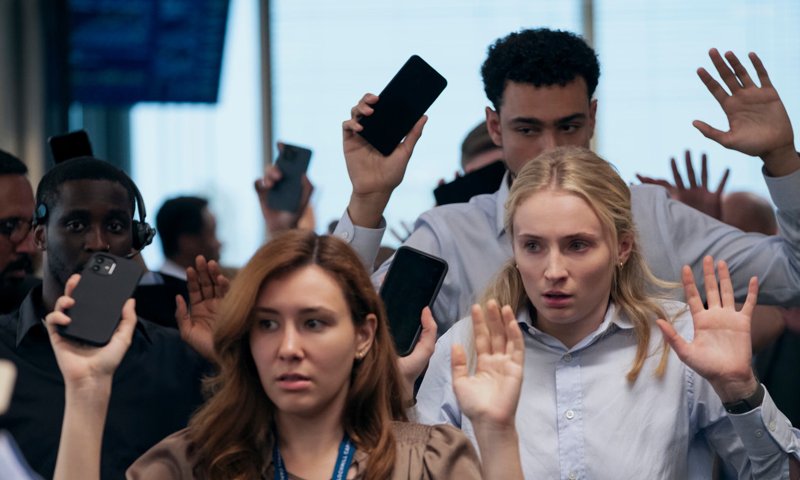
The glossy six-part thriller wastes no time escalating. The attackers don’t wear ski masks or clownish disguises, but meticulously crafted prosthetics designed to defeat facial recognition software — a clever, unsettling detail that sets the tone for the show’s modern, tech-savvy menace. Zara (Sophie Turner), Myrtle (Eloise Thomas), colleague Luke (Archie Madekwe), and dozens of others are herded into a conference room while senior executives are locked away elsewhere.
A couple of vicious beatings remove any illusion of resistance. Zara and Luke are dragged out and forced to execute a series of trades worth a staggering £4bn, while management is coerced into approving them. When Luke buckles under pressure, Zara steps in, keeping the operation afloat. Once the thieves vanish, she’s publicly framed as a hero who kept her nerve under fire.
Naturally, nothing is that simple.
The opening episode — tense, tightly paced, and refreshingly restrained — closes with a reveal that redefines everything that came before. Zara isn’t just a victim. She’s part of the job. Or is she?
As police begin investigating, led by the quietly perceptive DCI Rhys Kovac (Jacob Fortune-Lloyd), the story twists and doubles back on itself. Kovac may be sharp, but he’s burdened with secrets of his own, and Steal thrives on ambiguity. Alliances shift, loyalties fracture, and the truth becomes something negotiable. It’s the television debut of writer Sotiris Nikias, better known as crime novelist Ray Celestin, and his command of misdirection is impressive.
Luke, emotionally shattered by the ordeal, fades into fragility. Zara, by contrast, is built for survival. Her toughness isn’t flashy or superhuman — it’s hard-earned, shaped by a brutal childhood under the thumb of her alcoholic, unpredictable mother Haley. The scenes between Turner and Anastasia Hille are devastatingly raw, so charged they could anchor an entirely different series. Turner plays Zara not as an action hero but as a cornered animal, all instinct and defiance, making her victories feel earned rather than inevitable.
Yet Steal isn’t content to simply thrill. Beneath the gunfire and financial sleight of hand lies a sharp critique of modern capitalism. The series paints the financial world as a legalized casino, run by a tiny elite gambling with other people’s money. Executives pull in £1m salaries plus guaranteed bonuses, while workers like Zara and Luke scrape by on a fraction of that — perks measured in free biscuits rather than real security.
Resentment, the show suggests, is not a flaw but an inevitability. When wealth created by many is endlessly funneled upward to a select few, the system itself invites rupture. Multiply that imbalance across society, and the consequences become unavoidable.
Steal barrels toward its conclusion with confidence, delivering enough spectacle to satisfy genre fans while leaving behind something more unsettling: the sense that the real theft isn’t the £4bn heist, but the quiet, normalized extraction happening every day. Zara may survive with her crypto wallet intact, but the rest of us — trapped inside systems we barely understand — might need more than good biscuits to get through what comes next.
