

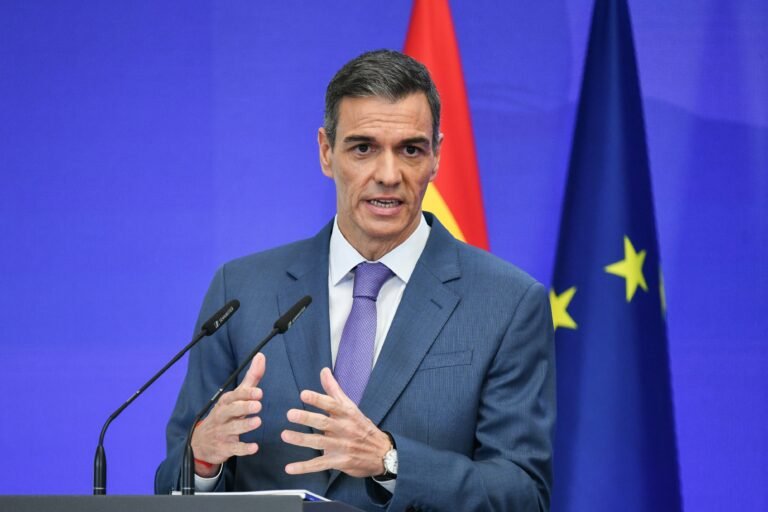

Spain has declined to participate in U.S. President Donald Trump’s newly launched Board of Peace initiative, citing its commitment to multilateralism and the United Nations system, Spanish Prime Minister Pedro Sanchez said on Thursday.
Speaking to reporters after an EU summit in Brussels, Sanchez stated, “We appreciate the invitation, but we decline,” underscoring that Spain’s decision aligns with its longstanding approach to international law and global diplomacy.
The initiative, unveiled at the World Economic Forum in Davos, aims to tackle global conflicts by brokering and monitoring ceasefires, organizing security arrangements, and coordinating reconstruction in post-war regions. The concept draws inspiration from Trump’s Gaza peace plan.
The launch ceremony in Davos saw participation from only a limited number of countries, with notable absences among traditional U.S. allies. Canada, Britain, and most European Union members did not attend, leaving Hungary and Bulgaria as the only EU participants.
Israel, along with Middle Eastern countries such as Qatar, Saudi Arabia, and the United Arab Emirates, confirmed their involvement. However, the Palestinian Authority was not included in the board, a point highlighted by Sanchez as inconsistent with inclusive diplomacy.
Sanchez emphasized that Spain remains committed to supporting UN-led initiatives and multilateral mechanisms for conflict resolution. The government’s refusal to join the board reflects a cautious approach toward initiatives that bypass established international institutions.
Observers noted that Spain’s decision may influence other EU members to take a similar stance, potentially limiting the perceived legitimacy and reach of the Board of Peace.
Despite the absence of several Western allies, the board is expected to continue its work with participating nations, aiming to provide a framework for post-conflict recovery and ceasefire enforcement in targeted regions.
Spain’s position signals a reaffirmation of its support for multilateral diplomacy, highlighting the importance of the UN and collaborative approaches in addressing global conflicts.
