

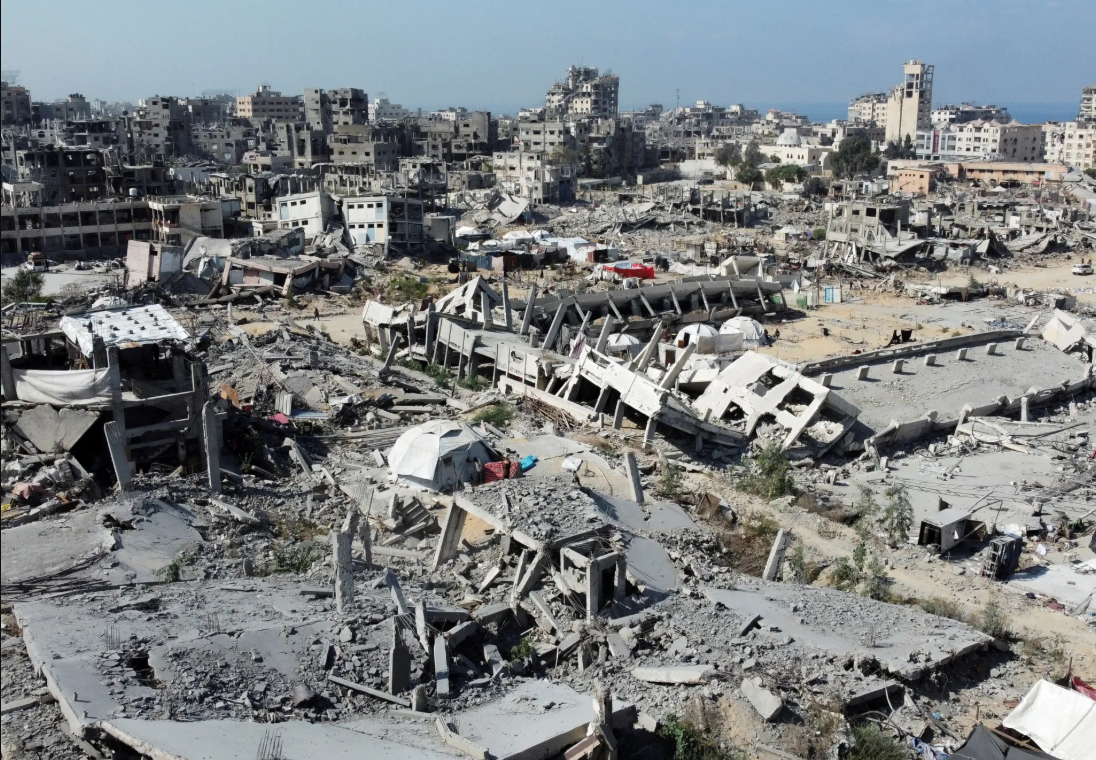

Washington Pushes Ambitious Gaza Rebuild Plan Amid Ongoing Airstrikes
The United States has announced plans for a sweeping redevelopment initiative dubbed “New Gaza,” even as violence continues in the besieged Palestinian territory. The proposal was revealed on Thursday as part of President Donald Trump’s broader effort to stabilize an Israel-Hamas ceasefire that has been repeatedly strained by violations on the ground.
The announcement came on the same day Gaza health officials reported that Israeli airstrikes killed at least five people in the enclave. There was no immediate comment from Israel regarding the latest strikes. The renewed violence has further tested the October truce agreement, which was meant to ease hostilities and improve humanitarian conditions.
President Trump has linked the ceasefire to a wider diplomatic effort known as the “Board of Peace” initiative. The plan aims to address long-running global conflicts through economic incentives and large-scale development projects. Gaza has emerged as a central focus of this strategy.
Following a signing ceremony for the initiative at the World Economic Forum in Davos, Switzerland, Trump invited his son-in-law Jared Kushner to outline the proposed vision for Gaza’s future.
Jared Kushner Presents ‘Master Plan’ for a Rebuilt Gaza
Speaking to an audience in Davos, Kushner described early discussions around Gaza’s reconstruction. He said initial ideas included dividing areas into zones. These included a free economic zone and areas governed by Hamas. He later said those concepts were abandoned.
Kushner told attendees the administration instead opted for what he called “catastrophic success.” He then presented a slideshow detailing a comprehensive “master plan” for what he termed a “New Gaza.”
The presentation showed a color-coded map of Gaza. Specific areas were designated for residential towers, data centers, industrial parks, and commercial zones. One image depicted a Mediterranean coastline lined with high-rise buildings similar to those seen in Dubai or Singapore.
According to the slides, redevelopment would begin in Rafah, located in southern Gaza. Rafah is currently under full Israeli military control. The proposal envisions Rafah as a starting point for large-scale reconstruction.
However, the plan left several critical questions unanswered. It did not address property rights for Palestinians who lost homes and businesses during the war. It also did not clarify compensation mechanisms or where displaced residents would live during rebuilding.
Kushner acknowledged that the project would require clearing an estimated 68 million tonnes of rubble. He did not specify who would fund the effort. He said a conference would be held in Washington in the coming weeks to announce private sector contributions.
Rafah Crossing to Reopen as Ceasefire Faces Uncertainty
Alongside the redevelopment announcement, Palestinian technocrat leader Ali Shaath said Gaza’s Rafah border crossing with Egypt will reopen next week. The crossing has largely remained closed throughout the conflict.
Shaath made the announcement via video link during the Davos event hosted by Trump. He described Rafah as a vital lifeline for Palestinians. He said reopening the crossing would allow movement of people and goods in both directions.
“Rafah is more than a gate,” Shaath said. “It is a symbol of opportunity and connection to the world.”
The reopening of Rafah was a key element of the October ceasefire agreement. Until now, it remained unfulfilled. Israel has controlled the crossing since 2024. There was no immediate response from Israeli officials to Shaath’s remarks.
Under the ceasefire framework, Israel retains control over more than half of Gaza, including areas adjacent to the Rafah crossing. Hamas continues to govern the remaining parts of the enclave.
Despite diplomatic efforts and redevelopment promises, the situation in Gaza remains fragile. Continued airstrikes and unresolved political issues cast doubt on the sustainability of both the ceasefire and the ambitious reconstruction vision.
