

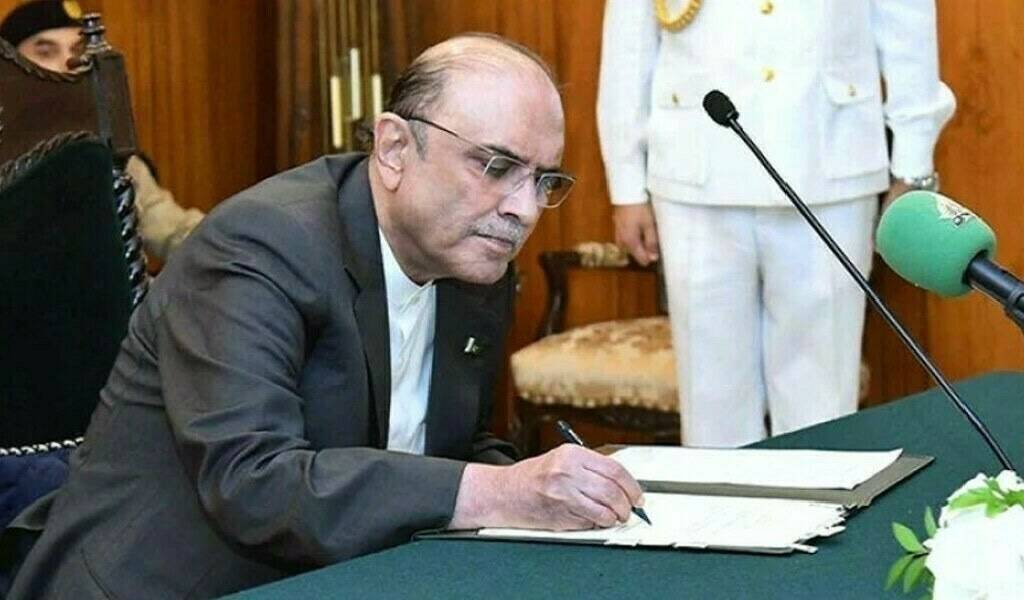

ISLAMABAD: President Asif Ali Zardari today approved the confirmation and tenure extensions of additional judges in the High Courts in Sindh, Lahore, and Peshawar. The President’s Secretariat issued an official press release today.
The president’s secretariat stated that President Zardari granted the approvals in line with the recommendations submitted by the Judicial Commission of Pakistan.
As a result, the move advances the process of strengthening judicial capacity across multiple provinces. Officials added that the approvals were issued on the advice of the prime minister, which completed the constitutional procedure.
Approvals Granted for Sindh and Lahore High Courts
For the Sindh High Court, the president confirmed 10 additional judges: Justices Miran Muhammad Shah, Tasneem Sultana, Riazat Ali Sahar, Muhammad Hasan, Abdul Hamid Bhurgi, Jan Ali Junejo, Nisar Ahmed Bhanbhro, Ali Haider Ada, Muhammad Osman Ali Hadi, and Muhammad Jaffer Raza. Moreover, he approved a six-month extension in the tenure of Justice Khalid Hussain Shahani and Justice Syed Faiz ul Hassan Shah.
For the Lahore High Court, President Zardari confirmed 11 additional judges: Justices Hassan Nawaz Makhdoom, Malik Waqar Haider Awan, Sardar Akbar Ali, Syed Ahsan Raza Kazmi, Malik Javed Iqbal Wains, Muhammad Jawad Zafar, Khalid Ishaq, Malik Muhammad Awais Khalid, Chaudhry Sultan Mahmood, Tanveer Ahmad Sheikh and Abher Gul Khan. In addition, he granted a six-month extension to Justice Tariq Mahmood Bajwa as an additional judge of the LHC.
Confirmations Finalised for Peshawar High Court
For the Peshawar High Court, the president confirmed six additional judges: Justices Muhammad Tariq Afridi, Abdul Fayaz, Salah ud Din, Sadiq Ali, Syed Mudasser Ameer and Qazi Jawad Ehsanullah. He also extended the tenure of Justices Farah Jamshed, Inam Ullah Khan, Sabit Ullah Khan and Aurangzeb for another six months.
Last week, the Judicial Commission of Pakistan recommended these confirmations during multiple sessions chaired by Chief Justice of Pakistan Yahya Afridi at the Supreme Court. The commission reviewed data, antecedents and evaluation material before reaching its decisions, thereby completing the consultative process.
