

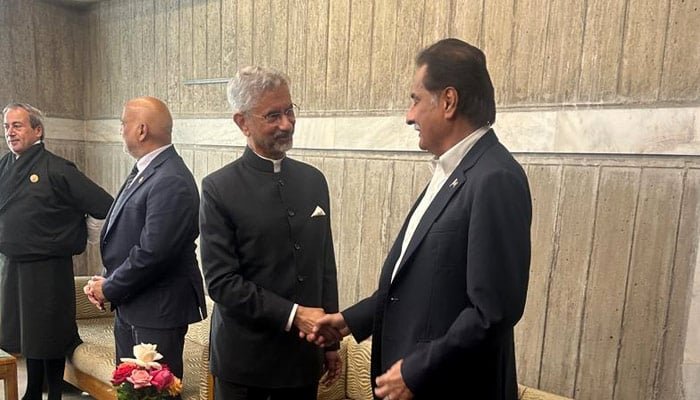

Historic Meeting at Khaleda Zia’s Residence
In a significant diplomatic development, National Assembly Speaker Ayaz Sadiq of Pakistan met Indian External Affairs Minister Subrahmanyam Jaishankar in Dhaka on Wednesday. The meeting took place at the residence of former Bangladeshi Prime Minister Khaleda Zia, sources said. Both leaders exchanged pleasantries and engaged in initial discussions, signaling a possible thaw in relations after months of heightened tension.
This meeting marks the first high-level interaction between Pakistan and India since May 2025, when the two nations engaged in a brief but intense war. The conflict, lasting four days, involved fighter jets, missiles, artillery, and drones, resulting in multiple casualties on both sides before a US-brokered ceasefire was agreed upon.
Background: Cross-Border Tensions and the Pahalgam Incident
The recent meeting comes in the aftermath of the Pahalgam incident, which triggered cross-border clashes between Pakistan and India. The incident involved an attack on Hindu tourists in Indian Illegally Occupied Jammu and Kashmir (IIOJK). New Delhi alleged, without presenting evidence, that Pakistan was behind the attack. Pakistan strongly denied any involvement, with the Foreign Ministry criticizing India’s account as “replete with fabrications.”
During the May 2025 conflict, Pakistan claimed to have shot down seven Indian fighter jets, including Rafale jets, while New Delhi acknowledged “some losses” but denied the reported scale. The clashes underscored the fragility of peace in the region and the risk of escalation between the two nuclear-armed neighbours.
Significance of the Dhaka Dialogue
The Dhaka meeting is being seen as a cautiously positive development, as both nations seek ways to manage tensions while avoiding further conflict. Holding the discussions at the residence of a former Bangladeshi premier also highlights Bangladesh’s role as a neutral ground for diplomacy.
Analysts suggest that while no major agreements were expected, the dialogue could lay the groundwork for more sustained communication channels, confidence-building measures, and potential collaboration on regional security issues.
The meeting is a reminder of the delicate balance in South Asia, where even minor incidents can escalate into larger confrontations. As both countries navigate past hostilities and recent provocations, this interaction could be the first step toward stabilizing bilateral relations in the region.
