

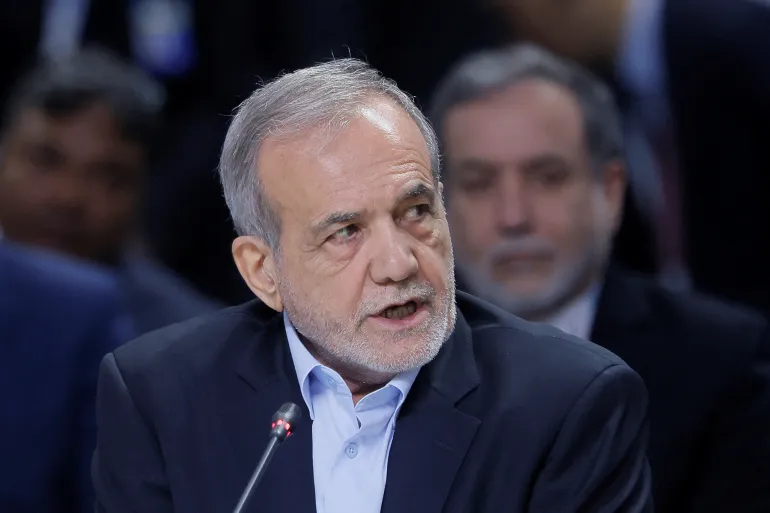

Iranian President Masoud Pezeshkian has issued a stark warning, claiming the United States, Israel, and Europe are engaged in a “total war” against Iran. He described the current situation as more complex and dangerous than the Iran-Iraq war of the 1980s. Moreover, he stressed that Iran now possesses stronger military capabilities and is prepared to respond decisively to any confrontation.
Speaking in an interview published on an official leadership platform, Pezeshkian said external powers aim to bring Iran to its knees. He argued that the pressure campaign extends beyond military action and includes political, economic, and psychological dimensions. According to him, this makes the present conflict far more intricate than previous wars. Consequently, Iran sees the situation as an all-encompassing struggle rather than isolated hostilities.
The president accused Western nations and Israel of pursuing internal destabilization inside Iran. He claimed such efforts seek to weaken the state from within and justify future interventions. At the same time, he rejected suggestions that Iran is vulnerable under pressure. Instead, he asserted that Iran has learned from past conflicts and strengthened its defensive posture accordingly.
Escalating regional and international tensions
These remarks follow months of heightened tensions involving Iran and its adversaries. Earlier this year, a series of Israeli and U.S. strikes targeted Iranian military and nuclear facilities. Iranian authorities reported significant casualties from these attacks. As a result, indirect nuclear negotiations between Tehran and Washington, which began in April, came to a halt.
Meanwhile, European pressure has also intensified. France, Britain, and Germany reimposed United Nations sanctions in September. They cited concerns related to Iran’s nuclear activities. Additionally, the United States revived a policy of maximum economic pressure under President Donald Trump. This policy included new sanctions targeting Iran’s economy and oil exports. Consequently, Iran now faces mounting diplomatic and financial constraints alongside security threats.
Iran’s military stance and warning
Pezeshkian emphasized that Iran’s military strength has grown since earlier attacks. He stated that any future confrontation would trigger a more forceful response. According to him, Iran’s adversaries underestimate its preparedness and resilience. Therefore, he warned that miscalculations could escalate the conflict further.
He also argued that hostile powers hope to exploit internal unrest. However, he insisted that Iran remains capable of countering such strategies. In his view, national unity and military readiness form the backbone of Iran’s defense. Thus, he framed Iran’s position as one of deterrence rather than provocation.
As regional uncertainty deepens, Pezeshkian’s remarks signal a hardened Iranian stance. They reflect Tehran’s belief that it is facing coordinated pressure on multiple fronts. At the same time, his warning underscores the risk of broader confrontation if tensions continue to rise unchecked.
