


In recent years, Pakistan has witnessed a renewed national debate about administrative restructuring, decentralization of power, and the creation of new provinces. These discussions stem from concerns over governance quality, uneven development, population pressures, and the mismatch between provincial capacities and local needs. Although Punjab often dominates this conversation due to its demographic and political weight, Khyber Pakhtunkhwa (KPK) offers an equally significant case for understanding how governance structures shape economic and social outcomes.
KPK, with its unique geography, youthful population, and history of conflict and resilience, stands at a defining moment. It is a province that has endured greater security and administrative challenges than any other region of the country, yet it continues to demonstrate remarkable social cohesion, innovation, and adaptability. For KPK, the question is no longer whether administrative restructuring is necessary, but what form that restructuring should take and how it can enable inclusive development.
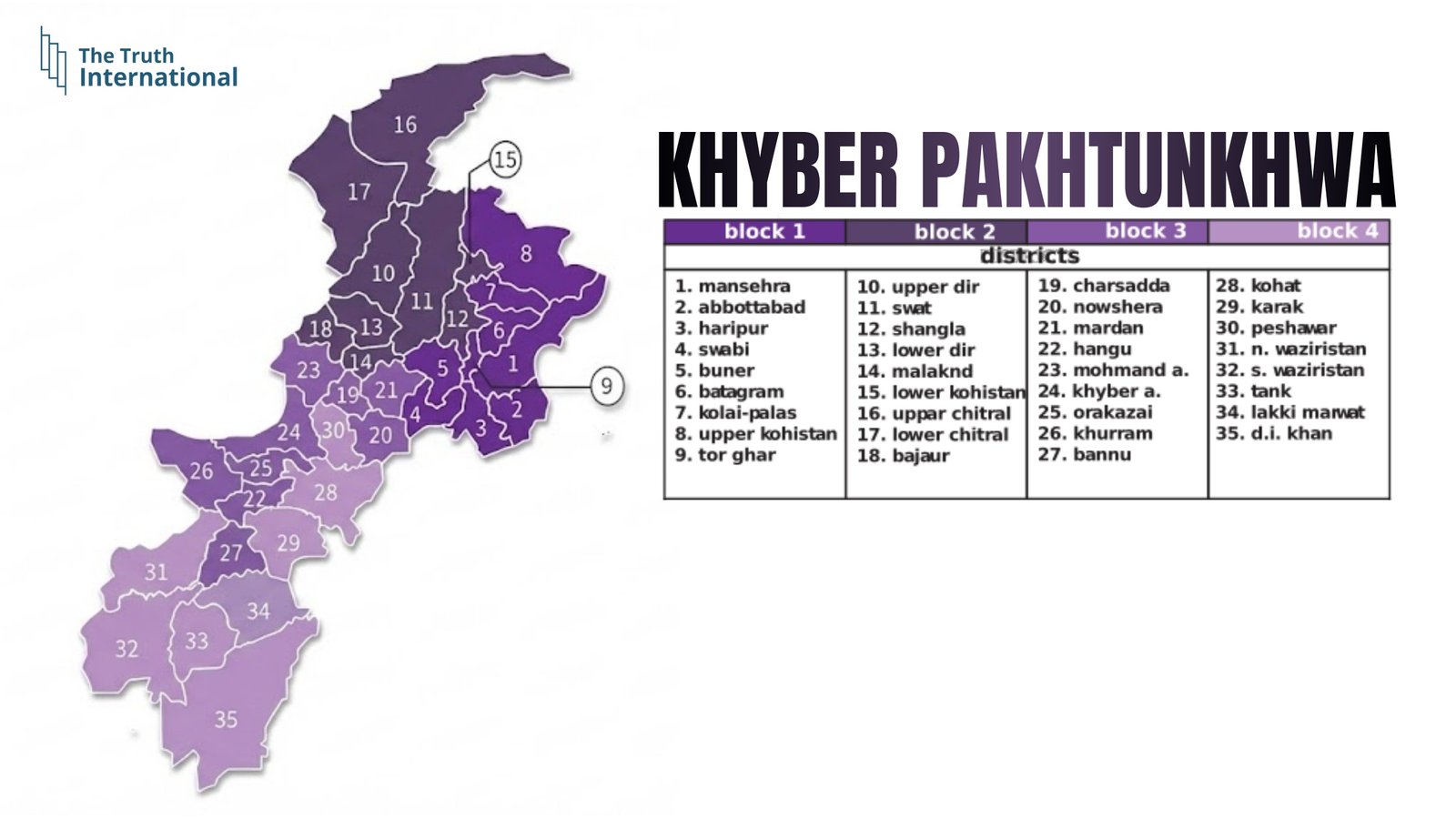
This article provides a deep analysis of Khyber Pakhtunkhwa’s demographic trajectory, historical evolution, administrative pressures, and economic possibilities. It integrates new district-level data, organized into four administrative blocks as shown in the accompanying map, and uses this structure to illustrate how KPK may benefit from region-specific governance models, potentially evolving into multi-zone or multi-province arrangements. Ultimately, the province’s future depends on whether its institutions can harness its human, cultural, and natural capital to deliver long-term prosperity.
Historical and Geopolitical Context
Khyber Pakhtunkhwa’s identity has always been shaped by its geography. Positioned at the crossroads of South Asia, Central Asia, and the Middle East, the province has long served as a strategic entryway for trade, migration, and military movements. From the Gandhara civilization flourishing in present-day Swat and Mardan to caravans traveling the ancient Silk Route through its rugged mountains, KPK has stood as a hub of cultural and commercial exchange. This historical richness, visible across districts such as Mansehra, Abbottabad, Charsadda, and Lower Dir, forms the foundation of its diverse contemporary landscape.
Yet this same geography has exposed the province to prolonged instability. The Soviet-Afghan War in the 1980s turned KPK, especially its western belt, into a humanitarian and military frontline, hosting millions of refugees. In the 2000s, the rise of militancy further disrupted socioeconomic life, leaving deep scars in districts now grouped under Block 2 and Block 3, including Swat, Bajaur, Mohmand, Khyber, and North Waziristan. Entire communities were displaced, schools and markets destroyed, and development halted for years. The newly merged districts in Block 4, such as South Waziristan and Tank, faced some of the harshest consequences, reflecting the uneven burdens carried across the province’s four administrative blocks.
Despite these shocks, the resilience of KPK’s people remains remarkable. Over the last decade, strengthened policing, community collaboration, and coordinated security operations have brought substantial stability to areas once engulfed by conflict. Mingora, Miranshah, and parts of Kurram and Orakzai, previously at the center of violence, now show signs of revival, from reopened schools to returning businesses and tourism. Nevertheless, the lingering effects of decades of conflict continue to shape governance priorities. The differing challenges faced by each block, from densely populated valleys in Block 1 to remote mountainous districts in Block 2, underscore the need for context-specific planning as Khyber Pakhtunkhwa navigates its future.
Population Pressures and the Challenges of Scale
Khyber Pakhtunkhwa’s population, now exceeding 40 million, is larger than that of many independent nations, including Iraq, Romania, and Australia. This demographic weight shapes every aspect of governance and development in the province. More than 60% of KPK’s residents are under the age of 30, creating both immense potential and significant strain. On one hand, this youthful population represents a powerful workforce capable of driving economic growth, entrepreneurship, and innovation. On the other, it places sustained pressure on the education system, job market, and public services, particularly in regions already struggling with limited infrastructure.
Population distribution across the province further complicates governance. Unlike Pakistan’s flatter provinces, KPK is dominated by mountains, deep valleys, and scattered high-altitude settlements. This uneven terrain makes even basic service delivery disproportionately difficult. Constructing a school or hospital in Upper Kohistan, Upper Dir, or parts of Chitral is far more costly and time-consuming than building the same facility in Peshawar or Mardan. Roads require constant maintenance due to landslides and harsh weather, while emergency services often face hours-long travel times to reach remote communities.
This geographic reality means that evaluating governance in KPK must account not only for administrative capacity but also for the structural challenges the province inherently faces. Effective planning, therefore, requires both realism about constraints and strategic investment tailored to KPK’s unique demographic and topographic profile.
Integrating the Ex-FATA Districts: A Historic but Difficult Reform
The 2018 merger of the former Federally Administered Tribal Areas (FATA) into Khyber Pakhtunkhwa stands as one of the most consequential administrative reforms in Pakistan’s history, fundamentally reshaping the province’s demographic, political, and governance landscape. The merger brought nearly five million new residents into KPK, many of whom lived in districts that had remained outside Pakistan’s mainstream administrative framework for decades. These regions, now part of districts such as Khyber, Kurram, Orakzai, Bajaur, Mohmand, and the Waziristans, previously lacked formal policing, judicial systems, and modern bureaucratic structures, operating instead under the Frontier Crimes Regulation and centuries-old tribal decision-making institutions. As a result, the task facing the provincial government is profoundly complex and unfolds along two demanding fronts. The first is institutional integration, which requires merging traditional structures, particularly the jirga system, with Pakistan’s constitutional governance, policing, and judicial framework while maintaining local legitimacy and cultural respect. The second is developmental integration: establishing schools, courts, hospitals, markets, communication networks, and local government bodies in regions where infrastructure was minimal or entirely absent. Many of these areas had been heavily affected by militancy and conflict, adding an additional layer of logistical and financial difficulty. Achieving meaningful transformation will require decades of sustained investment, culturally informed policymaking, stable administrative capacity, and strong coordination between provincial and federal authorities. The merger is therefore not a short-term project but a generational undertaking, one that, if seen through with commitment and sensitivity, has the potential to bring long-term stability, inclusion, and development to some of Pakistan’s most historically marginalized communities.
Block-Wise Structure: A Model for Administrative Restructuring
The map and dataset of Khyber Pakhtunkhwa divide the province into four major administrative blocks, each reflecting distinct geographic, economic, demographic, and cultural realities. Together, these blocks encompass the full range of KPK’s districts and illustrate why region-specific governance models are both necessary and increasingly discussed in provincial planning circles. The diversity between these blocks, spanning from densely populated valleys to remote mountainous corridors, shows that a uniform administrative approach is often insufficient, and that decentralization or zonal governance could significantly improve service delivery and long-term development outcomes.
Block 1
Districts include: Mansehra, Abbottabad, Haripur, Swabi, Buner, Battagram, Kolai-Pallas, Upper Kohistan, Lower Kohistan, Torghar.
Characteristics:
This block covers the Hazara and central-northern belt, known for its relatively strong educational outcomes, vibrant tourism industry, and moderate urbanization patterns. Abbottabad, Haripur, and Mansehra serve as economic and educational anchors, while the Kohistan belt represents some of Pakistan’s most rugged terrain, where infrastructure development remains challenging. The cultural and linguistic distinctiveness of Hazara has long fueled debates on whether a dedicated Hazara administrative zone, or even a sub-province, would allow for more responsive governance. This block’s mix of established cities and deeply remote areas makes it a compelling example of why administrative flexibility matters.
Block 2
Districts include: Upper Dir, Swat, Shangla, Lower Dir, Malakand, Bajaur, Upper Chitral, Lower Chitral, Dir areas, Bannu .
Characteristics:
This block represents the core of KPK’s high-altitude tourism economy. With world-renowned destinations such as Swat, Malam Jabba, Kumrat, and Chitral, the region plays a major role in tourism, hospitality, and ecological conservation. However, its mountainous terrain, harsh winters, and vulnerability to natural disasters demand specialized governance. Road connectivity, tourism regulation, environmental protection, and sustainable development are central priorities. Many policymakers and local groups advocate for a Northern or Malakand administrative zone that could streamline decision-making and ensure more focused investment across this geographically sensitive belt.
Block 3
Districts include: Charsadda, Nowshera, Mardan, Hangu, Mohmand, Khyber, Orakzai, Kohat, Kurram.
Characteristics:
Block 3 forms a transitional region that blends urban growth corridors with districts from the newly merged areas. Mardan and Nowshera function as major urban and commercial hubs, while Mohmand, Khyber, Orakzai, and Kurram continue to navigate the complex process of post-merger administrative integration. Here, governance requires a hybrid approach: strengthening established municipal institutions while simultaneously building judicial systems, policing structures, and basic service networks in former tribal territories. This block demonstrates the administrative challenge of aligning mature city systems with emerging governance frameworks.
Block 4
Districts include: Lakki, Karak, Peshawar, North Waziristan, South Waziristan, Tank, Baittani region, Dera Ismail Khan.
Characteristics:
This block stretches across the southern plains and includes both merged districts and the urban core anchored by Peshawar. It combines arid agricultural zones, emerging hydropower potential, security-sensitive border regions, and a capital city struggling with rapid population growth. Governance needs here range from water management and agricultural modernization to counter-terrorism stabilization and metropolitan planning. Long-standing proposals for a Southern KPK administrative zone centered on Dera Ismail Khan or Kohat arise from the belief that the region’s unique challenges warrant a dedicated administrative structure.
Together, these blocks reveal that KPK is too diverse for a single centralized administrative model. Each block has different terrain, population density, cultural traditions, economic potential, and security needs. Thus, the block-wise data provide a concrete framework for discussing future provinces or sub-provincial zones, rooted not in politics but in administrative logic.
Education and Human Capital: The Foundation of Progress
Khyber Pakhtunkhwa (KPK) continues to face a significant challenge with low literacy rates, particularly among women. In some of the recently merged districts, female literacy remains alarmingly below 10%, reflecting deep-rooted educational disparities. This educational deficit limits opportunities for economic growth, social development, and the empowerment of women, creating a cycle of poverty and inequality. To address these challenges, KPK must prioritize modernizing schools, ensuring access to quality education in both urban and rural areas. Additionally, establishing technical institutes and upgrading existing universities across all four provincial blocks is crucial to equip the youth with relevant skills for the modern workforce. Without these strategic interventions, the province risks falling behind in the global knowledge economy, unable to compete in industries that demand innovation and technical expertise. Investing in comprehensive educational reform is therefore essential for KPK’s sustainable development and societal progress.
Economic Diversification and Industrial Development
Khyber Pakhtunkhwa’s (KPK) economy relies primarily on agriculture, remittances, small workshops, and mining, yet the province’s diverse geography and resources demand a differentiated economic strategy. Each of KPK’s four blocks has unique strengths that require tailored interventions to maximize growth and development.
Block 1, with its natural beauty and potential for human capital development, is well-suited for tourism, hydropower, education, and service-sector expansion. Investment in infrastructure, hospitality, and renewable energy can generate jobs while attracting domestic and international visitors. Block 2 offers rich forestry and mineral resources alongside opportunities for eco-tourism, but sustainable management of these assets is critical to prevent environmental degradation and ensure long-term economic returns.
Block 3, encompassing the Nowshera-Mardan industrial belt, benefits from proximity to CPEC corridors and existing industrial zones. Targeted incentives, infrastructure upgrades, and skill development programs can transform this block into a manufacturing and trade hub, fostering both local employment and export potential. Meanwhile, Block 4, characterized by arid zones and agricultural reliance, requires investments in water management, logistics, and mineral exploitation. Modern irrigation, storage, and transport solutions will strengthen agricultural productivity and connect local producers to wider markets.
Without a block-specific industrial and economic policy, KPK risks underutilizing its diverse resources and missing opportunities for inclusive growth. A strategic, regionally differentiated approach can unlock the province’s full potential, drive sustainable development, and create employment opportunities across sectors, ensuring KPK contributes meaningfully to Pakistan’s broader economic trajectory.
Tourism: The Sleeping Giant of KPK’s Economy
Khyber Pakhtunkhwa (KPK) boasts some of Pakistan’s most breathtaking landscapes, from Kaghan and Naran to Swat, Dir, and Chitral, yet these natural assets remain largely underutilized. The province has immense potential to attract both domestic and international tourists but realizing this requires a strategic shift toward world-class tourism infrastructure. Investments in cable cars, eco-resorts, regulated hotels, and trained local guides are essential to provide a safe, enjoyable, and sustainable experience for visitors. Additionally, protecting fragile ecosystems and valleys will preserve the region’s environmental and cultural heritage, ensuring tourism growth does not come at the cost of nature.
Block 2, with its mountains, forests, and mineral-rich landscapes, stands out as a prime candidate for developing global-standard mountain tourism. By combining adventure tourism, eco-tourism, and hospitality training, the province can position Block 2 as a hub for international travellers seeking unique experiences. Such focused development will generate employment, boost local economies, and establish KPK as a premier tourism destination on the world map.
Urbanization and Modern Governance
Rapid urban expansion in Khyber Pakhtunkhwa’s major cities, Peshawar, Mardan, Swabi, and Mingora, is putting immense pressure on outdated municipal systems. Existing infrastructure struggles to cope with rising populations, increasing traffic congestion, inadequate waste management, and environmental degradation. Without proactive planning, these cities risk facing worsening pollution, unregulated construction, and declining quality of life for residents.
Each block requires a tailored, city-specific masterplan that addresses its unique challenges and growth patterns. Comprehensive transport planning, including public transit networks and road expansions, is essential to ease mobility and reduce congestion. Zoning regulations must balance residential, commercial, and industrial development while preserving green spaces and cultural heritage. Effective waste management systems, water supply upgrades, and environmental protection measures are critical to sustainable urban living.
By implementing forward-looking, block-specific urban strategies, KPK can transform its growing cities into well-organized, livable, and resilient urban centers, capable of supporting economic activity, social development, and long-term sustainability.
Security and Police Reforms
Khyber Pakhtunkhwa’s police reforms of the mid-2010s set a national benchmark, modernizing law enforcement, enhancing accountability, and improving public trust. These reforms strengthened operational efficiency, introduced better training programs, and emphasized citizen-focused policing. However, evolving security challenges, especially in the merged districts, demand renewed attention and investment. Rising threats from organized crime, insurgency, and cross-border activities require a shift toward intelligence-led policing, leveraging technology, data analytics, and proactive threat assessment.
Equally important is community engagement, which builds public cooperation, enhances situational awareness, and fosters trust between law enforcement and citizens. Strengthening local police presence, improving training in human rights and crisis response, and integrating modern communication systems are critical for effective law enforcement. Sustained investment in these areas will ensure KPK’s police remain adaptive, professional, and capable of maintaining peace in both urban centers and the more complex security environments of the merged districts, safeguarding public safety while upholding democratic norms.
Why New Provinces or Administrative Zones Matter
Using the block-based structure, it becomes evident that Khyber Pakhtunkhwa (KPK) may benefit from 3–4 administrative zones, each empowered with governance autonomy. Such a structure would enable more localized decision-making, tailored development strategies, and efficient resource allocation, addressing the distinct socio-economic and geographic characteristics of each block.
- Hazara Province / Zone (Block 1)
- Malakand-Dir-Chitral Province / Zone (Block 2)
- Central KPK Province / Zone (Block 3)
- Southern KPK Province / Zone (Block 4)
By creating these administrative zones, each region can focus on its unique priorities. Hazara’s emphasis could be on tourism, education, and hydropower development, while Malakand-Dir-Chitral could concentrate on eco-tourism, forestry, and sustainable mineral extraction. Central KPK, encompassing industrial hubs such as the Nowshera-Mardan belt, could prioritize industrialization, trade facilitation, and infrastructure aligned with CPEC connectivity. Southern KPK, with its agricultural and arid landscapes, would benefit from targeted water management, logistics, and agricultural modernization policies.
These structural proposals align with international examples where multi-layered governance promotes balanced development. India’s Uttarakhand demonstrates how regional autonomy can accelerate development in mountainous and resource-rich areas. Similarly, Nigeria’s federal model and Malaysia’s state-based governance showcase how decentralized authority enables better local planning, improved service delivery, and economic growth tailored to regional strengths.
Implementing such a zonal governance framework in KPK would foster inclusive development, enhance accountability, and allow each block to fully leverage its potential while contributing to the province’s overall progress. This approach ensures that economic, social, and environmental planning is context-specific, sustainable, and responsive to local needs.
A Vision for KPK’s Future
Khyber Pakhtunkhwa’s governance transformation must prioritize a multi-faceted and forward-looking approach to address longstanding challenges and unlock the province’s full potential. Administrative decentralization is critical to ensure that decision-making is closer to the communities it affects, allowing policies to reflect local needs and priorities. Empowering local governments will enhance accountability, improve service delivery, and foster citizen participation in governance. Modernizing and digitizing land systems is equally essential to streamline property management, reduce disputes, and encourage investment. Education reform remains a cornerstone for long-term development, addressing low literacy rates, particularly among women, and creating a skilled workforce ready to meet the demands of a modern economy. Sustainable tourism development, leveraging KPK’s natural and cultural assets, can generate employment while preserving the environment, while industrial diversification across all four blocks ensures that economic growth is resilient and inclusive. Integrating the merged districts through tailored policies and infrastructural development will promote social cohesion and equitable progress. Urban master planning in rapidly expanding cities like Peshawar, Mardan, Swabi, and Mingora is necessary to manage congestion, improve transport, and protect the environment. Finally, transparent, long-term policy continuity is crucial to instill investor confidence, maintain developmental momentum, and avoid the pitfalls of short-termism. Only by addressing these interconnected priorities can KPK transform its historical struggles into a sustainable platform for growth, ensuring prosperity, stability, and improved quality of life for all its citizens.
Conclusion
Khyber Pakhtunkhwa stands at a historic turning point. Its people have endured immense challenges yet remain resilient, dynamic, and hopeful. Its geography, once an obstacle, is now an asset rich in tourism opportunities, minerals, and hydropower potential. Its young population is an engine waiting to be activated by good governance.
The block-wise administrative structure provides a practical roadmap for future development, highlighting the need for decentralization and region-specific planning. If KPK adopts visionary governance reforms, empowers local leadership, and restructures itself around its diverse regional realities, it can become one of Pakistan’s most successful and transformative provinces.
