


ISLAMABAD: Punjab is the largest province in Pakistan by population. Its total population is, more or less, around 120 million (12 crore) in 2025. The total area of the Punjab province in Pakistan is 205,344 square kilometers. It is the second-largest province in Pakistan by area and the most populous province. Punjab means the land of the five rivers. The province produces more than 70 percent of the staple foods (wheat, rice, etc.) for the entire country. When we look at Punjab’s population, it is at par with Japan’s (120 million). For decades, Japan has been at the top of the nations with massive development in technology, modernization, exports, industrialization, innovation, and among the top-10 economies globally. The whole world acknowledges the development in Japan, in almost all spheres of life. Nevertheless, when we look at Punjab province, it stands nowhere in modernization, development, industrialization, and other aspects of modern life. Poverty, corruption, bad governance, rising crimes, nepotism, unemployment, lack of justice, and basic amenities are some of the hallmarks of the Punjab province.
After Japan, South Korea has a population less than half that of Punjab (51.75 million in 2024, according to World Bank data). South Korea is also among the top 15 economies in the world. Its annual exports are more than 700 billion dollars. South Korea is famous globally for its growing industrialization, modernization, and technological advancements.
Likewise, Malaysia’s population is just 35 million as compared to 120 million in Punjab province. However, Malaysia has gained fame across the globe for its technological advancement, tourism growth, and a stronger economy. Unfortunately, Punjab stands nowhere in comparison with Malaysia, South Korea, and Japan. These are just a few examples of the countries having equal or fewer than Punjab’s population, but they are growing by leaps and bounds.
The major challenges Punjab province has been facing for decades were poverty, poor governance, lack of adequate employment opportunities, and transparent distribution of development funds, and inadequate basic social amenities for 120 million people in the province. Frankly speaking, urban development in Punjab has been Lahore-centric for years, while other key cities, sub-urban and rural areas are plagued with multiple problems.
When we look at the system in Punjab, the governance exists in the dictionary only, while in practice, the governance system is rarely witnessed in the largest province of Pakistan, because of the hold of a few families on the entire system for many years.
Now we look at the key problems in the Punjab province in detail:
Poverty in Punjab Province
In 2024, the World Bank reported a 30 percent rate of poverty in Punjab with an increase of seven percent over the preceding year. In other words, more or less, over 40 million people in the province were living in poverty in 2024 _ some below the poverty line and others on the poverty line. The people living below the poverty line are those who don’t have proper meals (three times a day), no sewerage/toilet facilities, and without safe/clean drinking water. This has been happening in Pakistan’s largest province for decades. Though the poverty rate in the Punjab province is lower than in Balochistan, Khyber Pakhtunkhwa, and Sindh, still, millions of people don’t have access to basic amenities.
The sharp rise in poverty pushed nearly 13 million additional people below the poverty line in 2024, underscoring growing concerns about the country’s economic direction. The report noted that poverty has increased steadily since 2019, when 21.9% of the population lived below the national poverty threshold. It attributed the surge to the combined effects of the COVID-19 pandemic, the catastrophic 2022 floods, and a deepening macroeconomic crisis. These overlapping shocks, the World Bank stated, have eroded household resilience and worsened financial hardship.
Furthermore, record inflation has intensified the strain on low-income communities. Poor households, the report observed, experienced disproportionate welfare losses as rising prices for essential goods pushed them further into deprivation. Food and energy inflation, in particular, contributed to widening inequality across regions and income groups. To produce its projections, the World Bank employed a microsimulation model that integrates household survey results with high-frequency macroeconomic data. However, it cautioned that the absence of an updated household survey remains a major obstacle to accurately tracking poverty dynamics and evaluating the impact of government policies.
Unemployment in Punjab
According to the survey of the Planning Division, unemployment in the Punjab province has increased to more than 7 percent in 2024. In simple words, millions of people were jobless in 2024 in the largest province of Pakistan. Hence, lack of jobs is among the key challenges for the Punjab rulers and the policy makers.
Energy Deficiency & Lack of Social Development
Punjab has been grappling with deep-rooted economic challenges that have intensified in recent years. The province has been experiencing a deficiency in energy, falling public and private investment, and weakening industrial and agricultural productivity. Gas shortage is common across the province, while frequent power outages and planned load-shedding schedules often cripple social and economic activities in the province. These chronic problems have triggered unemployment, and a growing number of households have been living below the poverty line.
Meanwhile, Punjab’s economic growth potential could not be realized without improved governance. Experts believe that inadequate governance systems, weak service delivery, and fiscal constraints have collectively hindered development outcomes in the province. A massive investment in social sectors such as health, education, water supply, and key production sectors, including agriculture and manufacturing, is crucial for sustainable and inclusive growth.
The Proposed New Boundaries for Punjab
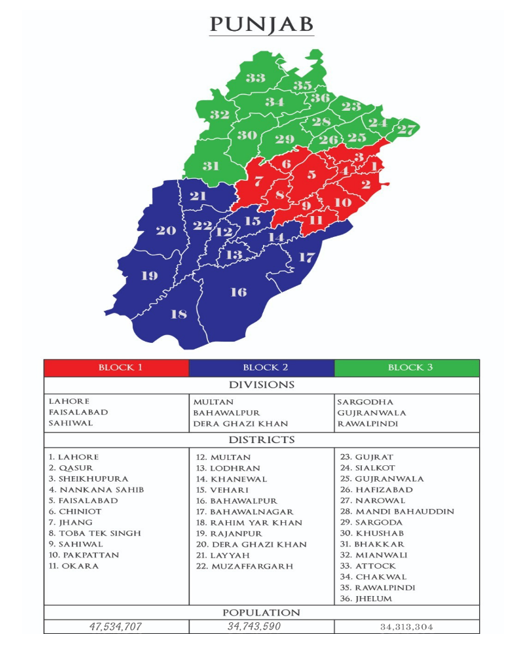
The Truth International is a Pakistani think-tank involved in creating awareness about better governance and policy-making, which can bring desired changes in the governance system in Punjab, Pakistan, and improve the provision of basic amenities to the people. TTI has evolved a map and a roadmap for the new provinces along with their proposed boundaries and population. For example, the map suggests the creation of a total of three provinces in Punjab. The names of the new provinces can be finalized in consultation with the key stakeholders _ politicians, leading businessmen, lawyers, and other renowned leaders in the province. Public surveys can also be conducted to select the names for new provinces.
1st Province in Punjab
The first province of Punjab will consist of three Divisions _ Lahore, Faisalabad, and Sahiwal. The districts falling in this province are Lahore, Kasur, Sheikhupura, Nankana Sahib, Faisalabad, Chiniot, Jhang, Toba Tek Singh, Sahiwal, Pakpattan, and Okara. The total population of this province will be around 47.535 million (47,534,707).
2nd Province in Punjab
The second province in Punjab will also have three Divisions _ Multan, Bahawalpur, and Dera Ghazi Khan, having more than 34.743 million population.
Districts in the region
The districts falling in the jurisdiction of the province are Mulan, Lodhran, Khanewal, Vehari, Bahawalpur, Bahawalnagar, Rahim Yar Khan, Rajanpur, Dera Ghazi Khan, Layyah, and Muzaffargarh.
3rd Province in Punjab
The third province in Punjab comprises three Divisions _ Sargodha, Gujranwala, and Rawalpindi.
Districts in this Region
The districts included in this region are Gujrat, Sialkot, Gujranwala, Hafizabad, Narowal, Mandi Bahauddin, Sargodha, Khushab, Bhakkar, Mianwali, Attock, Chakwal, Rawalpindi, and Jhelum. The total population of this province will be more or less 34.313 million. Hence, the map and roadmap of The Truth International give a clear picture of the new provinces to be established in Punjab. In this article, we also look at the past efforts for the creation of more provinces.
The Past Efforts for New Provinces
In the past, some concerted efforts have been made for the creation of new provinces in Punjab. The National Assembly and the Punjab Assembly have also approved the Resolutions to set up new provinces in 2012. Unfortunately, the resolutions could not be implemented because of the lack of political will.
“West Punjab” Bill Triggers New Provinces Debate
In August 2025, MNA Riaz Fatyana presented a bill in the National Assembly, seeking constitutional amendments to create the “West Punjab” province in the Punjab. This bill triggered the long-standing debate over creating new provinces in Pakistan’s political landscape, following the submission of a fresh constitutional amendment bill in the National Assembly. Despite several previous attempts that yielded no concrete outcome, legislators have revived discussions over administrative restructuring, this time through a proposal to carve a new province named West Punjab out of the existing Punjab.
Moved by MNA Riaz Fatyana, the bill sought amendments to multiple constitutional articles with the aim of redefining Punjab’s administrative boundaries. Fatyana has previously championed similar proposals in the past. In 2019, he advocated for the creation of Southern Punjab, Bahawalpur, and Hazara provinces, and requested the formation of a parliamentary committee to refine the legislation. His renewed effort reflected a persistent push among certain lawmakers to decentralize power and improve governance in densely populated regions.
According to the latest proposal, the new province of West Punjab would consist of the Faisalabad and Sahiwal divisions. Fatyana confirmed that the bill has been forwarded to the relevant standing committee for detailed deliberation, signaling the beginning of a renewed review process rather than immediate legislative action. The bill outlines a structural framework for the proposed province. West Punjab’s provincial assembly would include 58 seats, divided into 46 general seats, 10 reserved for women, and 2 for non-Muslim members. The draft further suggests establishing an independent high court with Faisalabad as its principal seat. It also calls for Senate representation through five seats allocated to the new province.
Resource distribution remains central to the proposal. The bill mandates the Council of Common Interests (CCI) to finalize the division of resources, assets, liabilities, and employees between Punjab and West Punjab within three months of the amendment’s passage. This provision highlights the administrative complexity of altering provincial boundaries and the need for a coordinated institutional response. The statement of objects and reasons attached to the bill argues that creating West Punjab is essential to addressing mounting administrative pressures. Advocates contend that the current provincial structure struggles to accommodate rapid population growth, uneven service delivery, and governance inefficiencies. By dividing Punjab, supporters believe the state can manage administrative burdens more effectively and respond to regional needs with greater precision.
However, the proposal enters a political environment historically cautious toward provincial restructuring. Previous efforts faltered due to disagreements over boundaries, political motivations, and resource implications. The progression of this bill will therefore depend on consensus-building within parliament and alignment between federal and provincial stakeholders. While the resubmission of the proposal has reignited debate, its future remains uncertain. What is clear, however, is that the conversation around new provinces — particularly in Punjab — continues to reflect broader concerns about equitable governance, administrative efficiency, and political representation in Pakistan’s evolving federal structure.
Commission for the creation of new provinces in Punjab
Earlier, in July 2012, the Speaker of the National Assembly constituted a Commission, headed by PPP’s Senator Farhatullah Babar, for the creation of new provinces in Punjab. Senators Syeda Sughra Imam, Haji Mohammad Adeel, Kamil Ali Agha, Malik Muhammad Rafique Rajwana, Moulana Abdul Ghafoor Haideri, and MNAs Arif Aziz Sheikh, Jamshaid Ahmad Dasti, Syed Ali Musa Gilani, Tahmina Daultana, Ch. Saud Majeed and Dr. Muhammad Farooq Sattar were among the members of the Commission who recommended new provinces in Punjab.
National and Punjab Assemblies’ Resolutions for new provinces
Meanwhile, in May 2012, then Law Minister Farooq H. Naek issued a circular about the Resolution approved by the National Assembly for the creation of a new province. According to the Resolution, “This House resolved that to address the grievances and to secure the political, administrative, and economic interests of the people of Southern Punjab of the province of the Punjab and to empower them in this regard, it was important that a new province to be known as the province of “Janoobi Punjab” be created from the present province of the Punjab. The House, therefore, called upon the Punjab Assembly to present a Bill in the lower house to amend the constitution in accordance with article 239(4) of the Constitution of the Islamic Republic of Pakistan, 1973, for passage, which would have the effect of altering the limits of province of the Punjab, thereby creating the province of “Janoobi Punjab”.
Consequently, the Punjab Assembly passed a resolution supporting the creation of a new province for Bahawalpur. The lower House, therefore, urged the federal government to form a commission to achieve this ambitious goal. At that time, PML-N MPA Rana Sanaullah presented the resolution in the Punjab Assembly that was approved unanimously.
Unfortunately, since then, the formation of new provinces in Punjab has remained only in papers, discussions, resolutions, and commissions, and the dream of forming more provinces did not materialize.
Small Counties and Big Impact
Some of the most influential actors in global politics are not the largest countries. Instead, several small nations have developed strategic models that allow them to exert influence far beyond what their geographic size suggests. Their success shows that global relevance stems less from physical scale and more from deliberate focus, sharp policy choices, and the ability to occupy unique strategic niches.
Singapore offers one of the clearest examples of this phenomenon. Its population is only around 6.03 million in 2024, according to the World Bank data. The island nation transformed its lack of natural resources into a strategic advantage by building a highly efficient, rules-based economy. Its commitment to strong governance, infrastructure development, and economic openness helped it evolve into a major financial center. Beyond economics, Singapore has also cultivated a reputation as a neutral mediator. Its political stability and non-threatening size make it a preferred venue for sensitive negotiations between major powers. By positioning itself as a trusted facilitator, Singapore shows how credibility and neutrality can become powerful diplomatic assets.
Switzerland demonstrates another model of influence built on neutrality and reliability. Its total population is more or less 9.03 million in 2024. Its well-known stance on non-alignment is not passive; it is a carefully managed diplomatic identity. Geneva’s role as host to many international organizations — including the United Nations’ European headquarters and the International Committee of the Red Cross — gives the country significant influence in global governance. Switzerland’s stability and impartiality allow it to function as a central convening point for international diplomacy. Its example underscores the value of building spaces where global decision-making naturally converges.
Qatar, with only 2.85 million people, illustrates how natural resources, when paired with strategic vision, can amplify national influence. Though small, the country used its natural gas wealth to cultivate energy partnerships with Europe and Asia. At the same time, investments in soft power — including the creation of Al Jazeera and hosting major global events such as the FIFA World Cup — elevated its international visibility. Qatar’s role as a mediator in regional disputes further strengthened its diplomatic profile, demonstrating how diversified influence helps small nations remain relevant.
Luxembourg (0.677 million population), despite its small size, became a financial powerhouse within Europe. Its strategic location and multilingual workforce helped the country develop a robust investment fund and private banking sector. Active participation in European Union financial rulemaking gives Luxembourg substantial influence in shaping regulations that apply across a major economic bloc. Its model shows how deep expertise in a critical sector can translate into significant global impact.
Estonia took a different path by embracing digital transformation after regaining independence. The country built a fully digital governance system, offering online services for voting, taxation, and healthcare. Its e-Residency program enables entrepreneurs worldwide to run EU-based businesses remotely, helping Estonia export its digital expertise. By specializing in a future-oriented niche, Estonia positioned itself as a global leader in digital governance and innovation.
These cases reveal a common thread: strategic clarity. Each nation identified a unique advantage — whether neutrality, digital innovation, energy resources, or financial specialization — and invested consistently in building global relevance around it. Their experiences highlight an important lesson for states and organizations alike: influence depends not on size, but on the ability to define a clear role and pursue it with purpose.
The examples of different countries’ populations and their economic and political might make it clear that good governance and economic prosperity are directly linked to the size of the population and apt decision-making. In Pakistan, Punjab is the largest province in population, and making the province an ideal place seems to be a distant dream in reality. Therefore, the best way to turn Punjab into an ideal place is to create new provinces. Punjab means the land of the five rivers. Punj (a Punjabi word for five) and Aab (an Urdu word for water) define the name and distinction of the province. It, nonetheless, does not mean that the new provinces should be created along the rivers (from the start to the end of each river). Not at all. A viable solution to the creation of new provinces is the roadmap floated by The Truth International. It gives a comprehensive solution to the new provinces in Punjab. With this strategy, at least three new provinces can be established in the Punjab. The motto behind the creation of new provinces should be the welfare of the masses, not the elite class. Since its Independence in 1947, the people of Pakistan have been waiting for a system that changes their fate, ends deprivation, and systematic exploitation.
