

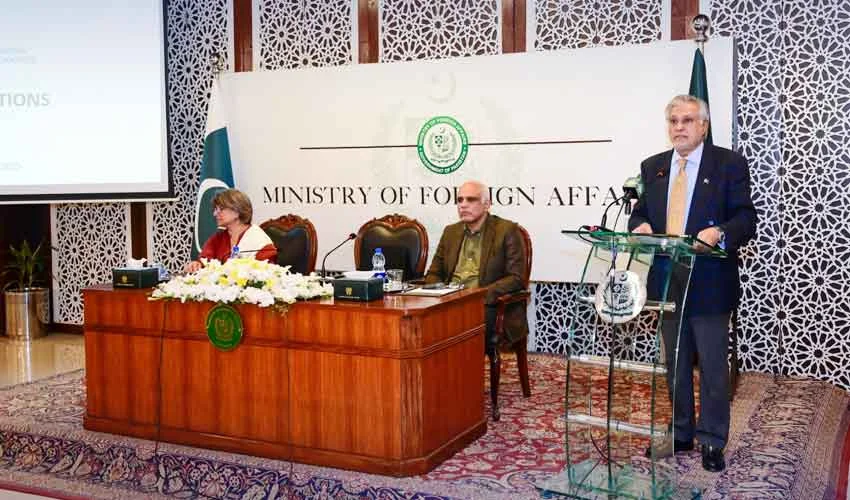

ISLAMABAD: Pakistan has strongly condemned India’s unilateral suspension of the Indus Waters Treaty, calling the move a clear violation of international law and a serious threat to peace in South Asia. Addressing foreign diplomats in Islamabad, Deputy Prime Minister and Foreign Minister Ishaq Dar warned that India’s actions endanger millions of Pakistani lives and undermine regional stability.
Dar said the Indus Waters Treaty remains a binding international agreement and cannot be suspended by one party alone. He stressed that India’s decision violates both international law and the Vienna Convention, adding that such conduct places long-standing regional peace arrangements under strain. According to him, the treaty serves as a stabilising mechanism between two nuclear-armed neighbours.
Despite rising tensions, Dar said Pakistan remains committed to the peaceful resolution of all disputes. However, he made it clear that Pakistan will not compromise on the water rights of its people under any circumstances.
Accusation of using water as a weapon
The foreign minister accused India of deliberately using water as a weapon by releasing water into the Chenab River without prior notification. He said such actions put downstream communities in Pakistan at serious risk, threatening lives, property and livelihoods.
Dar stated that India’s recent behaviour reflects a pattern of weaponising water resources. He warned that these actions pose direct risks to Pakistan’s national security, economic stability and public safety. He added that agriculture, which depends heavily on regulated water flows, faces severe disruption as a result.
Highlighting the scale of the threat, Dar said any attempt to stop or divert Pakistan’s allocated share of water under the treaty would be viewed as an act of war. He emphasized that water is the backbone of Pakistan’s economy and a lifeline for its people, and any disruption could lead to devastating humanitarian and economic consequences.
Concerns over data withholding and projects
Dar further accused India of withholding critical hydrological data and undermining the joint monitoring mechanisms established under the Indus Waters Treaty. He said India has failed to share essential technical information, which the agreement clearly requires.
He also raised concerns over Indian hydroelectric projects, including Kishanganga and Ratle, stating that they violate the treaty’s technical and design conditions. According to Dar, these projects have consistently raised objections from Pakistan due to their potential impact on downstream water flows.
Dar said Pakistan has pursued all available diplomatic and legal channels through the Indus Water Commission to address these violations. He reiterated that Pakistan has acted responsibly and strictly within the framework of international agreements.
Call for global action
Calling on the international community, Dar urged global stakeholders to ensure the full restoration of the Indus Waters Treaty. He warned that continued international silence would only embolden actions that threaten peace and stability in the region.
“The Indus Waters Treaty is not just a bilateral agreement; it is a cornerstone of peace in South Asia,” he said, urging immediate intervention to prevent further escalation. He also referred to recent remarks by India’s home minister, who publicly stated that the treaty would not be restored and that water would be diverted.
Dar concluded by reaffirming Pakistan’s stance that while it seeks peace, its water rights remain non-negotiable.
