


Chief of Defence Forces (CDF) and Chief of Army Staff (COAS) Field Marshal Asim Munir has reaffirmed Pakistan Army’s commitment to tackling all internal and external threats, ensuring national stability and operational readiness, according to the Inter-Services Public Relations (ISPR).
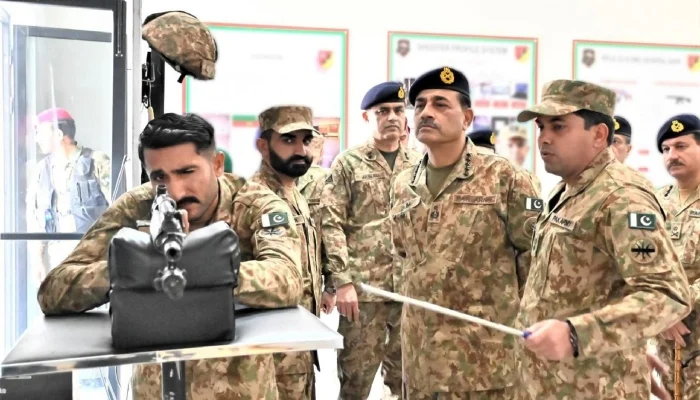
During visits to the Gujranwala and Sialkot Garrisons on December 13, 2025, Munir was briefed on key initiatives to strengthen combat preparedness and witnessed field training exercises and advanced simulator sessions, praising the troops’ professionalism and high morale.
Munir emphasized that the Army remains fully focused on internal and external challenges, including extremist ideologies, divisive elements, and hostile hybrid campaigns. He highlighted the importance of technological adaptability, agility, precision, situational awareness, and swift decision-making in modern warfare.
While interacting with officers and soldiers, Munir lauded their commitment to national security and stressed rigorous, mission-oriented training as crucial for operational effectiveness.
The CDF — who was promoted to the rank of Field Marshal earlier this year — will concurrently serve as Chief of Army Staff for five years.
His appointment follows the parliamentary approval of the Pakistan Army, Air Force, and Navy (Amendment) Bills 2025 and presidential assent, establishing the unified Defence Forces Headquarters (DHQ) and extending Field Marshal powers to appointed generals.
During his visit, Munir also addressed regional security issues, warning India of a “more severe response” to any future aggression and confirming that Pakistan has sent a clear message to the Afghan Taliban regarding cross-border threats. He reaffirmed Pakistan’s stance as a peace-loving country while underlining that the country’s sovereignty, territorial integrity, and resolve will not be challenged.
Munir described the establishment of the CDF as a “historic” step necessary to enhance multi-domain operations under the unified command of the Army, Air Force, and Navy, reflecting a significant evolution in Pakistan’s military structure.
