

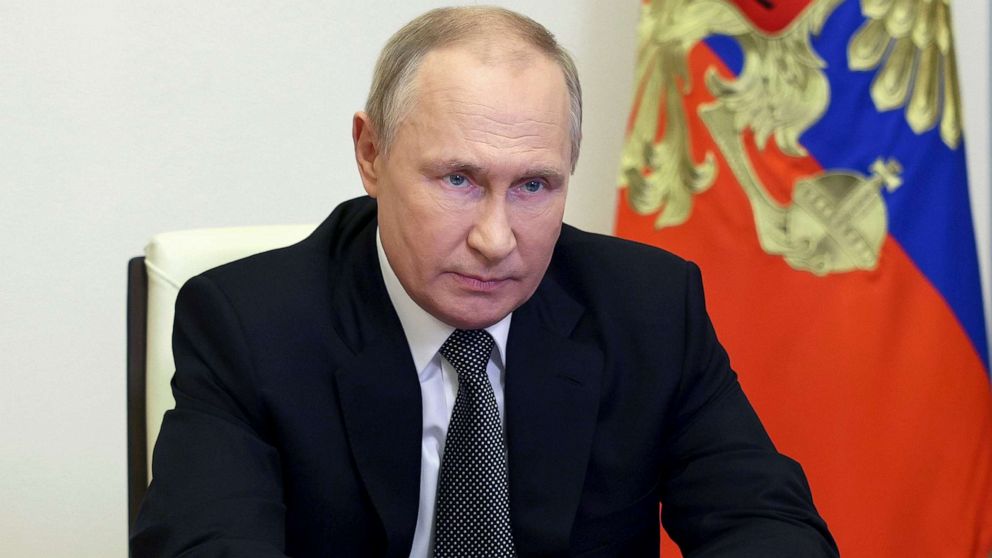

President Vladimir Putin has warned that Russia will take full control of Ukraine’s Donbas region. He stressed that this would happen either through military action or through a withdrawal of Ukrainian troops. Kyiv has firmly rejected the idea and stated that surrendering territory remains unacceptable.
Putin gave this warning during an interview ahead of his planned visit to New Delhi. He said Russia would not step back from its aim. According to him, Donetsk and Luhansk must come under Russian authority. He added that Ukrainian troops must leave the region or face intensified military action.
Ukraine insists that it will not cede land to Russia. President Volodymyr Zelensky has repeatedly argued that rewarding aggression encourages further conflict. Kyiv maintains that Moscow has failed to secure many of its objectives on the battlefield and therefore seeks gains through pressure and threats.
Wider Territorial Control Claimed by Moscow
Russia currently controls a significant portion of Ukraine’s territory. This includes Crimea, which Russia annexed in 2014. Moscow also holds all of Luhansk, most of Donetsk, and large parts of Kherson and Zaporizhzhia. It also occupies smaller areas in Kharkiv, Sumy, Mykolaiv and Dnipropetrovsk.
Despite this, Ukraine still holds about 5,000 square kilometres of Donetsk. These areas remain heavily contested. Fighting has continued, and neither side appears willing to compromise.
Russia has told the United States several times that any peace framework must recognise Moscow’s control over the entire Donbas. Russian officials argue that the region is non-negotiable. They also insist that the United States should acknowledge the new territorial boundaries informally before any lasting peace can be achieved.
Declared Annexations Continue to Deepen the Standoff
In 2022, Russia declared that Donetsk, Luhansk, Kherson and Zaporizhzhia were now part of the Russian Federation. Moscow claimed this was the result of local referendums. These votes were rejected by Ukraine and most of the world. Many countries insist that these regions remain part of Ukraine according to international law.
The dispute over Donbas remains the core obstacle to meaningful diplomacy. Neither side is willing to step back. Ukraine says that peace cannot come at the cost of giving up territory. Russia argues that the areas have already joined its federation and must be recognised as such.
Meetings With U.S. Figures Add New Dimension
Putin recently met two American envoys, Steve Witkoff and Jared Kushner, in Moscow. He described the meeting as productive and said Russia had accepted parts of the U.S. proposals regarding Ukraine. He noted that these ideas were similar to discussions he held with Donald Trump during a meeting in Alaska earlier this year.
Although details remain unclear, the talks show that unofficial channels are still active. Both sides appear interested in exploring possible outlines for a future agreement. However, the unresolved question of full Donbas control remains the major barrier.
Russian Strikes Intensify as Winter Approaches
While political negotiations take place, the fighting has grown more intense. Russian nighttime strikes on Odesa and Kherson have disrupted essential utilities. Tens of thousands of residents have been left without heating or electricity. These attacks have increased as temperatures drop.
Officials in Odesa said a key energy facility suffered damage during overnight strikes. Around 51,800 households lost power as a result. Repair crews have been working, but the scale of the damage has slowed progress.
In Kherson, continuous shelling forced the shutdown of a heat and power plant. About 40,500 customers were left without heat. Local authorities said the facility suffered serious damage and that restoring services would take time.
Kherson remains a frontline city and faces daily missile, drone and artillery strikes. Many residents have struggled to cope with prolonged outages as winter draws closer.
Impact on Donetsk and Other Frontline Regions
Ukraine’s energy ministry said that strikes in Donetsk also caused major power cuts. Around 60,000 residents were left without electricity. Officials did not share details but confirmed that repairs were underway.
Russian attacks on energy infrastructure have become more frequent. Entire cities have faced blackouts. The strikes target power stations, heating plants and distribution lines. Ukraine says these attacks aim to break civilian morale.
Humanitarian Concerns Grow With Each New Strike
As the conflict enters another winter, humanitarian concerns are growing. Civilian areas have been hit repeatedly. Many families have been forced to leave their homes. Others remain at risk due to cold weather and a lack of essential services.
Local officials say the attacks show no signs of slowing. Emergency crews work daily to restore utilities, clear debris and support displaced civilians. The strain on resources has increased, and temporary shelters are filling quickly.
Donbas at the Center of a Deepening Crisis
Putin’s firm stance on Donbas signals that the conflict will continue. Russia views the region as strategically vital. Ukraine sees it as an integral part of its sovereignty. With no middle ground, both sides appear locked in a long struggle.
The recent escalation in attacks on southern Ukraine highlights how the war continues to evolve. Cities remain vulnerable, and infrastructure damage has become a defining feature of the conflict.
Political talks may continue, yet the situation on the ground suggests a prolonged standoff. Control of Donbas remains the heart of the dispute, shaping the future of the wider conflict.
