

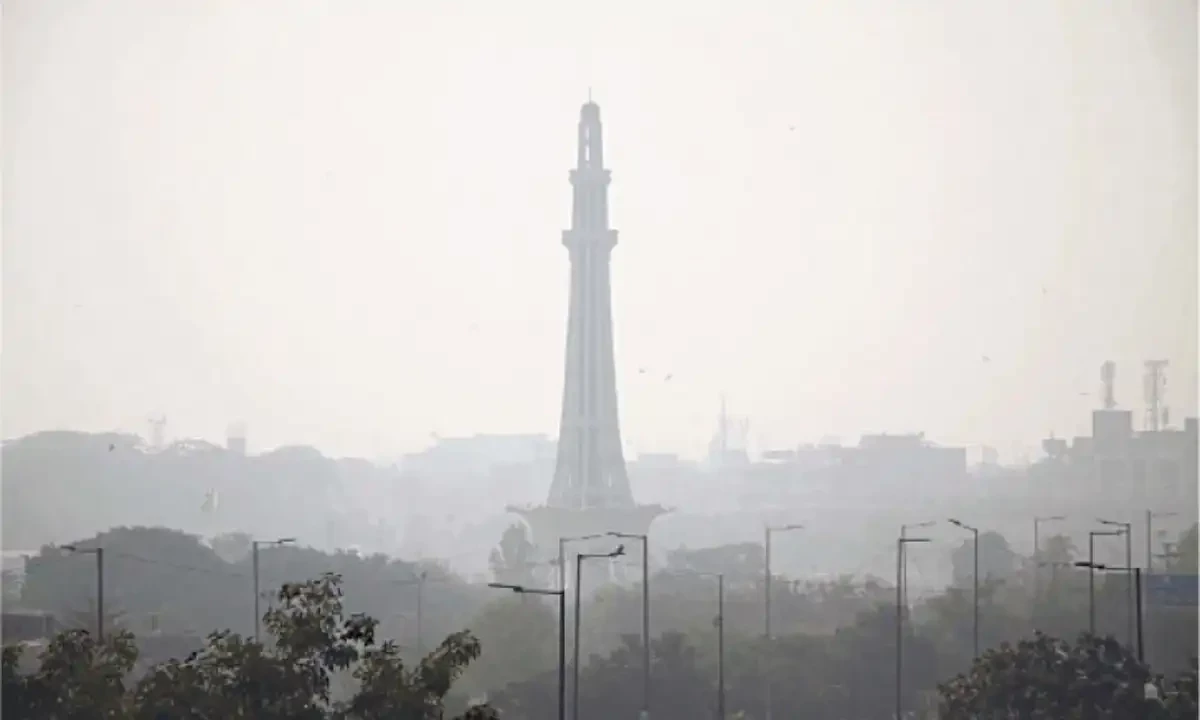

LAHORE: Smog is expected to worsen across Lahore and other Punjab cities, the provincial government warned today. Officials attributed the intensifying smog to local emissions and pollutants drifting from India after Diwali celebrations.
According to IQAir, Lahore ranked as the world’s third most polluted city in terms of air quality.
At 8 p.m., Lahore’s Air Quality Index (AQI) reached a “very unhealthy” 182, behind Kolkata (203) and New Delhi (213).
Government Launches Anti-Smog Operations
To combat rising pollution, the Punjab government began water sprinkling operations and activated anti-smog guns on Sunday night.
Authorities deployed these measures across major hotspots, including Shahdara Flyover, GT Road, Thokar Niaz Baig, and Allama Iqbal Town.
Officials advised citizens to limit outdoor activity, especially during early morning and late evening hours.
Winds from India Likely to Worsen Conditions
The Environment Protection Department warned that slow winds from New Delhi and other Indian cities are carrying pollutants toward Punjab.
These winds, blowing at 4–7 km/h, are expected to affect Lahore, Gujranwala, Faisalabad, Sahiwal, Multan, and Bahawalpur.
Pollutants from Diwali fireworks will also impact southern districts like Bahawalnagar and Rahim Yar Khan.
AQI Expected to Worsen Before Minor Improvement
The Punjab Smog Monitoring Centre predicted Lahore’s AQI to stay between 210 and 230 on Tuesday.
High pollution levels will persist in the morning and night, with slight improvement expected between 1 p.m. and 5 p.m.
Low wind speeds and the absence of rain will keep harmful particles suspended in the air.
Authorities Urge Public Cooperation
Punjab Senior Minister Marriyum Aurangzeb urged citizens to take simple steps to reduce smog.
She advised wearing masks while riding motorcycles and covering construction materials during transport.
Residents should also keep windows and doors closed to limit exposure to harmful air.
Crackdown on Smog Offenders
Lahore police arrested 83 individuals and registered 77 cases during an anti-smog operation.
Most arrests targeted emissions from factories, kilns, and vehicles. Others were caught burning tyres, plastics, and crop residue.
Police used Punjab Safe Cities Authority’s camera network to identify and trace polluters across different city zones.
Delhi Engulfed in Toxic Haze
Across the border, New Delhi remained covered in toxic smog after Diwali, with pollution levels soaring 16 times above WHO limits.
The Indian Supreme Court recently allowed “green firecrackers” that emit fewer pollutants, easing a previous blanket ban.
