

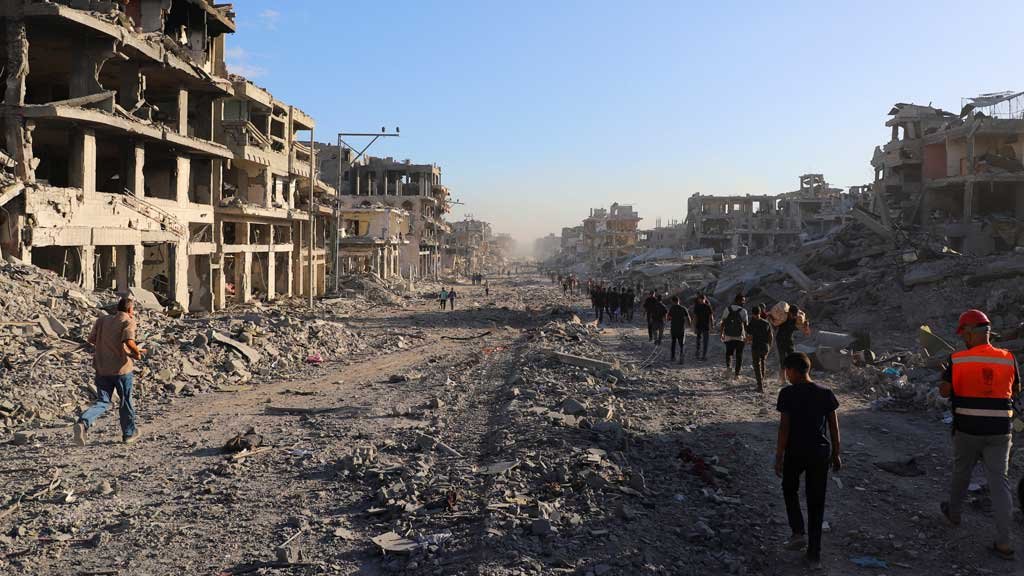

Thousands of displaced Palestinians began their long walk back to northern Gaza on Friday, following the announcement of a ceasefire between Israel and Hamas. The truce, which took effect at noon local time, has brought a fragile calm after months of devastating warfare that left much of the enclave in ruins.
Families, many carrying what little they had left, moved through the scorched and desolate landscape that was once their neighbourhoods. The coastal road toward Gaza City, once filled with tanks and debris, saw streams of men, women, and children heading north.
Ismail Zayda, 40, was among the returning residents. “Thank God my house is still standing,” he said while standing amid the wreckage of Sheikh Radwan district. “But everything around it is gone. My neighbours’ homes are dust.”
Life Amid Destruction: Survivors Return to Shattered Cities
In southern Gaza, the destruction was even more severe. Khan Younis, the enclave’s second-largest city, now lies in ruins after heavy bombardment. Survivors carefully picked their way across the wreckage, searching for remnants of their homes and belongings.
Ahmed al-Brim, a middle-aged man, was seen pushing a bicycle loaded with bundles of scrap timber. “We found nothing left,” he said. “No furniture, no clothes, nothing at all. We only took some wood for fire.”
The war displaced millions and turned entire cities into wastelands. Despite the devastation, returning residents expressed relief that they could finally walk back to the places they once called home.
Ceasefire Implementation and Conditions
According to the ceasefire deal, Israeli troops began withdrawing from Gaza’s urban centres within 24 hours of the truce. However, forces are expected to maintain control over more than half of the enclave to ensure security measures.
Prime Minister Benjamin Netanyahu said in a televised address that Israeli troops would stay in Gaza to ensure Hamas’s disarmament. “If Hamas disarms the easy way, good. If not, we will achieve it the hard way,” he said.
As the military began retreating, a slow trickle of displaced Palestinians turned into a flood, with families carrying mattresses, blankets, and bags on foot or on donkey carts.
Hostage Exchange and Humanitarian Aid
Under the ceasefire agreement, Hamas is required to release 20 Israeli hostages within 72 hours after the troop withdrawal. In return, Israel will release 250 long-term prisoners and 1,700 detainees captured during the war.
Humanitarian aid is also expected to surge into Gaza, with hundreds of trucks carrying food, water, and medical supplies crossing into the territory daily.
Brigadier General Effie Defrin, an Israeli military spokesperson, urged Gazans to avoid entering areas still under Israeli military control. “Keep to the agreement and ensure your safety,” he advised.
Despite the ongoing hardships, many Gazans said returning home—even to rubble—was a symbolic victory after years of displacement. Mahdi Saqla, 40, who fled with his family during the conflict, said they were determined to go back. “There are no homes left, but we are happy just to return to where our homes were,” he said. “Even over the rubble, it feels like hope.”
The ceasefire has brought a momentary pause to one of the deadliest conflicts in recent memory. Whether it marks the beginning of lasting peace or just another brief respite remains uncertain. For now, families continue to return, step by step, through the ruins—seeking to rebuild not just their homes, but their lives.
