

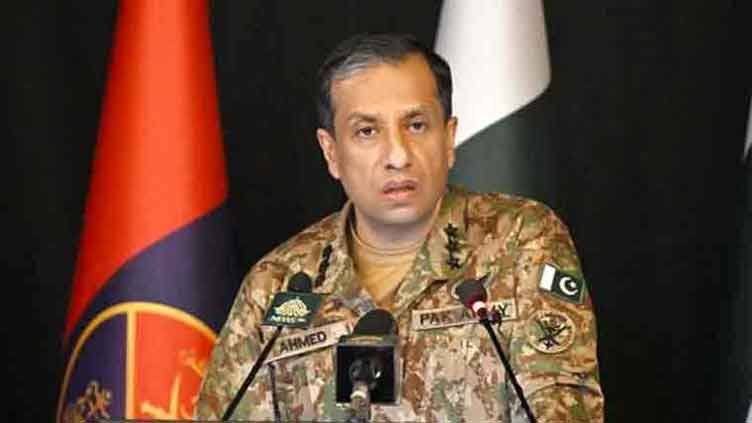

Lt Gen Ahmed Sharif Chaudhry highlights governance gaps, terrorism challenges, and ongoing security operations in Khyber Pakhtunkhwa
PESHAWAR: Inter-Services Public Relations (ISPR) Director General Lt Gen Ahmed Sharif Chaudhry on Friday urged the Khyber Pakhtunkhwa government to prioritize protecting its people instead of “begging Afghanistan” for support.
Addressing a press conference at the Peshawar Corps Headquarters, the DG ISPR said governance failures in the province were being paid for with the blood of security personnel.
“Appeasement of terrorists and their facilitators is never a policy,” he stressed. “The state and its institutions will not be affected by any political distortions.”
He added, “The state and its people cannot be left to the whims of any single person who is most responsible for bringing terrorism back to KP.”
‘Protect the People You Are Duty-Bound to Serve’
Lt Gen Chaudhry expressed hope that the provincial government would focus on governance and fulfill its duty to protect the people.
“We also hope that instead of begging Afghanistan, you will protect this province and its people,” he said.
The DG ISPR began the briefing by paying tribute to the “brave sons of the soil” from Khyber Pakhtunkhwa and said the purpose of the session was to review the province’s security situation.
Security Operations and Terrorism Statistics
He said Pakistan, particularly KP, had faced terrorism for over two decades. In 2024, the security forces conducted 1,435 intelligence-based operations in the province.
During these operations, 769 terrorists — including 58 Afghans — were killed. Meanwhile, 272 army and FC personnel, 140 policemen, and 165 civilians embraced martyrdom.
He added that from January to mid-September 2025, 10,115 operations were carried out in KP, resulting in the deaths of 970 terrorists, while 311 Pakistan Army personnel were martyred.
Although terrorism incidents increased from 2021 onwards, he noted, the state’s response and counter-operations also intensified, resulting in the elimination of more militants.
Roots of the Crisis and National Action Plan Implementation
Lt Gen Chaudhry said the security forces began a comprehensive counterterrorism drive after the 2014 Army Public School attack in Peshawar.
“We were close to achieving a peaceful KP,” he said. “But unfortunately, terrorists and their facilitators were again provided space here. Governance and welfare were deliberately weakened, and misleading narratives were built. The people of KP are now paying the price with their blood.”
He outlined several reasons behind the resurgence of terrorism:
-
Incomplete implementation of the National Action Plan (NAP)
-
Politicisation of counterterrorism efforts
-
Indian involvement using Afghanistan as a base
-
Modern weapons flow to terrorists from Afghanistan
-
A terrorism-crime nexus with local and political backing
Call for National Unity Against Terrorism
Recalling the consensus reached after the APS tragedy, he said all political parties had agreed to fully implement the NAP.
However, in 2021, parts of the plan were altered, undermining its progress. A revised NAP was later introduced, reaffirming all 14 points for implementation by federal and provincial governments.
Displaying a graphic of the plan, the DG ISPR said:
“The first point concerns kinetic operations. Are law enforcement agencies not conducting more than 40 intelligence-based operations in KP alone?”
He stressed that while progress had been made on kinetic actions, unity and consistency were missing in other areas.
“Do we all stand under one narrative? Do you not hear calls for talks with terrorists?” he questioned.
He concluded: “If dialogue is the solution to every issue, then why did no one call for talks when India fired missiles on Pakistan on May 6 and 7?”
This story will be updated further
