

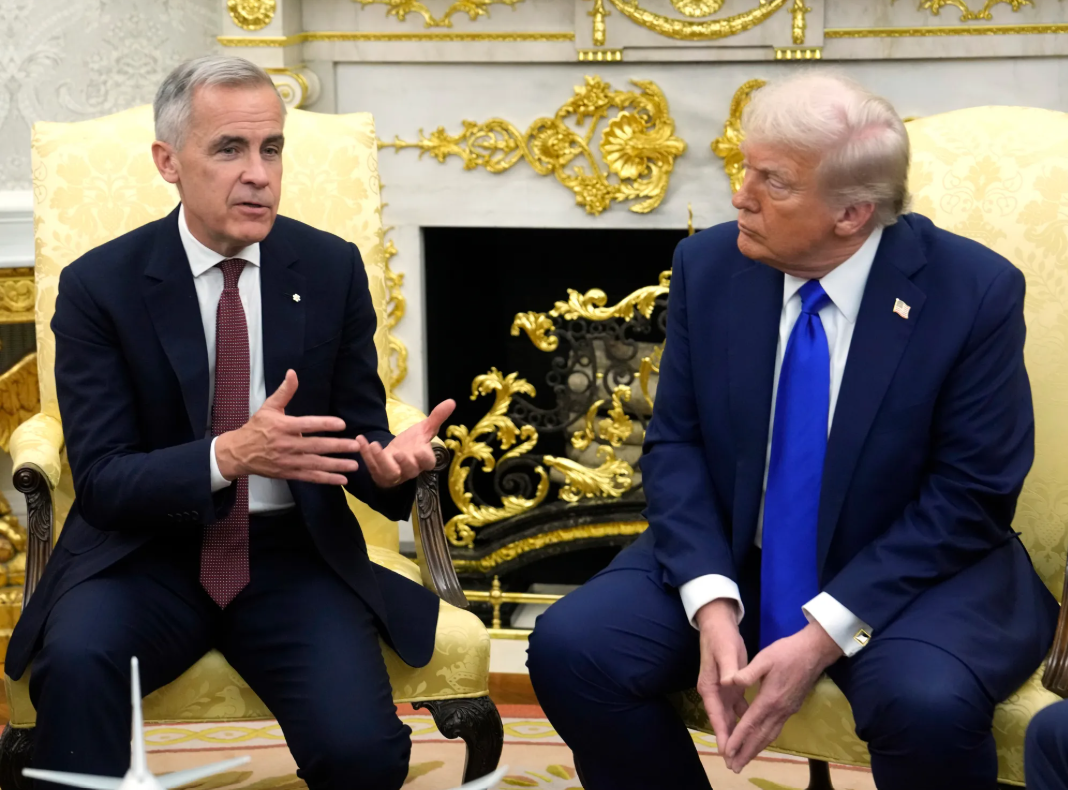

In a recent meeting in Washington, D.C., Canadian Prime Minister Mark Carney and U.S. President Donald Trump reportedly discussed the potential revival of the Keystone XL pipeline, a project long considered defunct after years of political and environmental battles. Sources familiar with the matter confirmed that the conversation took place during Carney’s working visit to the White House, where trade, energy, and security were top priorities.
Pipeline Revival Linked to Trade Negotiations
According to insiders, Carney raised the Keystone XL issue within a broader discussion about U.S. tariffs on Canadian steel and aluminium, both of which have become contentious points between Ottawa and Washington. President Trump was said to be “receptive” to the idea of revisiting the pipeline proposal, signalling renewed interest in strengthening North American energy cooperation.
The conversation remains preliminary, but both leaders have reportedly instructed their teams to continue consultations in the coming days. A statement from the Canadian Prime Minister’s Office confirmed discussions on trade and defence, though it avoided naming specific energy projects.
A Controversial Legacy: The Keystone XL Story
The Keystone XL pipeline, first proposed over a decade ago, was designed to carry 830,000 barrels of oil per day from Alberta’s oil sands to Steele City, Nebraska, connecting with existing U.S. pipelines. Approved by the Canadian National Energy Board in 2010, the project was repeatedly halted by U.S. administrations over environmental and political concerns.
Former President Barack Obama denied its presidential permit following EPA objections, citing environmental risks. Donald Trump, during his first term, revived the project and even began partial construction. However, the initiative was cancelled again on President Joe Biden’s first day in office, with billions of dollars in losses — including a C$1.5 billion investment from the Alberta government.
The project’s owner, TC Energy, later spun off its oil pipeline business into a new company called South Bow, which declared in early 2025 that it had “moved on” from Keystone XL.
Industry and Political Reactions
While South Bow confirmed it is not involved in any current government-level discussions, it expressed support for policies aimed at improving Canadian crude oil transportation. “We will continue to explore opportunities that leverage our existing corridor,” a company spokesperson said.
News of the renewed dialogue has drawn praise from Alberta Premier Danielle Smith, who welcomed the inclusion of energy, steel, and aluminium in bilateral talks. Speaking at a U.S.-Canada summit in Toronto, Smith stated, “We shouldn’t be threatening to sell the Americans less — we should be promising to sell them more.”
She also emphasized Alberta’s role in a potential renegotiation of the USMCA trade agreement, aiming for a deal that “benefits all North American partners.”
Meanwhile, Smith’s government is reportedly considering an alternative pipeline proposal running through British Columbia, though it faces sharp opposition from B.C. Premier David Eby, who called the idea “fictional” and environmentally dangerous.
In contrast, Bloc Québécois Leader Yves-François Blanchet criticized Alberta’s expansion plans, asserting that new pipelines would “destroy the environment of the whole planet.”
Trump’s Energy Agenda and Carney’s Balancing Act
President Trump’s renewed interest in Keystone XL aligns with his energy-first policy, which seeks to increase North American fossil fuel production while reducing dependency on foreign imports. For Carney, however, the challenge lies in balancing environmental commitments with economic pressures, particularly as Canadian industries struggle under heavy U.S. import tariffs.
The discussions suggest that both leaders may be open to a new framework for North American energy trade, one that could integrate oil, gas, and renewable sources under revised terms. Whether that includes a full-scale revival of Keystone XL remains uncertain, but the topic’s return to the negotiation table signals shifting geopolitical and economic priorities.
A Potential Turning Point for North American Energy Relations
The revival of the Keystone XL pipeline, even as a discussion point, underscores the evolving dynamics of U.S.-Canada relations under Trump and Carney’s leadership. As both governments face mounting domestic and global challenges, energy cooperation could once again become a cornerstone of bilateral diplomacy.
If realized, the project could reshape North American energy infrastructure, enhance Canada’s export capacity, and solidify the continent’s position as a global energy power. Yet, environmentalists and Indigenous groups are expected to renew opposition, ensuring that any future proposal will remain politically charged.
