

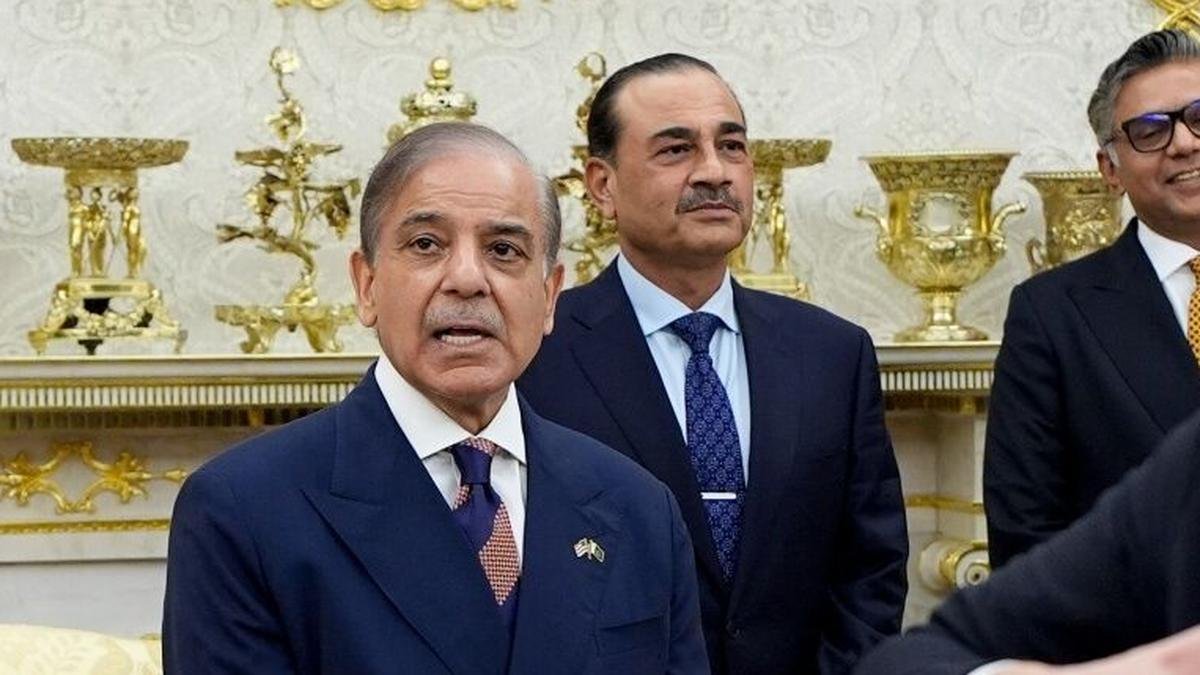

Prime Minister Shehbaz Sharif, while addressing the Pakistani community in London following his recent diplomatic engagements, emphasized that the political and military leadership of the country are fully aligned on key matters, including foreign policy and economic direction.
He underscored that consultations are held on every important issue, and both sides are making sincere efforts with complete unity of vision. Stressing the need for continued coordination, he prayed for this harmony to help Pakistan recover from past setbacks and achieve new heights.
Lauding the role of Field Marshal Asim Munir, the premier described him as a true nationalist who cares only for Pakistan.
He praised the achievements of the armed forces under Munir’s leadership, noting that both the army and air force had demonstrated remarkable successes. According to the prime minister, decisions are being made through collective consultation and mutual trust, reflecting a spirit of unity.
During his address, PM Shehbaz highlighted that Pakistan had nominated U.S. President Donald Trump for the Nobel Peace Prize, recognizing his mediation efforts in international conflicts, including the Democratic Republic of Congo, the Ethiopia-Egypt dispute, and the ongoing war in Ukraine. He said that Trump’s role also prevented a major war in South Asia, underscoring his credentials as a “man of peace.”
Shehbaz also shed light on the recently concluded Strategic Mutual Defence Agreement with Saudi Arabia, clarifying that the pact is not targeted against any country but is aimed at formalizing the long-standing brotherly ties between the two nations.
He stressed that Pakistan seeks no involvement in power struggles and instead aims to focus on its economic growth by exploiting opportunities in agriculture, artificial intelligence, minerals, and youth development through education and skills training.
The prime minister termed his visits to New York and Washington as highly fruitful, especially the multilateral meeting on Gaza co-chaired by President Trump and Turkish President Erdogan, which he attended along with other Muslim leaders.
He expressed optimism that the discussions would yield a positive outcome for a Gaza ceasefire. Strongly condemning Israeli atrocities, he reaffirmed Pakistan’s commitment to supporting Palestine, Kashmir, and the nation’s own water rights at international forums.
Reflecting on Pakistan’s recent military success in the Marka-e-Haq, he said the world had recognized the nation’s defense capabilities, not only as a nuclear power but also as a skilled force in conventional warfare. He credited the armed forces’ professionalism and courage under Field Marshal Munir for securing this outcome.
On Pakistan’s economic outlook, the premier acknowledged the challenges posed by devastating floods but noted that macroeconomic stability had been achieved. He urged the nation to seize the moment, as friendly countries including the U.S., China, Saudi Arabia, and the Gulf states were willing to extend support.
Stressing that only political will is lacking, he concluded that if Pakistanis commit themselves with determination, no power can obstruct the country’s path to progress.
