

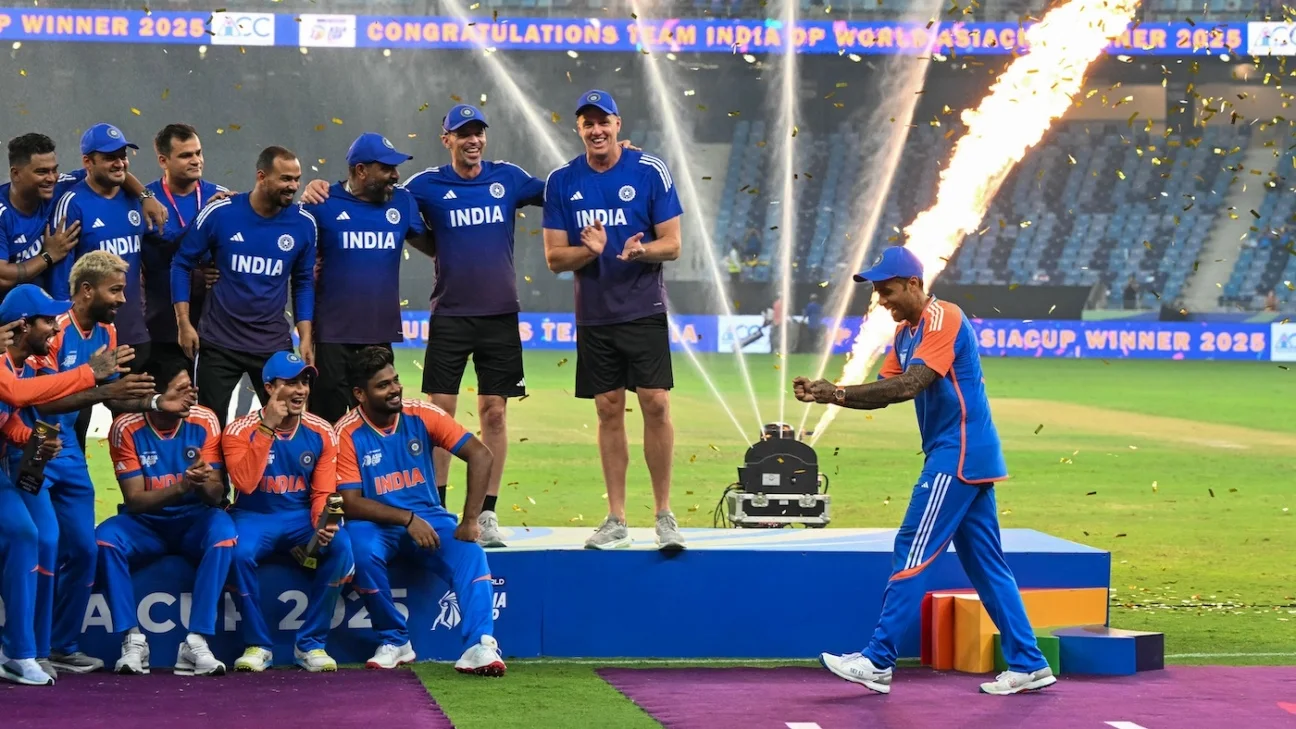

Final Ceremony Disrupted Over Trophy Presentation Dispute
The closing ceremony of the Asia Cup 2025 descended into drama when India refused to accept the winners’ trophy from Mohsin Naqvi, who is both Asian Cricket Council chief and Pakistan’s Interior Minister. This political stand delayed the presentation proceedings and caused major disruption.
India had earlier beaten Pakistan by five wickets in a tense finish, securing their ninth Asia Cup title. But the customary post‑match formalities were derailed when the Indian team declined to partake in the trophy ceremony with Naqvi. According to presenter Simon Doull, India had informed the ACC that they would not collect their awards from Naqvi. This decision followed strained exchanges and a refusal to shake hands between the two teams during earlier matches.
At the ceremony, Pakistan captain Salman Ali Agha accepted the runners-up trophy. Indian players Tilak Varma, Kuldeep Yadav, and Abhishek Sharma collected their individual awards but notably did not acknowledge Naqvi. When asked about the controversy, Indian skipper Suryakumar Yadav declined to comment.
On‑field Victory Overshadowed by Political Tension
The match itself was a dramatic affair. Pakistan elected to bat and posted 146 all out, having collapsed after an 84‑run opening stand. Kuldeep Yadav took 4‑30, triggering a collapse where nine wickets fell for just 33 runs. India’s top order crumbled early, with Suryakumar Yadav and Abhishek Sharma dismissed in the first ten balls. But Tilak Varma anchored the chase with an unbeaten 69, partnering with Shivam Dube to take India to victory in the last over.
Following the win, India’s Prime Minister Narendra Modi made a political statement in his X post, referencing “Operation Sindoor” and celebrating the result. The mix of sport and politics drew strong reactions. Pakistan’s officials accused India of disrespecting the spirit of cricket.
Many observers viewed the episode as a low point in India‑Pakistan cricketing relations. The sport, once seen as a bridge between the two nations, now appeared overshadowed by political hostility.
