

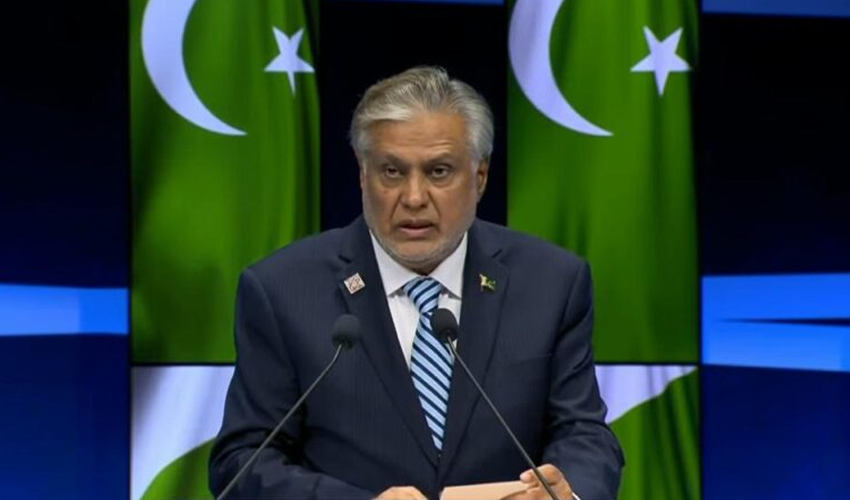

DPM Ishaq Dar Calls for Concrete Action During OIC Contact Group Meeting in New York
NEW YORK – Deputy Prime Minister and Foreign Minister Senator Ishaq Dar has urged the Afghan interim government to take clear and verifiable steps to prevent terrorist groups from using Afghan soil to launch attacks against neighbouring countries—particularly Pakistan.
Speaking at the inaugural meeting of the OIC Contact Group on Afghanistan, Dar expressed Pakistan’s serious concerns over the presence of more than two dozen terrorist organisations currently operating within Afghanistan. He specifically named the Tehreek-e-Taliban Pakistan (TTP), Baloch Liberation Army (BLA), Majeed Brigade, and East Turkestan Islamic Movement (ETIM), highlighting their collaboration with Al-Qaeda and their threat to regional and global security.
“Pakistan’s law enforcement and civilians continue to pay the price for terrorism emanating from Afghanistan,” Dar said. “Just this month, 12 Pakistani soldiers were martyred while confronting TTP militants attempting to infiltrate our borders.”
Dar emphasized that no country desires peace and stability in Afghanistan more than Pakistan, citing the two nations’ shared 2,500-kilometre porous border and deeply connected histories.
Pakistan Proposes OIC Working Group, Highlights Humanitarian and Security Challenges
Senator Dar proposed the formation of a working group within the OIC, consisting of security, diplomatic, and humanitarian experts, to formulate a practical roadmap with reciprocal commitments from both Afghanistan and the international community.
He also referenced a UN Security Council report, which corroborated Pakistan’s concerns by confirming alleged logistical, operational, and financial support provided to the TTP from within Kabul.
The Deputy Prime Minister further warned about terrorist groups exploiting digital platforms and social media to spread propaganda and incite violence. “This cannot and must not be tolerated,” he stressed.
In addition to counterterrorism, Dar highlighted a range of pressing challenges facing Afghanistan, including:
-
Crippling international sanctions
-
A collapsed banking system
-
Escalating poverty and unemployment
-
Ongoing human rights violations
-
Restrictions on women and girls’ education
-
Political isolation
He outlined a six-point plan for the OIC to support Afghanistan, including:
-
Securing humanitarian funding without political conditions
-
Stabilizing the Afghan economy and banking sector
-
Promoting trade and regional connectivity
-
Supporting alternative livelihoods for ex-poppy farmers
-
Engaging the Taliban in dialogue to ensure international compliance
-
Creating conditions for the safe repatriation of Afghan refugees
Dar concluded by stressing the need for mutual respect, sincerity, and political will from the Taliban authorities. He warned that shifting international focus risks leaving Afghanistan further isolated, at a time when support is needed the most.
“We must not let Afghanistan slip into deeper crisis,” he urged. “As neighbours, partners, and members of the Muslim world, the responsibility to support a stable Afghanistan lies with all of us.”
