

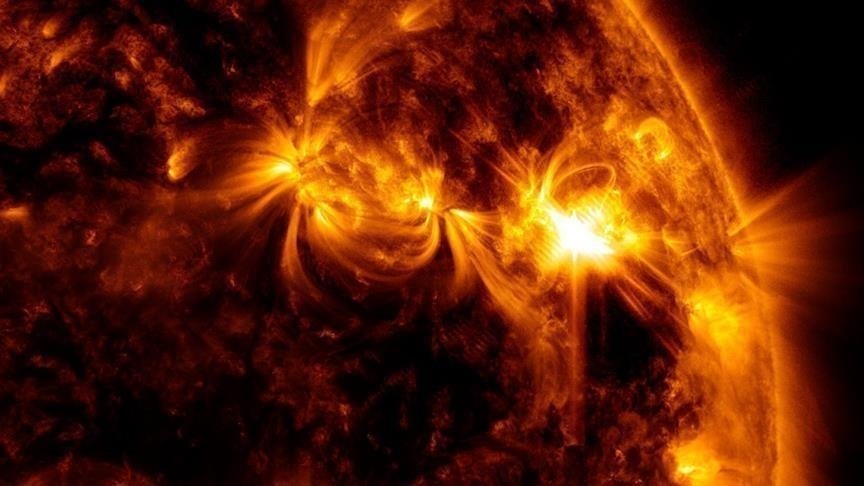

NASA and the US National Oceanic and Atmospheric Administration (NOAA) are preparing to launch a joint mission aimed at strengthening Earth’s defenses against solar storms, which pose risks to technology and critical infrastructure.
A SpaceX Falcon 9 rocket is scheduled to lift off from NASA’s Kennedy Space Center on Wednesday, carrying three specialized spacecraft designed to track solar activity and its effects on Earth, according to reports.
NASA’s science chief Nicky Fox emphasized the urgency of better understanding the sun’s behavior, stressing its impact on both astronauts and civilian systems.
While NASA will focus on astronaut safety in space, NOAA will take the lead in providing forecast services to mitigate risks for industries and the public.
The payload includes three key observatories. NOAA’s SWFO-L1 will become the agency’s first dedicated space-weather observatory, monitoring solar activity in real time. NASA’s Carruthers Geocorona Observatory will study Earth’s outermost atmospheric layer, known as the geocorona.
Meanwhile, the Interstellar Mapping and Acceleration Probe (IMAP) will measure solar particles and map the heliosphere’s boundary, which acts as a shield against harmful interstellar radiation.
These satellites will operate near the sun-facing Lagrange Point 1 (L1), located about one million miles from Earth, offering a continuous vantage point to monitor solar conditions.
According to Fox, space weather can disrupt critical services including GPS navigation, aviation systems, power grids, mining operations, and precision agriculture. She likened solar-storm monitoring to hurricane forecasting, noting that improved predictions are essential to protecting infrastructure and daily life.
Fox added that the three satellites working together will provide unprecedented insights into how the sun influences Earth as well as the broader solar system. The mission underscores the growing recognition of space weather as a vital area of study, as nations increasingly depend on vulnerable technologies exposed to solar disruptions.
