

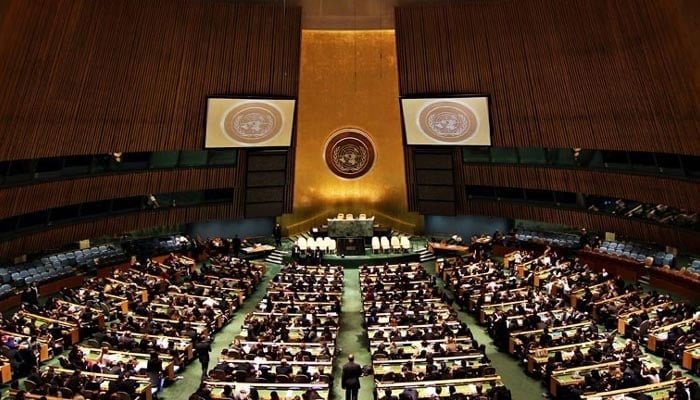

Beneath the inscription of Sa’adi’s timeless verse at the United Nations, reminding the world that humanity is one body, the 80th General Assembly will open summit meetings on Monday with the unresolved Palestinian question set to dominate.
The atmosphere at the UN headquarters mirrors the gravity of the moment—calm in the early morning but increasingly tense as protests and rallies swell outside.
The forecourt has become a battleground of voices. Anti-Israel demonstrators chant under the slogan “Stop Starving Gaza,” while pro-Israel groups stage counter-rallies in defiance.
Pakistanis and Kashmiris gather to protest the possible execution of Yasin Malik, while Ukrainians and victims of other conflicts join in, creating a chorus of grievances that reflect the UN’s broad but often burdened mandate.
Inside, nearly 150 world leaders convene to mark the UN’s 80th anniversary, yet the institution finds itself surrounded by wars and crises. From its earliest days, the unresolved issue of Palestine has loomed large, testing both the credibility of the UN and its ability to broker lasting peace.
The centerpiece of this year’s session is the high-level international conference for the Peaceful Settlement of the Question of Palestine and the Implementation of the Two-State Solution, co-chaired by France and Saudi Arabia. The gathering seeks to inject new momentum into support for a two-state solution amid escalating violence and deadlock.
Breaking with protocol, the General Assembly voted to allow Palestinian President Mahmoud Abbas to address the conference by video link after the United States denied visas to him and his delegation.
Washington has meanwhile cautioned countries against rushing to recognize Palestinian statehood and threatened visa restrictions on the Palestinian team. All eyes will now turn to President Donald Trump, whose address to the Assembly on Tuesday is expected to shape the debate and influence the future trajectory of the Palestinian cause.
