

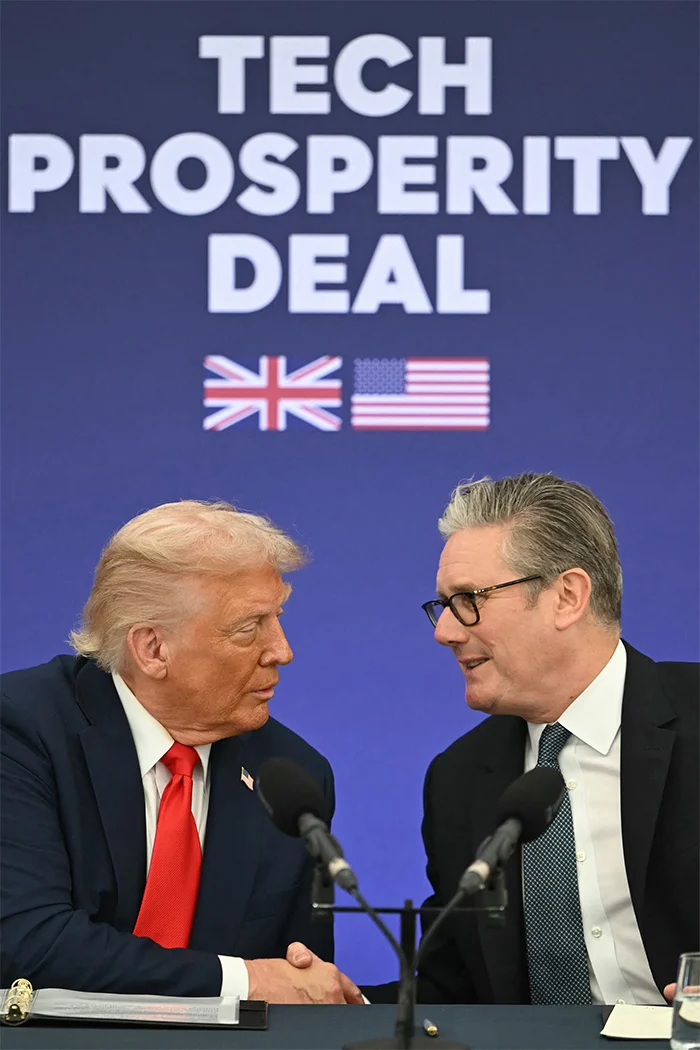

LONDON — In a landmark moment for transatlantic relations, US President Donald Trump and UK Prime Minister Keir Starmer signed a wide-ranging technology partnership deal on Thursday, pledging to strengthen what Trump called an “unbreakable bond” between the two longtime allies. The agreement, announced during Trump’s state visit to the UK, cements cooperation in artificial intelligence, quantum computing, and nuclear energy.
The deal follows a flurry of investment commitments from American tech giants, amounting to $205 billion (£150 billion) in new capital directed toward UK innovation and infrastructure by firms including Microsoft, Google, and Blackstone.
A Warm Welcome Amid Political Contrasts
After a day of royal pageantry with King Charles III at Windsor Castle, Trump was welcomed by Starmer at the Chequers estate, the British Prime Minister’s official country residence. Despite stark political differences — with Starmer leading the UK’s Labour Party and Trump the Republican Party — both leaders presented a united front, emphasizing mutual respect and strategic alignment.
“It is the biggest investment package of its kind in British history by a country mile,” said Starmer at the signing ceremony, which was attended by CEOs from leading US tech firms.
Trump, for his part, praised the partnership, saying, “It’s a very big deal… it’s an unbreakable bond we have, regardless of what we’re doing today.”
Starmer, aiming to position the UK as a diplomatic bridge between the US and Europe, also gave Trump a private tour of Winston Churchill memorabilia, appealing to the former president’s admiration for Britain’s wartime leader.
Epstein Fallout and Policy Divides Loom Over Talks
However, the diplomatic charm offensive could not entirely escape controversy. The meeting came as both leaders face renewed scrutiny over the late financier Jeffrey Epstein. Starmer is under pressure after dismissing UK Ambassador to Washington Peter Mandelson over alleged Epstein ties. Trump, too, has faced lingering questions about his historical association with Epstein, following new revelations about their relationship in the 1990s and 2000s.
Tensions also persist on foreign policy. While Starmer is reportedly preparing to formally recognize Palestinian statehood, the US remains opposed to such a move, creating friction in their discussions on the Gaza conflict. The war in Ukraine was another key agenda item, with Starmer pushing for increased US commitments to Kyiv.
Despite these sticking points, both sides highlighted recent trade developments. Starmer praised the May trade agreement with the US, calling it “the best” and the first signed under Trump’s renewed leadership.
State Banquet and Royal Pageantry Charm the US President
On Wednesday, Trump received a lavish state welcome from King Charles III, including a military flypast, carriage procession, and a formal banquet at Windsor Castle.
“This is truly one of the highest honours of my life,” Trump said during the evening, as the King commended the president’s efforts in supporting peace and aiding Ukraine.
Charles also made subtle remarks about the climate crisis, calling on world leaders to consider their duty to “our children, grandchildren, and those who come after them”—a nod likely aimed at Trump’s rollback of environmental protections.
Meanwhile, First Lady Melania Trump remained in Windsor on Thursday morning, where she met with Princess Catherine and Queen Camilla, viewed Queen Mary’s Doll’s House, and interacted with local scouts.
Despite the ceremonial optics, protests shadowed Trump’s visit. An estimated 5,000 demonstrators marched in central London on Wednesday, voicing opposition to the US president’s policies and presence in the UK.
As both countries move forward with the tech partnership, the deal is being framed as a long-term strategic alignment, reinforcing not just economic ties but a shared vision for technological leadership in a rapidly evolving global AI landscape.
