

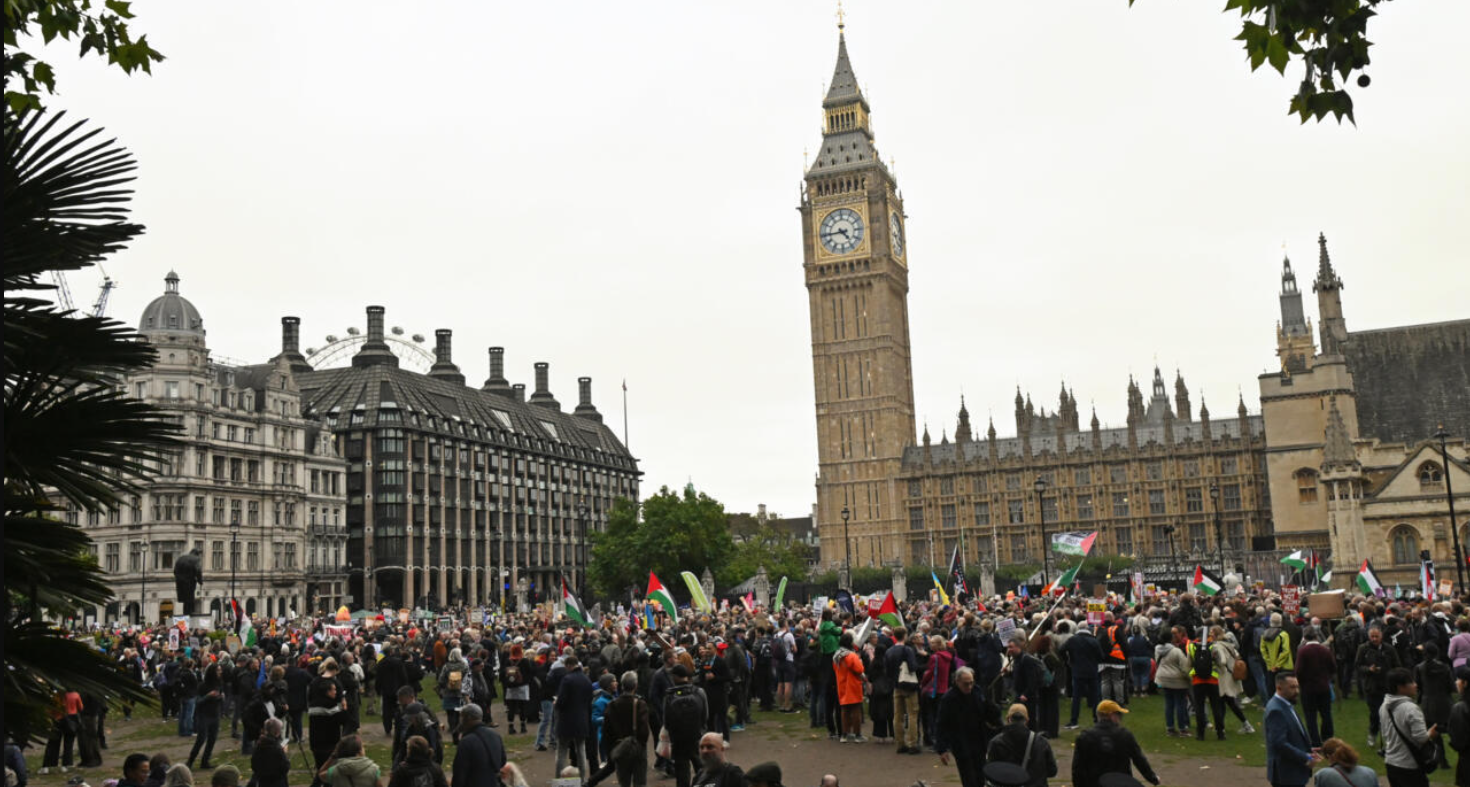

Thousands of demonstrators marched through central London to protest Donald Trump’s unprecedented second state visit to the United Kingdom. Armed with banners, placards, and chants, protesters gathered in the capital to express frustration with Trump’s politics and his presence in Britain.
London’s police estimated the crowd at around 5,000 people. The demonstration culminated in Parliament Square, where speeches and chants filled the air. Meanwhile, Trump enjoyed ceremonial receptions at Windsor Castle, far from the main protest site.
Anger Over Trump’s Return
Many protesters argued that the invitation itself was misguided. A recent poll revealed that nearly half of British respondents opposed inviting Trump again. Only a quarter of respondents felt the visit might improve UK-US relations.
Former teacher Dave Lockett, 67, joined the march, saying Trump represented “destruction and disorder.” He warned that adopting Trump’s political ideas in Britain could push the country toward fascism. His concerns reflected the anger echoed by many in the crowd.
Voices of Political Leaders
Several political figures addressed demonstrators at the rally. Green Party leader Zack Polanski urged citizens to reject Trump’s divisive politics. He declared, “This is the moment to challenge everything Donald Trump stands for.” Comedian Nish Kumar hosted the rally, using humor and sharp critique to energize the crowd.
London Mayor Sadiq Khan, a frequent critic of Trump, also weighed in. Writing in a national newspaper, Khan accused Trump of promoting far-right politics and scapegoating minorities. He argued that Trump’s actions echoed tactics often seen in autocratic regimes.
Creative Displays of Resistance
Protesters displayed creativity with placards, flags, and symbolic props. Some carried miniature versions of the famous Trump baby blimp, which first flew in London during Trump’s 2019 visit. Others highlighted global issues, including solidarity with Palestine, environmental concerns, and opposition to fascism.
Among them was Yashi Sriram, a doctor originally from India. Holding a sign reading “End the genocide. Stop Trump,” she said her motivation was to show support for the people of Palestine.
The Stop Trump Coalition organized the protest. Groups including Amnesty International UK, Greenpeace, Black Lives Matter UK, and the Palestine Solidarity Campaign sponsored the event. The coalition accused Trump of avoiding London because of public opposition. They claimed he chose Windsor instead to escape mass demonstrations.
Protest Atmosphere
The rally carried a vibrant yet defiant tone. Drums, chants, and banners created a powerful atmosphere of unity. Protesters repeatedly chanted, “Say it loud, say it clear: Donald Trump is not welcome here.”
One counter-demonstrator attempted to show support for Trump with a single placard. Surrounded by police, he faced boos from passing protesters. His presence highlighted the overwhelming imbalance between Trump supporters and critics in Britain.
Security and Policing
Authorities deployed more than 1,600 officers to manage the protest, including 500 officers brought in from other regions. Despite the large turnout, the event remained peaceful, with no arrests reported. Police efforts ensured that the protest proceeded without significant disruption.
Trump’s Image in the UK
Trump continues to face deep unpopularity in Britain. His policies on immigration, climate change, and foreign affairs have sparked widespread criticism. During his first state visit in 2019, the Trump baby blimp became an enduring symbol of resistance. Today, that symbol resurfaced in smaller replicas, reinforcing public opposition.
London Mayor Sadiq Khan has maintained a consistent stance against Trump. He criticized Trump’s alleged actions of illegally deporting citizens and deploying military forces in diverse cities. Khan described such moves as dangerous for democratic values.
Wider Political Context
The protest occurred just days after a massive far-right rally in London organized by activist Tommy Robinson. That event drew an estimated 150,000 participants, with 26 police officers injured in related clashes. The contrast between the two gatherings underscored Britain’s sharply polarized political environment.
Trump’s second state visit came under scrutiny not only for its timing but also for its symbolism. Critics argued that granting him another red-carpet welcome contradicted Britain’s values of tolerance and democracy.
Public Opinion and Legacy
For many protesters, the demonstration was about more than a single visit. It symbolized a broader rejection of Trump’s influence on global politics. His rhetoric on minorities, climate issues, and international relations has left a lasting mark on his global image.
Although Trump’s supporters argue that his leadership strengthens ties with allies, critics insist his approach divides societies. The London protest highlighted this division, with thousands making clear that Trump’s politics are not welcome in Britain.
Donald Trump’s second state visit to the United Kingdom reignited public opposition. Thousands took to the streets of London, sending a loud message of rejection. With banners, chants, and speeches, demonstrators emphasized that Trump’s politics of division would not go unchallenged.
While Trump enjoyed royal ceremonies at Windsor Castle, the protests in London reminded the world of his polarizing legacy. The day reinforced Britain’s image as a nation unafraid to speak out against leaders who threaten democratic values and unity.
