

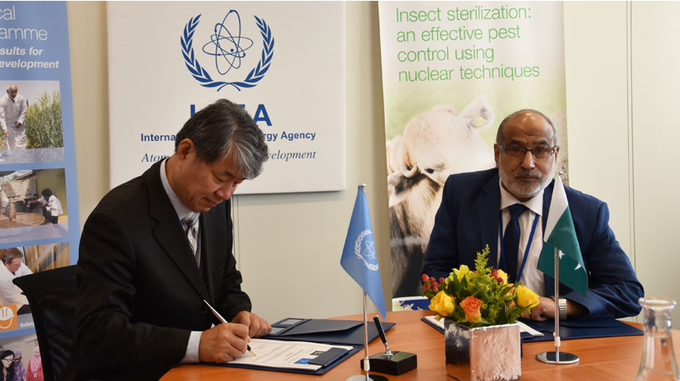

Pakistan has signed a new six-year Country Programme Framework (CPF) with the International Atomic Energy Agency (IAEA). The agreement, covering 2026 to 2031, was signed in Vienna during the IAEA General Conference.
Pakistan Atomic Energy Commission (PAEC) Chairman Dr. Raja Ali Raza Anwar and IAEA Deputy Director General Hua Liu signed the framework. The agreement aims to strengthen cooperation in peaceful nuclear applications across multiple priority sectors.
Five Priority Areas Defined
The CPF identifies five major priority areas: food and agriculture, human health and nutrition, climate change and water resource management, nuclear power and radiation, and nuclear safety.
The framework aligns with Pakistan’s national development objectives and the United Nations Sustainable Development Goals (SDGs). It will also span three IAEA technical cooperation cycles.
Nuclear Role in Agriculture and Food Security
Agriculture accounts for nearly a quarter of Pakistan’s GDP. Within this sector, the CPF will promote nuclear techniques to improve crop yields. It will also support pest control and livestock health improvements.
These measures will directly contribute to enhancing food security in a country vulnerable to climate shocks and resource pressures.
Expansion of Healthcare Services
In the health sector, the CPF targets improvements in nuclear medicine and radiation oncology. Pakistan currently operates 20 Atomic Energy Cancer Hospitals. These facilities treat more than one million patients annually.
The framework will expand diagnostic and treatment capabilities, strengthening Pakistan’s healthcare infrastructure for cancer care and related diseases.
Nuclear Science for Climate Adaptation
Given Pakistan’s vulnerability to climate change, the CPF highlights nuclear techniques to address water challenges. Isotope hydrology will support water resource management, enabling adaptation to changing rainfall patterns and drought risks.
Nuclear Energy and Safety Standards
Nuclear power provides over 18% of Pakistan’s electricity generation. Under the CPF, Pakistan will focus on safe plant operations, effective waste management, and long-term life-cycle planning.
These measures will reinforce the safety and sustainability of Pakistan’s nuclear energy program.
Shared Vision for Sustainable Development
Dr. Anwar stated that the framework reflects Pakistan’s firm commitment to peaceful nuclear applications. He emphasized Pakistan’s determination to address food security, healthcare, energy, and environmental protection with IAEA support.
Hua Liu described the CPF as a “shared vision for sustainable development through peaceful nuclear cooperation.”
