

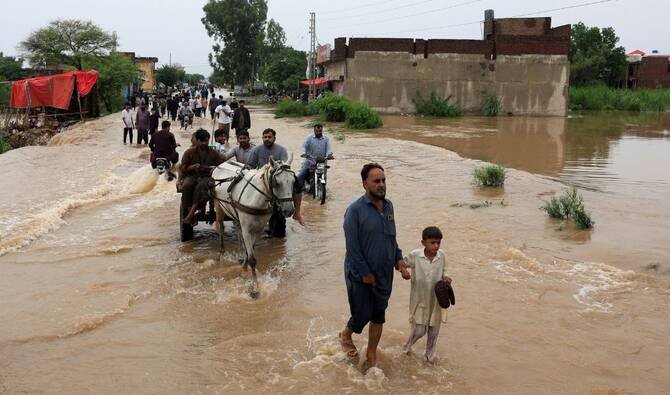

Evacuation and rescue operations are underway across central and southern Punjab as record-breaking floods continue to cause widespread devastation. Exceptionally high flood levels between the Panjnad confluence of Chenab-Ravi-Sutlej and Guddu Barrage in Sindh have displaced millions, destroyed crops, and left communities struggling without electricity or mobile services.
Officials have confirmed that at least 97 people have lost their lives in Punjab, which is now facing what authorities describe as the “biggest flood in history.” Nearly 2.45 million people across 4,500 villages have been affected, while 1.9 million cattle have been moved to safer areas.
The Flood Forecasting Division has issued warnings of very high flood levels at key points, including Head Panjnad, Sidhnai, and Ganda Singh Wala, while high levels persist at other barrages and headworks.
Controlled breaches have been carried out in multiple locations, such as Jalapur, Alipur, and Uch Sharif, to divert floodwaters and reduce pressure on embankments.
However, these measures have submerged several villages, trapping thousands on rooftops and leading to chaotic rescue efforts. In Shujabad, a collapsed dyke at Mouza Dhundwala flooded several villages, while a rescue attempt at the site turned tragic when three workers were swept away by strong currents, leaving one unaccounted for.
Punjab Senior Minister Marriyum Aurangzeb has toured several flood-hit areas, declaring Alipur a calamity-hit tehsil after visiting submerged villages and listening to residents’ pleas for boats and relief. Drone technology is being deployed in Alipur to deliver food to those stranded, while rescue teams report saving nearly 20,000 people across Punjab in the past 24 hours.
Meanwhile, Sindh is also grappling with the disaster, as overflowing waters of the Indus submerged more than 30 villages in Dadu district.
Outbreaks of waterborne and infectious diseases have been reported, prompting authorities to set up medical camps and mobile health units. Boats have been dispatched to rescue stranded families, with officials urging cooperation and adherence to safety measures.
Prime Minister Shehbaz Sharif has praised the coordinated relief efforts by provincial governments, particularly lauding Punjab Chief Minister Maryam Nawaz for “leading from the front” in managing the crisis.
Despite ongoing operations, the sheer scale of flooding continues to threaten lives, livelihoods, and infrastructure, making it one of the gravest humanitarian challenges in recent years.
