

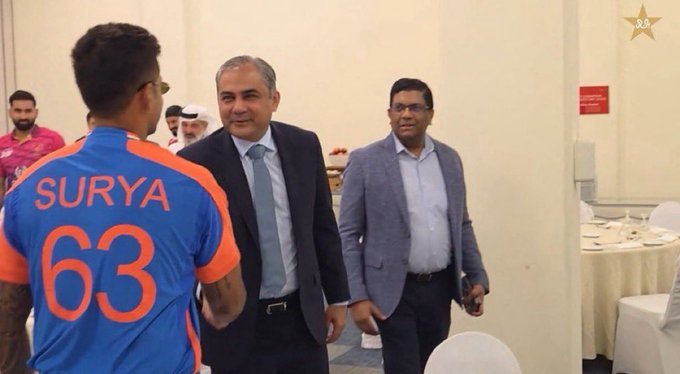

Indian cricket captain Suryakumar Yadav has sparked controversy after shaking hands with Mohsin Naqvi, the Asian Cricket Council (ACC) President and Pakistan’s Interior Minister, during the Asia Cup trophy unveiling. The incident, captured on camera, quickly circulated across Indian media and social media platforms, provoking strong reactions from fans and commentators.
Many social media users criticized Yadav’s gesture as inappropriate, citing Mohsin Naqvi’s political role and past statements against India. One user described the handshake as “the height of shamelessness,” while another commented, “Suryakumar Yadav is shaking hands with the very man who threatened India after Operation Sindoor.” These reactions reflect the sensitivity surrounding diplomatic and sports interactions between India and Pakistan, especially given the ongoing tensions between the two nations.
Indian media outlets also reported extensively on the incident, questioning the judgment of the Indian captain. Analysts noted that while sports are often seen as a bridge for diplomacy, gestures such as handshakes with politically significant figures from rival countries can carry unintended political connotations.
This is particularly relevant in the context of India-Pakistan relations, where any interaction between prominent figures is scrutinized heavily by the public and media alike.
Mohsin Naqvi, who assumed the role of ACC President earlier this year, also holds the position of Pakistan’s Interior Minister. His dual role has added to the controversy, as critics argue that a sports-related interaction inadvertently involved political symbolism.
The debate underscores the challenges faced by athletes in maintaining a balance between professional sportsmanship and public perception, especially in high-profile international tournaments like the Asia Cup.
While some cricket enthusiasts have defended Yadav, stating that sportsmanship should transcend politics, the backlash highlights the intensity of public sentiment in India regarding any perceived association with Pakistani officials. The incident continues to generate discussion, illustrating the complex interplay between sports, diplomacy, and national sentiment in the subcontinent.
