

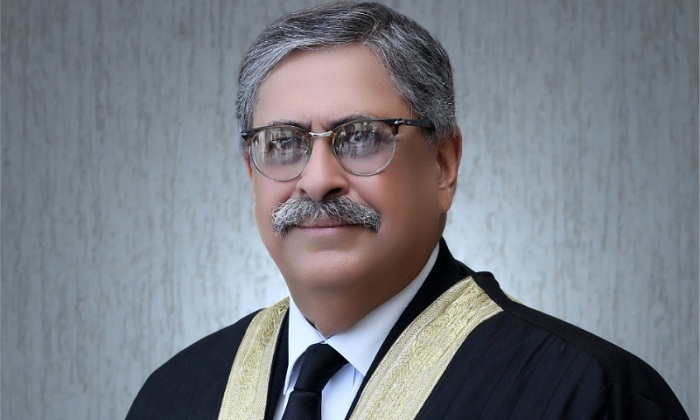

Supreme Court Justice Athar Minallah has strongly criticised the notion of a so-called “hybrid system,” describing it as an admission of dictatorship and a denial of constitutional governance. Speaking at the Karachi Bar Association, he highlighted the dangers of elite capture, political engineering, and the lack of true constitutional rule in Pakistan.
Hybrid System Equals Dictatorship
Justice Minallah emphasised that the very use of the term “hybrid system” — often used to describe power-sharing between civilian governments and the military — signals the absence of democratic governance. He warned that openly acknowledging such a system validates undemocratic practices and undermines the Constitution.
He stressed that the absence of constitutional governance had enabled elite capture, where powerful groups exploit institutions at the expense of the rule of law.
Judiciary’s Role in Upholding the Constitution
The judge openly reflected on Pakistan’s judicial history, admitting that it is not a source of pride. He stated that judges take an oath to decide impartially and defend the Constitution without fear or favour. Failing to act against unconstitutional governance, he said, would be a violation of both the Constitution and their oath.
Justice Minallah urged the legal community and younger generations to embrace truth, accountability, and constitutionalism. He observed that societies collapse when truth is suppressed and falsehood prevails.
Lessons from History Ignored
Referring to historical events, Justice Minallah noted that the roots of Pakistan’s 1971 split were planted in the dissolution of the constituent assembly by the civil-military bureaucracy. He argued that while individual judges had shown courage, the judiciary as an institution had rarely fulfilled its constitutional role.
He said the Constitution embodies the will of the people, ensuring governance through elected representatives. It prohibits political engineering and guarantees that elections must be free and transparent. However, he lamented that this ideal has remained unfulfilled throughout Pakistan’s history.
Call for Youth to Lead Change
Justice Minallah underscored that the country’s future depends on the younger generation, whose idealism and commitment to constitutional values can transform governance. He said meaningful change would only come through adherence to the Constitution and the protection of fundamental rights.
He pointed out that freedoms of expression, political thought, and criticism remain restricted in Pakistan. According to him, the lack of such freedoms played a major role in the country’s division in 1971.
The Way Forward
The only sustainable path, Justice Minallah said, is to govern strictly under the Constitution and empower youth to carry forward the struggle for democracy. He concluded that suppressing truth and denying fundamental rights will only lead to more divisions and instability, while truth, accountability, and constitutional rule are the foundations for national unity and progress.
