

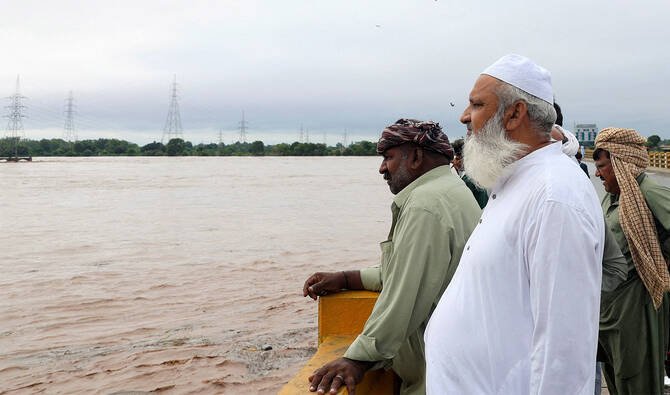

Punjab’s flood crisis has escalated as the confluence of the swollen Ravi and Chenab rivers near Khanewal threatens Multan and Muzaffargarh districts. Despite a series of controlled breaches over the past week, provincial authorities warned that the next 24 hours would be critical.
The water level at Muhammadwala and Sher Shah reached 412 feet, just five feet below the danger mark. Officials cautioned that pressure on embankments was mounting, especially after the powerful convergence of the Ravi and Chenab rivers. To protect urban centres, the Punjab government has relied on controlled breaches at selected points, a measure designed to relieve pressure on barrages and save densely populated areas. Decisions regarding potential breaches at Head Muhammadwala, Sher Shah Flood Bund, and Rangpur are expected imminently, with 17 sites already identified.
Exacerbating the crisis is a massive surge of about 550,000 cusecs of water that recently passed through the Marala and Khanki Headworks, measured at 530,000 cusecs at Qadirabad Headworks. This wave is expected to reach Trimmu Headworks on Thursday before arriving in the Multan region by Friday. Officials described the situation as a “dual threat”—existing high water coupled with an incoming surge.
Railway operations between Faisalabad and Karachi have also been suspended after floodwaters submerged a bridge on the Chenab River near Abdul Hakim.
Provincial Disaster Management Authority (PDMA) Director General Irfan Ali Kathia further warned that the situation may worsen, as three major Indian dams are nearing capacity. Within 72 hours, additional water releases could significantly raise levels across Punjab’s rivers. He noted that while the Chenab was temporarily stable, previously affected districts remain vulnerable.
Punjab Chief Minister Maryam Nawaz visited Head Muhammadwala, where only four to five feet of embankment capacity remains. At Sher Shah Bridge in Multan, the margin has narrowed to just two feet, prompting decisions for controlled breaches to avoid catastrophic overflow.
So far, the floods have devastated over 3,900 villages, affecting more than 3.7 million people. The death toll has risen to 46, with 1.4 million residents and one million livestock displaced. Relief efforts include 409 flood camps housing approximately 25,000 displaced persons.
With the Ravi River flowing in reverse at Ahmadpur Sial, further complicating the drainage system, experts warn that the coming days will test Punjab’s disaster management capacity.
