

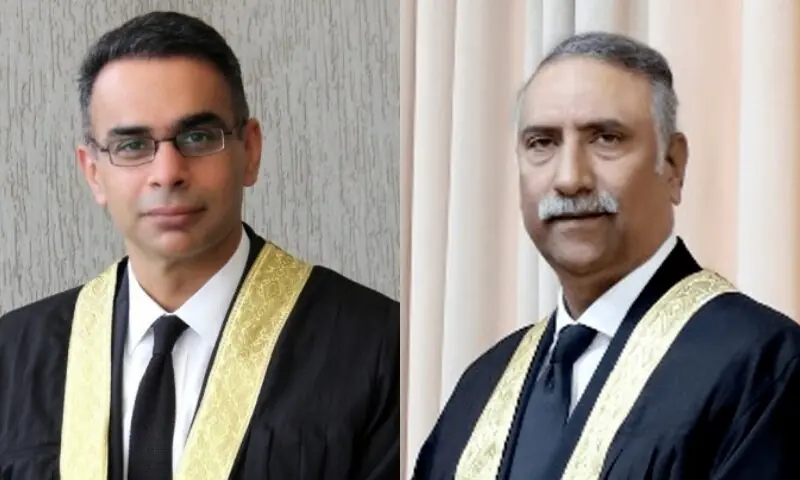

ISLAMABAD: The new judicial year at the Islamabad High Court (IHC) began with controversy on Tuesday as Justice Babar Sattar presented a strongly worded charge sheet against Chief Justice Mohammad Sarfraz Dogar, highlighting what he called “judicial ills plaguing the high court.” His letter, circulated among judges ahead of a full court meeting, raised sharp questions about the court’s independence, transparency, and administrative practices.
Chief Justice Dogar convened the meeting attended by all IHC judges, with another full court session scheduled for Wednesday at 2pm. While the official agenda has not been made public, such meetings traditionally review performance, discuss administrative affairs, and set priorities for the year ahead.
Justice Sattar’s Concerns
In his letter, Justice Sattar welcomed the long-overdue meeting but warned that the IHC was at risk of losing its credibility. He identified several critical issues:
-
Erosion of fundamental rights: Questioning whether the IHC was fulfilling its constitutional duty to protect citizens’ rights.
-
Supervision of district judiciary: Raising concerns over frequent transfers and deputations, calling it a “game of musical chairs” that undermines independence.
-
Case allocation and rosters: Criticizing what he described as arbitrary case fixation excluding senior judges and favoring transferred or additional judges.
-
Administrative overreach: Alleging that the CJ’s office transferred cases, withheld cause lists, and stripped certain judges of their dockets without legal authority.
-
Committee composition: Objecting to the exclusion of senior judges from administrative committees, replaced instead with recently appointed or transferred judges.
-
Travel restrictions: Questioning a circular requiring judges to seek the CJ’s no-objection certificate for travel abroad, equating it to placing them on an Exit Control List.
-
Performance evaluation: Calling for transparent, objective criteria rather than statistics he said were skewed to show some judges as “efficient” and others as “idle.”
A Call for Institutional Reform
Justice Sattar warned that decades of institutional development were being undone, likening current practices to authoritarian tactics that weakened judicial independence. “Power tends to corrupt and absolute power corrupts absolutely,” he wrote, urging corrective action through honest self-assessment.
Concluding his letter, he emphasized that his intent was not to offend but to “facilitate intra-institutional debate to stem the rot.” He added: “Without honest identification and admission of our failings, there can be no corrective action.”
Justice Sattar has previously written to the IHC chief justice on amendments to court rules and the composition of administrative committees. More recently, he was appointed to a special division bench tasked with clearing nearly 2,000 pending tax references, while his existing docket of cases was reassigned to other judges.
The unfolding events set the stage for a tense full court meeting, where judges are expected to deliberate not just on routine judicial matters but also on deep divisions within the IHC itself.
