

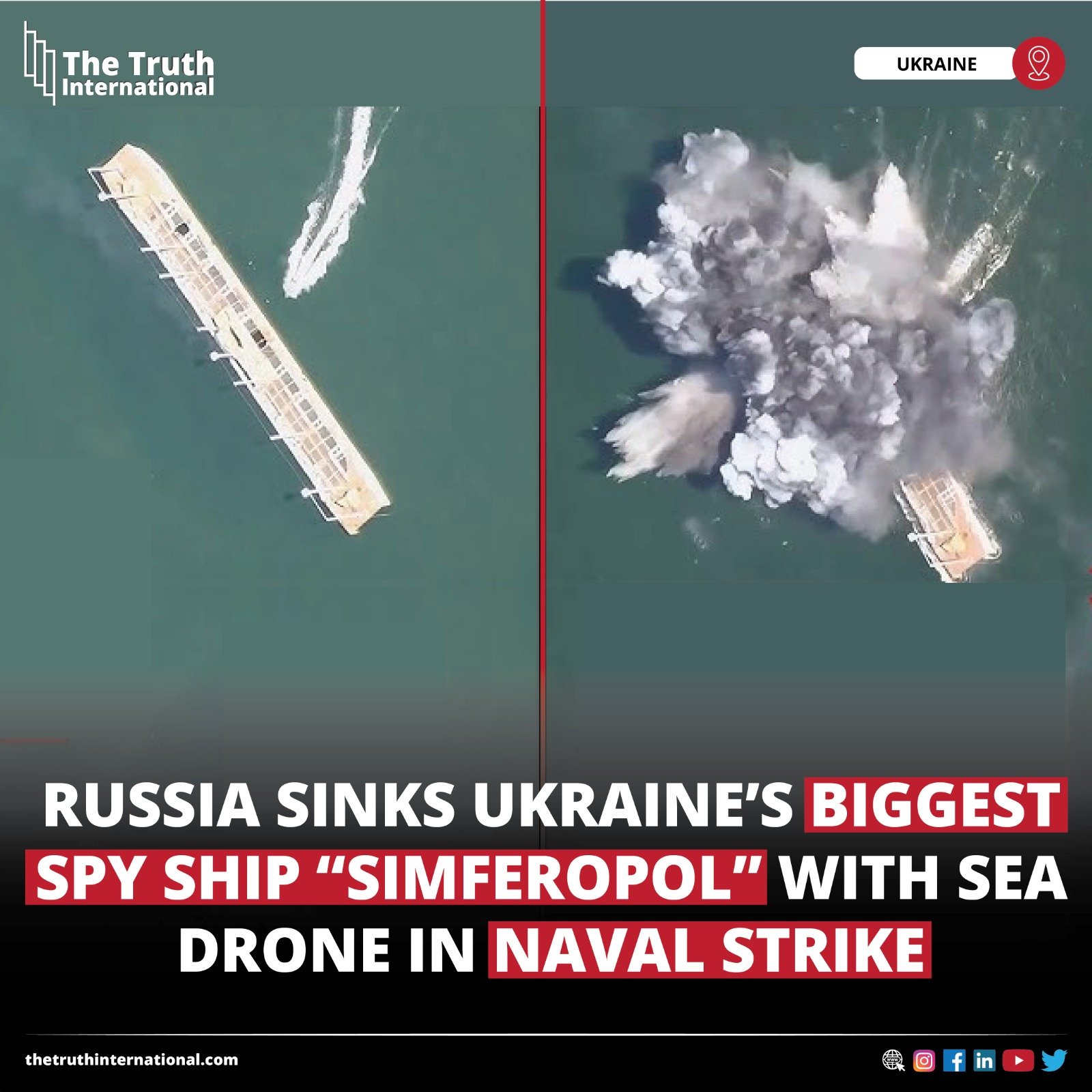

Russia has claimed responsibility for sinking Ukraine’s largest naval reconnaissance ship in what marks its first confirmed naval drone strike. The attack targeted the Ukrainian vessel Simferopol in the Danube River delta, signaling a new phase in maritime warfare between the two nations.
According to the Russian Defense Ministry, the operation was carried out using a high-speed uncrewed surface vehicle (USV). The ministry stated that the vessel sank as a result of the drone’s impact. Released footage included clips showing the drone boat closing in on the target and thermal imagery capturing the exact moment of the explosion.
Ukraine later confirmed the attack and acknowledged that the Simferopol had been struck. While most of the crew survived, one sailor lost his life, and several others sustained injuries. Search and rescue teams continue to work to locate missing personnel.
The Simferopol was a Laguna-class reconnaissance ship. Built in 2019 and inducted into the Ukrainian Navy in 2021, it was equipped for advanced intelligence missions. The ship’s systems were designed to conduct radio, radar, electronic, and optical surveillance, making it one of Ukraine’s most technologically advanced naval assets. Its loss is seen as a significant blow to Ukraine’s maritime defense capabilities.
This attack occurred just a day after a U.S. Navy P-8A Poseidon aircraft was observed flying over the western Black Sea. The patrol plane carried a specialized radar pod designed to detect small maritime threats, including naval drones. Russian military aircraft filmed the patrol, highlighting the rising tension in the region. Analysts noted the timing as unusual, suggesting that U.S. surveillance operations may have been linked to increased drone activity.
Meanwhile, Ukraine carried out its own retaliatory strike at sea. Reports indicate that Ukrainian forces used aerial drones to target a Russian missile corvette in the Sea of Azov. Although the full extent of the damage remains unclear, the attack demonstrated Kyiv’s continued reliance on unmanned systems for asymmetric warfare.
The incident underscores how rapidly naval warfare is evolving. Ukraine has pioneered the use of naval drones against Russian targets throughout the conflict, but this marks the first time Russia has employed similar tactics. Military experts suggest this development could intensify the battle for control over the Black Sea and its surrounding waterways.
The sinking of the Simferopol also highlights the increasing vulnerability of large warships to small, fast, unmanned systems. Traditional naval defenses often struggle to counter swarming or stealthy drone boats. This technological shift is reshaping strategies for both Russia and Ukraine, with long-term implications for global naval warfare.
In conclusion, the destruction of Ukraine’s Simferopol by a Russian drone boat represents a milestone in the conflict. With both sides escalating their use of unmanned weapons, the Black Sea region faces rising instability. The future of naval warfare appears increasingly tied to drones, precision strikes, and advanced surveillance capabilities.Russia sinks Ukraine’s largest naval ship using drone boat in first strike, escalating tensions in the Black Sea.
