

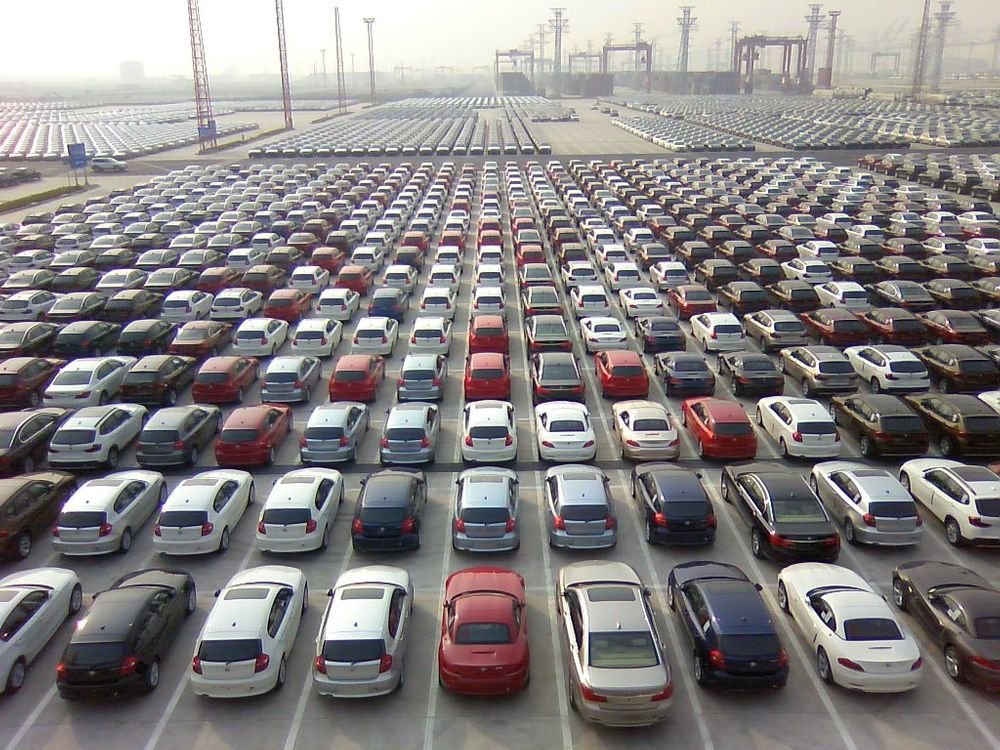

ISLAMABAD: The government has announced a new auto import policy, barring the entry of accidental and low-quality used cars into Pakistan while imposing a 40% tariff on commercial imports of used vehicles. The policy, effective from September, aims to protect the domestic auto industry but is unlikely to provide immediate relief to consumers facing record-high car prices.
The decision was unveiled on Monday during a joint session of the Senate Standing Committees on Finance and Industry. Joint Secretary for Trade Policy, Mohammad Ashfaq, explained that the tariff was being introduced under commitments made with the International Monetary Fund (IMF) as part of Pakistan’s ongoing bailout programme. He noted that the additional 40% tariff protection would be equivalent to the price of new cars, further discouraging excessive reliance on imports.
Currently, commercial imports of used cars are banned. Nearly one-fourth of market demand is met through schemes such as transfer of residence, baggage, and gift, under which imported vehicles—often mildly accidental but still cheaper and preferred by consumers—enter Pakistan. The government has yet to decide whether these schemes will continue once commercial imports are formally allowed.
From September, imports of used cars up to five years old will be permitted, with all age and quality restrictions to be lifted by July next year. Over the following four years, the additional 40% tariff will gradually be phased out, paving the way for imports of six- to eight-year-old vehicles. Officials also confirmed that quality and environmental standards would be introduced to ensure compliance with safety and emission norms.
The IMF programme also requires Pakistan to slash its overall tariff regime from the current average of 20.2% to 9.7% over the next five years, representing a 52% reduction. Customs duties, additional duties, and regulatory duties will be streamlined into four slabs, with the maximum capped at 15%.
However, local auto industry stakeholders are pushing back strongly. The Pakistan Automotive Manufacturers Association (PAMA) and the Pakistan Association of Automotive Parts and Accessories Manufacturers (PAAPAM) have both warned that liberalization could severely undermine domestic manufacturing. They urged the Senate committee to reconsider, arguing that without policy safeguards, the local industry may not withstand the impact of unrestricted imports.
