

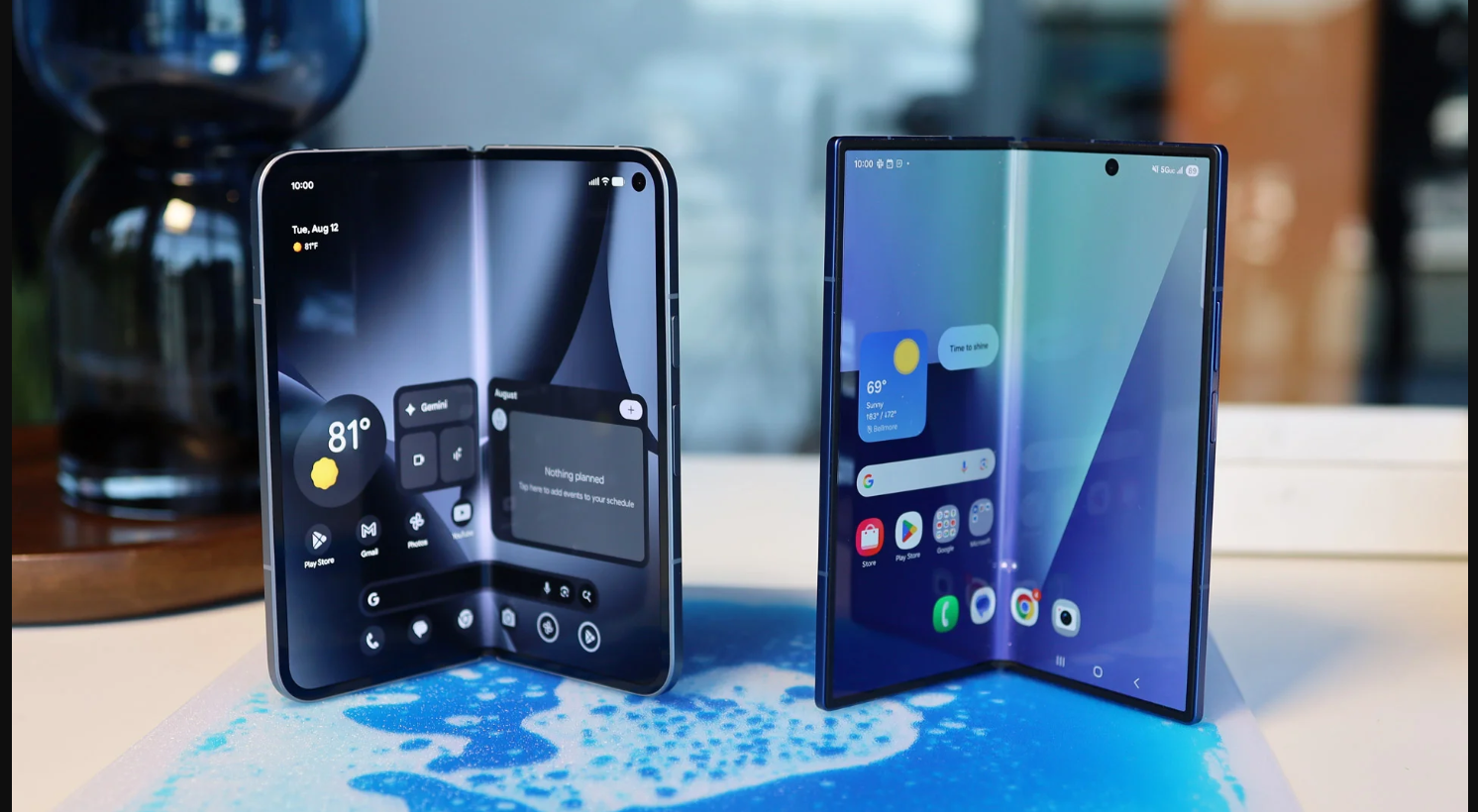

Foldable Smartphones Enter a New Era
Foldable smartphones are no longer futuristic prototypes; they are now highly polished premium devices. Both Google and Samsung are pushing boundaries with their latest offerings, the Pixel 10 Pro Fold and the Galaxy Z Fold 7. Running on Android 16, these two foldables promise powerful performance, next-level displays, and unique trade-offs in durability, design, and camera technology.
For consumers deciding between them, the choice comes down to priorities. Let’s break down how they compare in pricing, display, durability, camera systems, and battery life.
Price and Storage Options
Google’s Pixel 10 Pro Fold starts at $1,799. It comes with 16GB of RAM and three storage variants: 256GB, 512GB, and 1TB. The phone officially launches on October 9, 2025.
Samsung’s Galaxy Z Fold 7 begins at a slightly higher $2,000. It offers 12GB RAM for its 256GB and 512GB versions, while the 1TB model is equipped with 16GB RAM. Unlike Google’s upcoming release, Samsung’s foldable is already available.
Display and Build Quality
On the cover screen, Samsung takes the lead with a 6.5-inch AMOLED panel at 2,520×1,080 resolution, compared to Google’s 6.4-inch OLED at 2,364×1,080.
Inside, both foldables unfold into a large 8-inch LTPO display with adaptive refresh rates ranging from 1Hz to 120Hz. However, brightness is where Google shines, with the Pixel reaching a peak of 3,000 nits, surpassing Samsung’s 2,600 nits.
In terms of build, Samsung delivers a sleeker experience. The Galaxy Z Fold 7 measures just 4.2mm open and 8.9mm closed, weighing 215g. By contrast, the Pixel 10 Pro Fold is bulkier at 5.2mm open, 10.8mm closed, and weighs 258g.
Durability favors Google. The Pixel 10 Pro Fold carries an IP68 rating, meaning full dust resistance and water protection up to 1.5 meters for 30 minutes. Samsung’s Z Fold 7 is limited to IP48, offering only splash resistance.
Camera Performance
Samsung’s Galaxy Z Fold 7 is built for camera enthusiasts. It packs a 200MP main camera, a 12MP ultrawide lens, and a 10MP telephoto lens. The Pixel 10 Pro Fold opts for a 48MP main shooter, a 10.5MP ultrawide, and a 10.8MP telephoto.
Both models feature dual 10MP selfie cameras on the inner and cover displays.
For video, Samsung clearly dominates with 8K at 30fps and 4K at 60fps. The Pixel 10 Pro Fold maxes out at 4K 60fps. Another drawback for Google is the absence of Pro Res Zoom, with digital zoom capped at 20x, compared to Samsung’s superior AI-powered zoom capabilities.
Battery and Charging
The Pixel 10 Pro Fold comes with a larger 5,015 mAh battery, Qi2 wireless charging support, and magnetic PixelSnap accessories that are MagSafe compatible. Google claims 30+ hours of use, with a 50% charge in 30 minutes.
The Galaxy Z Fold 7 houses a smaller 4,400 mAh battery, lasting just over a day. It recharges to 42% in 30 minutes but lacks magnetic charging support.
Both phones promise seven years of software, security, and feature updates, ensuring long-term support.
The Pixel 10 Pro Fold is the better option if durability, brighter displays, larger battery, and wireless accessory support matter most.
On the other hand, the Galaxy Z Fold 7 is ideal for users who prioritize a lighter, sleeker build and the industry’s best 200MP camera system with 8K video recording.
Both devices highlight how far foldables have come. While neither is cheap, they represent the peak of innovation in mobile technology, giving users more choice than ever before.
